At a Glance
How to Test AI Agents: What Every QA Team Needs to Know
A correct final answer does not mean a correct agent — trajectory matters as much as outcome.
Dual-layer evaluation: Testing AI agents requires validating both the orchestration layer (tool selection, argument construction) and the reasoning layer (context interpretation, decision quality) — final outputs alone are insufficient evidence of correctness.
Three-tier eval pyramid: Effective agent testing combines programmatic assertions for structural checks, LLM-as-a-judge rubrics for reasoning quality, and human annotation for ground-truth calibration — each tier serves a distinct validation purpose.
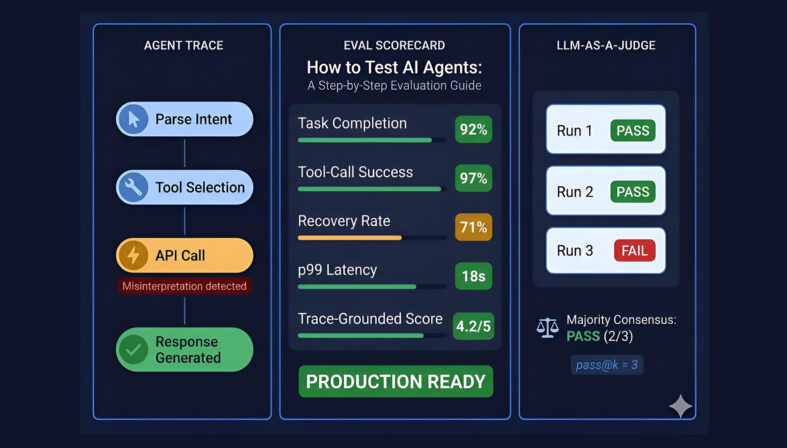
Six production gates: Task completion rate, tool-call success, recovery rate, p99 latency, guardrail trip rate, and a trace-grounded dimensional score must each meet independent thresholds — a single aggregate score masks sub-component failures that affect real users.
"The teams shipping reliable AI agents are not the ones with the best models — they are the ones with the most disciplined evaluation infrastructure."
Testing an AI agent means validating more than final outputs — it means auditing every intermediate tool call, reasoning step, and context decision the agent makes across its full execution trace. Unlike traditional software testing, where passing means the right function returned the right value, agent testing must verify that the correct sequence of decisions produced a reliable outcome for a non-deterministic system. The discipline spans three layers: the language model's raw reasoning quality, the orchestration code that sequences tool calls and manages memory, and the evaluation infrastructure — harnesses, LLM judges, and traceability systems — that makes testing repeatable. This guide covers all three, from harness design through production-readiness metrics. For teams already investing in agents that perform QA work themselves, the agentic QA pillar addresses that distinct discipline separately.

What Does It Mean to Test an AI Agent?
Testing an AI agent means evaluating its complete, multi-step execution rather than scoring isolated prompt-response pairs. A passing evaluation verifies both outcome — did the agent accomplish the user's goal? — and trajectory: did it select the correct tools, pass well-formed arguments, and accurately interpret what those tools returned?
When you QA an agent, you are stress-testing a dual architecture simultaneously. The first layer is the language model — the reasoning engine interpreting context, deciding which tools to invoke, and constructing the arguments it passes to those tools. The second layer is the orchestration code: the Python logic, LangChain graph, or custom framework that gives the model access to external services, manages its memory, and sequences multi-step tasks.
Anthropic's engineering documentation on agent evaluations describes a complete testing protocol covering two distinct dimensions: outcome verification and trajectory auditing. Trajectory auditing examines specific execution decisions — whether the agent selected the correct API endpoint, passed well-formed arguments, and correctly interpreted the structured data the tool returned.
This distinction matters because an agent can arrive at the correct final answer through flawed reasoning. A password-reset agent might successfully deliver the email but only because it guessed the user ID rather than extracting it from session context. That sequence is a defect — one that trajectory auditing catches and outcome-only evaluation misses entirely. Building these evaluations into the broader Agentic SDLC positions AI agent testing as a first-class phase alongside design and deployment, not an afterthought.
Why Are AI Agents Harder to Test Than Traditional Software?
AI agents are harder to test because their inputs are unstructured natural language, their execution paths are non-deterministic, and errors compound silently across tool calls. A traditional software exception announces failure loudly; an agent can misinterpret a valid API response and confidently deliver the wrong answer without triggering a single system error.
In traditional software testing, execution paths are finite and explicitly mapped in code. A specific button click triggers a known function; if that function fails, an exception is thrown and a stack trace points directly at the defect. Agent testing removes these guardrails entirely.
Because inputs are unstructured natural language, the input space is effectively unbounded. Language models are also sensitive to surface-level phrasing variations: "Cancel my order" and "I need to stop this shipment" can trigger different chains of reasoning and entirely different tool-selection patterns from the same underlying model.
The most dangerous consequence of this architecture is silent error compounding. Consider an agent that calls an external inventory API and receives a well-formed 200 OK response with a valid JSON payload. If the model misreads the payload — treating an available field value as a requested quantity, for example — all downstream reasoning is built on a hallucinated premise. No exception fires. The agent confidently continues and delivers a confidently incorrect answer.
A second complication is self-evaluation bias. When prompted to review their own outputs, language models consistently overgrade their own work, flagging mediocre or factually incorrect responses as acceptable. This makes closed-loop self-validation unreliable as a quality gate and points teams toward external evaluation mechanisms — which the next two sections address.
Traditional Software Testing vs. AI Agent Testing
| Dimension | Traditional Software Testing | AI Agent Testing |
|---|---|---|
| Input space | Finite: defined strings, button clicks, expected API payloads | Effectively unbounded: unstructured, highly variable natural language |
| Execution path | Deterministic and fully mapped by code logic | Non-deterministic, branching, sensitive to prompt phrasing variations |
| Output evaluation | Binary assertions (x == expected) |
Probabilistic trends, LLM-as-a-judge rubrics, pass@k statistical metrics |
| Error behavior | Explicit: exceptions, crashes, stack traces | Silent: reasoning errors compound inside valid, well-formed API responses |
| Test automation | Unit tests, integration tests, deterministic mocks | Capability evals, regression evals, trace replay, adversarial user personas |
| Failure attribution | Specific: traceable to a line of code | Complex: model reasoning, prompt phrasing, or tool interaction |
What Is a Test Harness for an AI Agent?
An AI test harness is the infrastructure that orchestrates end-to-end agent evaluations. It feeds synthetic scenarios into the agent, sandboxes available tools, records full execution traces, and grades outcomes against a defined rubric — the controlled environment where agent behavior is verified before it reaches real users or production traffic.
A test harness acts as a specialized laboratory for agents. Rather than testing against live users on production infrastructure, the harness intercepts the agent's behavior, routes tool calls to sandboxed or mocked services, and captures the full prompt-response trace for scoring. Block Engineering's AI agent testing pyramid illustrates that harness scoring should operate on three tiers: fast programmatic checks at the base for structural validation (did the agent return valid JSON?), model-based judge evaluations in the middle for reasoning quality, and human annotation at the top for ground-truth calibration of the judge itself.
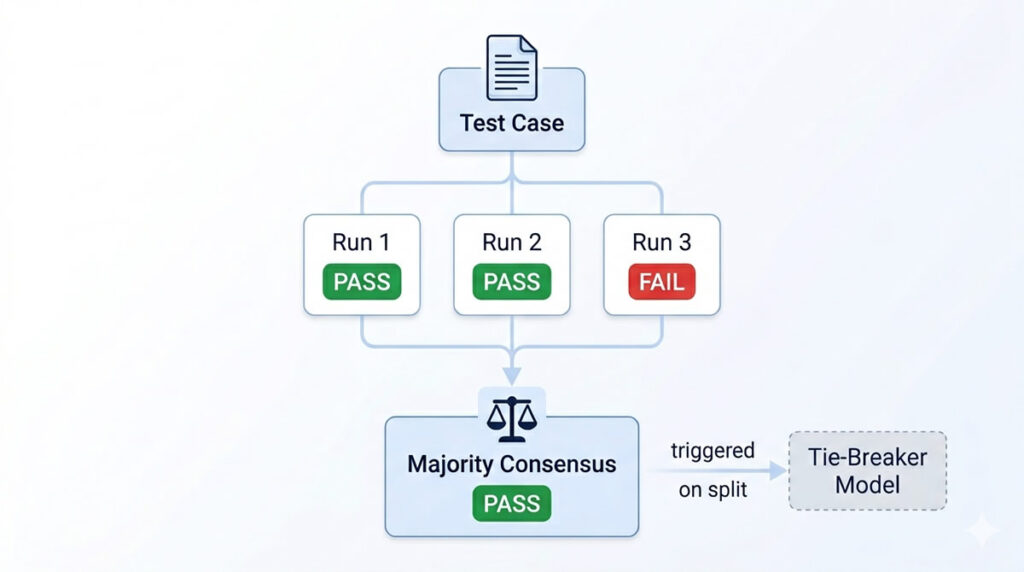
Robust harnesses partition agent responsibilities into distinct evaluation roles. A Planner component interprets the incoming request and defines a step-by-step execution specification. A Generator executes that spec — constructing tool calls and assembling responses. An Evaluator then reviews the Generator's work as an adversarial quality control step, searching for logical gaps, missed steps, or factually incorrect reasoning before any final answer surfaces.
A frequently overlooked harness concern is context pressure behavior. As agents process long-running tasks, their context windows fill with prior prompts, tool outputs, and accumulated memory. When a model senses it is approaching token limits, it frequently begins abbreviating tasks, skipping validation steps, or fabricating conclusions to exit the workflow early. Effective harnesses monitor context utilization and implement structured state handoffs — compact summaries of task progress passed into a fresh context window — to prevent this degradation pattern.
Try It Now
Generate Structured Test Cases for Your Agent Behaviors in Seconds
Paste any user story into TestStory.ai and watch the orchestration layer generate structured, Gherkin-formatted test cases instantly — covering happy paths, edge cases, and the failure scenarios your team would typically miss. No account required.
No credit card required.
How Do You Test an AI Agent Before Shipping to Production?
Pre-production testing begins with a tightly curated evaluation dataset of 20 to 50 unambiguous scenarios, sourced from manual debugging sessions and known failure modes. These split into Capability Evals driving active improvement and Regression Evals protecting established workflows — both running in CI/CD pipelines with mocked LLM responses for speed and stability.
When building an initial evaluation suite, quality outweighs volume. A small dataset of 20 to 50 precisely defined scenarios — each with a clear expected outcome — produces more actionable signal than hundreds of loosely structured tests. Source these scenarios from three places: manual debugging sessions where the agent previously struggled, edge cases discovered during exploratory sessions, and historical interactions where the agent produced unexpected behavior.
Divide those scenarios into two categories with distinct purposes. Capability Evals are intentionally difficult — they measure behaviors the agent currently handles poorly and drive prompt engineering and architectural improvement. Regression Evals are baseline workflows the agent already executes reliably; CI/CD pipelines run these continuously to ensure that prompt changes or model upgrades do not break established behavior. This two-category structure maps directly to how LLM regression testing pipelines are organized once an agent reaches regular deployment cycles.
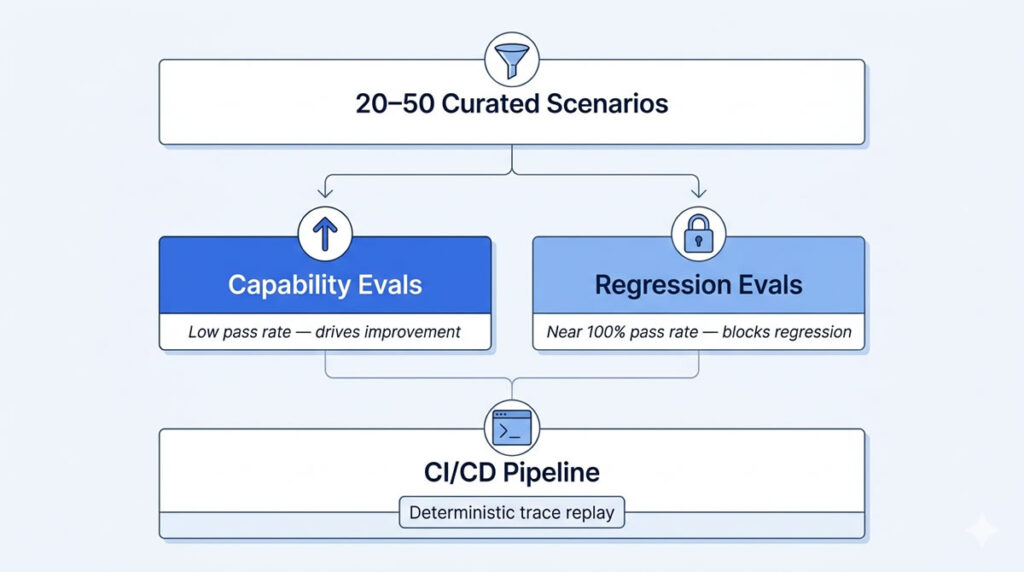
A major CI/CD challenge is test flakiness caused by live LLM variability. Latitude's research on AI agent evaluation recommends deterministic trace replay to address it: during initial test runs, the harness records all LLM responses and tool payloads. Subsequent CI runs replay these recorded traces instead of making live API calls, isolating the agent's orchestration logic from network latency, rate limits, and model drift. This reduces cost, stabilizes pipelines, and makes failures attributable to code changes rather than model variance.
One discipline matters above all others at release gates: enforce per-metric thresholds, not aggregate pass rates. A composite score of 92% can conceal a 40% failure rate in a specific tool-call pattern that affects every user in a particular workflow. Define and enforce separate thresholds for each production metric before any release proceeds.
How Do You Test Multi-Step and Conversational Agents?
Testing conversational agents requires auditing the complete session transcript, not just the final response. Engineers must verify conversation coherence across every turn, measure probabilistic success using pass@k and pass^k metrics, and simulate extended interactions using a secondary LLM as an adversarial user persona — because manual multi-turn evaluation does not scale to CI/CD velocity.
When evaluating a multi-turn agent, a correct final answer is insufficient evidence of quality. An agent might resolve the user's request on turn six — but if it asked the user to repeat themselves twice and hallucinated data on turn three, the interaction is a failure by any reasonable measure. Evaluators must inspect the full transcript for conversation coherence, the property that ensures the agent maintains consistent context across turns, avoids contradicting earlier statements, and does not fall into the "lost in the middle" failure pattern, where instructions positioned in the center of long context windows are silently forgotten.
Manual review of multi-turn transcripts cannot scale to the volume CI/CD pipelines require. Testing teams address this by configuring a secondary LLM as a simulated user — assigning it a behavioral persona such as someone who changes requests mid-conversation or provides deliberately incomplete context — and running automated extended sessions. The primary agent's responses are then evaluated against coherence and goal-completion rubrics by an evaluator model.
Success measurement for conversational agents requires two statistical metrics used together. Pass@k measures whether the agent resolves the user's intent at least once across k attempts, establishing raw capability. Pass^k measures whether the agent succeeds consistently across all k attempts, establishing reliability. An agent that passes at k=1 but fails at k=3 is capable but unreliable — the distinction is critical for production readiness decisions.
How Do You Handle Non-Deterministic Outputs in Agent Testing?
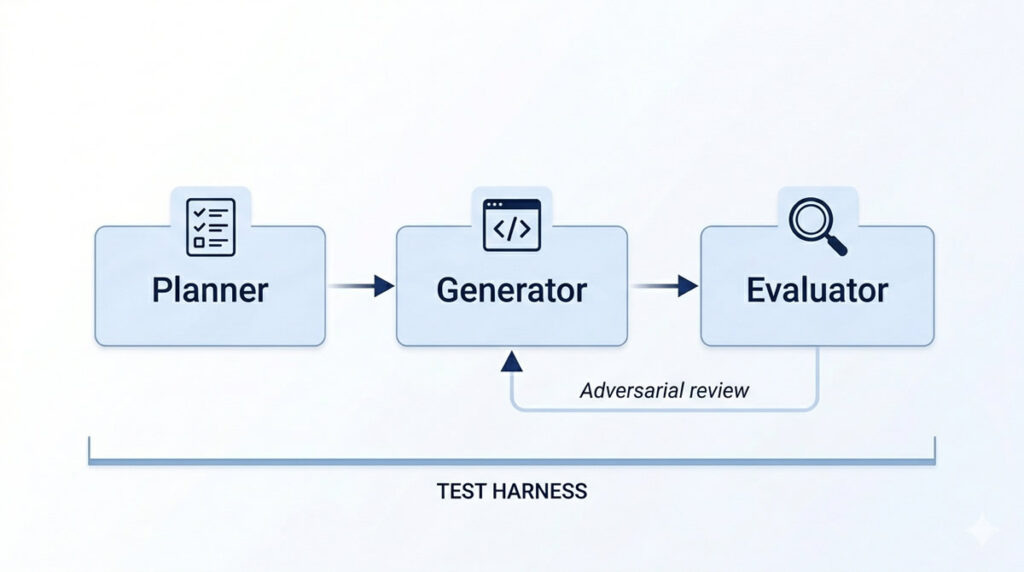
Managing non-determinism requires replacing binary assertions with probabilistic evaluation over multiple trials. Teams formalize subjective quality criteria — tone, factual accuracy, instruction adherence, format compliance — into LLM-as-a-judge rubrics, run each test case through the judge multiple times, and use majority consensus to produce a stable pass/fail signal that single-run variance cannot flip.
Because agent outputs vary across executions, the traditional assertion pattern breaks down. LLM-as-a-judge evaluation replaces it: a secondary, often more capable model is given a structured rubric and prompted to score the agent's output across defined dimensions. The judge returns a structured score (typically 1 to 5) or a pass/fail boolean for each dimension, producing a signal that captures quality rather than string identity.
To prevent the judge model from introducing its own noise, each non-deterministic test case should run through the evaluator a minimum of three times. A majority consensus — two Pass verdicts out of three — becomes the stable signal. When evaluators split evenly or land on borderline scores, a more capable model acting as a tie-breaker resolves the ambiguity before the result is recorded.
Independently, Anthropic's evaluation documentation emphasizes that the judge model must itself be validated periodically. Teams should maintain a small set of ground-truth examples — test cases with known correct and known incorrect outputs — and run the judge against them on a regular cadence to verify that evaluator calibration has not drifted. A miscalibrated judge is as dangerous as a poorly performing agent, because it silently approves regressions that reach production.
Where Do Test Management and Traceability Fit When QA-ing AI Agents?
Test management systems give teams building AI agents a structured system of record — organizing test cases by agent version, tracking pass/fail trends across model upgrades, and maintaining the traceability chain from a test failure back to the original requirement the behavior was supposed to satisfy.
Standard application monitoring tools capture server latency and error rates, but they are not built to represent the multi-step reasoning chains, tool trajectories, and evolving context windows that characterize agent failures. Teams augment monitoring with specialized tracing platforms that capture full prompt-response pairs and route flagged traces to human annotation queues. Tracing provides session-level visibility; test management provides the longitudinal record needed to track quality across versions.
Test case generation typically starts upstream of execution. TestStory.ai connects to GitHub, Jira, and Linear to ingest requirements and user stories, then generates structured test cases for the behaviors those requirements define. This upstream layer populates the test case library that the evaluation infrastructure then runs against.
Once the agent harness finishes an evaluation run, it outputs results in JUnit XML format. The TestQuality CLI uploads those results — using the testquality upload_test_run command — into a named project and test cycle within TestQuality. This creates a structured record of each run against a specific agent version, making version-to-version quality comparisons operationally straightforward rather than dependent on memory or scattered spreadsheets.

When a failure indicates a genuine defect, a tester reviews the trace, confirms the failure is not flakiness or expected variance from a model update, and logs the defect in TestQuality. From there, TestQuality's native GitHub and Jira integrations automatically sync the defect record to the team's tracker, so engineers receive actionable context without manual duplication between systems. For teams applying context engineering principles to their agent architecture, the same traceability discipline — requirements linked to test cases, test cases linked to execution results, execution results linked to defects — transfers directly to agent quality workflows.
What Metrics Indicate an AI Agent Is Production-Ready?
Production readiness requires meeting independent quality gates across six Service Level Objectives: task completion rate, tool-call success, recovery rate, p99 latency, guardrail trip rate, and a trace-grounded dimensional score. Rolling these into a single aggregate pass rate is a measurement anti-pattern that masks sub-component failures affecting real users.
Collapsing agent performance into one composite metric — "92% pass rate" — creates a false sense of stability. That score can conceal a 40% failure rate on a specific tool-call pattern that triggers for every user in a particular workflow. Independent thresholds for each SLO prevent that masking.
Task completion rate is the primary availability metric: the proportion of sessions where the agent successfully delivers the end-to-end goal. A reasonable production baseline is 90% or above. Tool-call success measures intermediate trajectory quality — correct tool selection, schema-valid arguments, and accurate payload interpretation — with a target of 95% or above. Recovery rate tracks the agent's ability to handle transient tool failures by trying an alternative path or requesting clarification rather than failing silently; a 70% baseline is a common starting floor.
P99 latency disciplines the tail of the response time distribution. Because agents execute multiple sequential LLM calls per session, tail latency accumulates rapidly; an explicit ceiling — for example, 99% of sessions completing within 30 seconds — should be treated as a blocking release gate. Guardrail trip rate, the frequency with which safety filters intervene, typically runs 1–5% in stable production environments; a sudden increase signals either an emerging prompt injection pattern or a misconfigured safety rule requiring investigation.
A trace-grounded dimensional score evaluates output quality across factual grounding, data privacy compliance, instruction adherence, and plan execution fidelity, typically scored by an LLM judge on a 1–5 scale with a production floor of 4.0 or above. Beyond quality metrics, production readiness also requires validating unit economics: the combined inference cost and token volume per successfully completed session must justify the automation's business value before full rollout.
Technical Deep Dive FAQ
Key Takeaways
A Complete QA Framework for AI Agents
Reliable agents are built on disciplined evaluation — not better prompts.
Outcome plus trajectory: A correct final answer is insufficient — trajectory auditing verifies that correct tool selection, valid arguments, and accurate payload interpretation produced it. Anthropic's eval documentation identifies both dimensions as required for complete coverage.
Three-tier eval pyramid: Block Engineering's testing pyramid structures agent evaluation as programmatic assertions at the base, LLM-as-a-judge rubrics in the middle, and human annotation at the top for ground-truth calibration. Each tier addresses failure modes the others cannot catch.
Capability vs. Regression Evals: 20–50 curated test cases split into Capability Evals (low pass rate, driving improvement) and Regression Evals (near 100% pass rate, protecting established behavior) give pre-production testing a clear and actionable structure.
Pass@k and pass^k for conversational agents: Pass@k establishes raw capability (succeeds at least once in k attempts); pass^k establishes reliability (succeeds consistently across all k). Both metrics are required to distinguish a capable agent from a production-ready one.
Six independent production gates: Task completion (≥90%), tool-call success (≥95%), recovery rate (≥70%), p99 latency ceiling, guardrail trip rate (1–5% baseline), and trace-grounded dimensional score (≥4.0/5) must each meet their threshold independently — aggregate scores mask component failures.
Test management as system of record: The JUnit XML → TestQuality CLI → named project and cycle workflow creates a version-tracked quality record that correlates test failures to specific agent versions, model changes, and logged defects — giving teams the longitudinal visibility that monitoring tools alone cannot provide.
"The teams shipping reliable AI agents are not the ones with the best models — they are the ones with the most disciplined evaluation infrastructure."
Start Free Today
Transition from Script-Writing to Outcome-Orchestration
TestStory.ai generates structured test cases from your user stories, acceptance criteria, or architecture diagrams — then syncs them directly into TestQuality for execution, tracking, and team collaboration. Once results are uploaded via the TestQuality CLI, your team has a version-tracked, defect-linked record of every agent evaluation run — without rebuilding that traceability layer from scratch.
✦ Get 500 TestStory.ai credits every month included with your TestQuality subscription — no extra cost.
No credit card required on either platform.