At a Glance
Human in the Loop Testing: Where AI Ends and QA Judgment Begins
The question isn’t whether to use AI in QA. It’s knowing exactly where to keep a human in control.
The core risk: Over 75% of multi-agent failures are silent semantic errors that pass automated checks but violate business logic — detectable only by human inspection (Cemri, Pan et al., NeurIPS 2025).
The division of labor: AI owns repetitive generation and execution; humans own risk analysis, requirement interpretation, exploratory investigation, and final sign-off.
The operational discipline: Every CI/CD pipeline handling AI-generated tests needs mandatory human review gates — AI reviewing its own output is a closed loop that produces false confidence.
The risk is not that machines test too little. It is that teams stop noticing what only humans can notice.
Human in the loop testing is a structured QA methodology where AI performs high-volume generation and execution tasks while human engineers retain authority over strategy, risk assessment, and final quality decisions. Rather than treating AI as an autonomous testing engine, this approach builds deliberate intervention points into automated workflows — ensuring that a qualified engineer confirms test coverage before it enters production. As AI takes on more drafting and scripting work, understanding precisely where algorithmic speed ends and human judgment becomes non-negotiable is the defining operational skill for modern QA teams. This article maps those boundaries with a decision framework built for SDETs and engineering leads who are actively integrating AI into their workflows.
What is human in the loop testing?
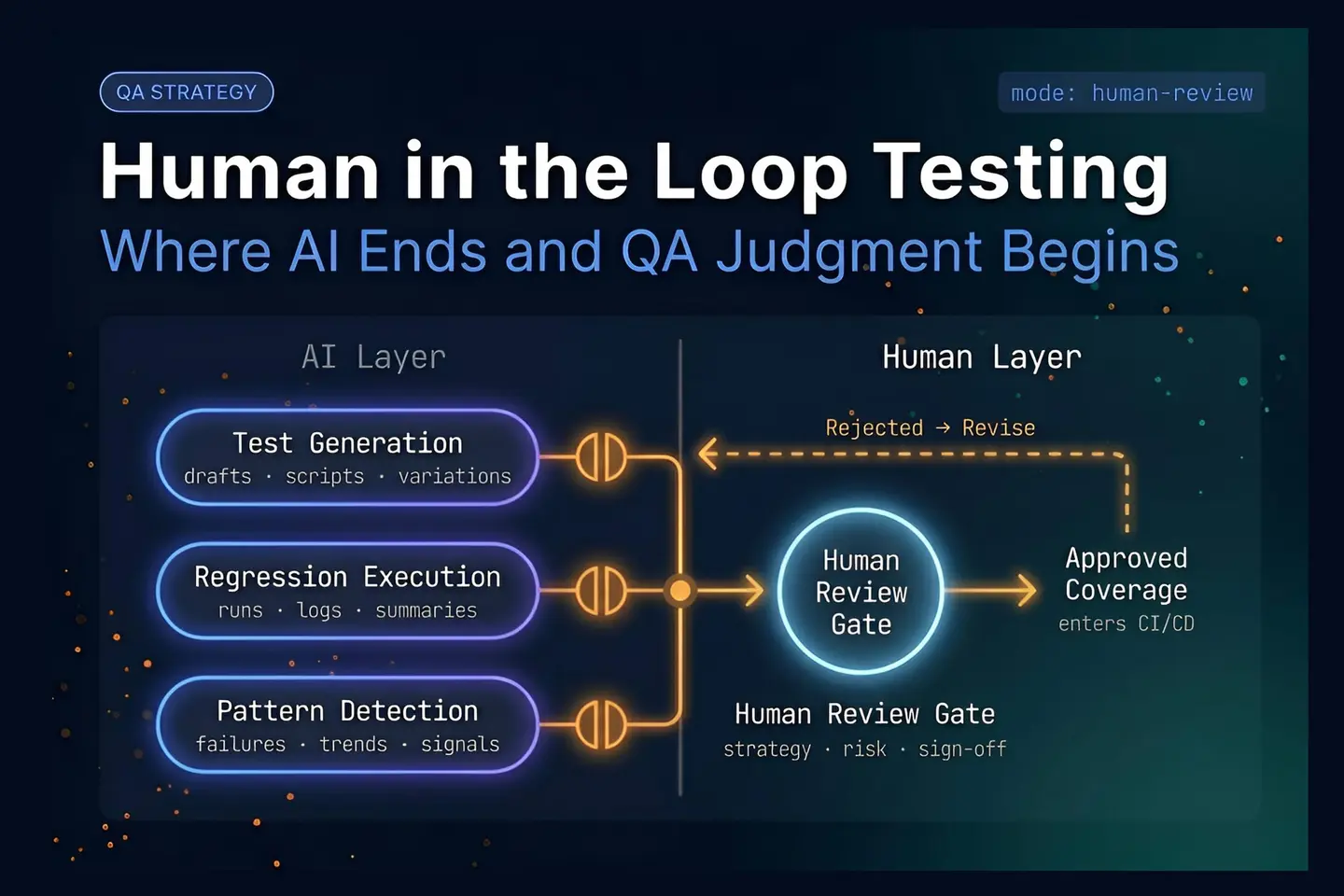
Human in the loop testing is an operational model where AI systems handle repetitive, pattern-heavy tasks (drafting scripts, generating test variations, summarizing logs…) while human engineers own all decisions involving risk, intent, and real-world correctness. Deliberate review checkpoints are built into the workflow so generated artifacts are confirmed before execution.
In practice, this means treating AI as an advanced drafting assistant rather than an independent decision-maker. A QA professional reviews every generated test artifact to confirm it reflects actual business logic before anything enters the CI/CD pipeline. The engineer is not just reviewing formatting, they are verifying that the test addresses what the application is genuinely supposed to do, not merely what the prompt inferred it should do.
This model exists because software validation is not the same as software execution. A test suite can run cleanly and still certify the wrong behavior. Understanding what AI cannot do in QA is the first step toward building a hybrid strategy that protects users without sacrificing velocity.
Why can’t AI handle QA entirely on its own?
AI models predict statistically likely outputs, they do not verify truth. Because they lack independent comprehension of user intent, business rules, or real-world consequences, fully autonomous testing creates false confidence. A structurally correct test can assert entirely the wrong behavior if the underlying requirement was ambiguous or incomplete.
The gap shows up specifically when requirements are vague. An algorithm will ingest a flawed specification and produce a polished test plan based on it, with no capacity to flag that the original requirement was logically contradictory or missing a critical compliance step. It follows the prompt, nothing more.
This limitation is documented at scale. According to Cemri, Pan et al. in “Why Do Multi-Agent LLM Systems Fail?” (NeurIPS 2025 / arXiv), more than 75% of failures in multi-agent systems manifest as silent semantic breakdowns, errors that pass automated validation layers while violating core business logic. These failures are only detectable through direct human inspection.
The practical implication: no matter how comprehensive the automated suite, any team that removes human review from the loop eventually discovers that their AI testing limitations aren’t visible in dashboards. They surface in production.
Which testing decisions should always involve a human?
Humans must govern risk analysis, requirement interpretation, edge-case identification from incomplete specifications, and user experience evaluation. These are not tasks where AI is merely slower, they are domains where AI lacks the foundational capability to produce reliable answers.
Software exists to serve people, and quality is ultimately judged by human experience. An automated check can confirm that a checkout page loads within two seconds. It cannot evaluate whether the error message displayed during a failed transaction is helpful, misleading, or anxiety-inducing. These experiential quality judgments require lived context.
Human testers also excel at identifying what is absent. If a product owner omits a security constraint from a Jira ticket, an AI will generate tests against the incomplete specification without flagging the gap. A senior SDET will catch the missing requirement immediately, drawing on institutional knowledge of how similar systems have failed before. That pattern-of-absence recognition, noticing what should be there but isn’t, is a core human QA capability that current AI systems cannot replicate.
How do human testers and AI agents divide responsibilities in a modern QA workflow?
AI acts as a high-throughput drafting layer, generating boilerplate scripts, creating test data variations, and categorizing failure patterns at volume. Human testers operate as editors and strategists, reviewing generated assets for logical accuracy, adding edge cases that require contextual reasoning, and maintaining ownership of coverage decisions at system boundaries.
This division mirrors the relationship between a junior engineer and a senior architect. The AI compresses the setup work. It can parse a full run history to surface failure trends, or instantly produce fifty variations of form-input data. That output frees the human engineer from tedious scaffolding and redirects their attention toward complex interaction paths and cross-system behavior.
Independently, the Stack Overflow 2025 Developer Survey makes the operational friction visible: 66% of developers cite correcting AI output that is nearly correct but ultimately flawed as their biggest workflow bottleneck. And 75.3% of respondents still default to consulting a human colleague whenever they distrust an AI-generated answer.
Understanding the efficiency breakdown between manual and AI test design helps teams assign the right task to the right intelligence — optimizing both speed and the quality of the decisions that speed depends on.
What does exploratory testing look like when AI is in the loop?
AI can support exploratory testing by seeding test data rapidly, flagging unusual API latency in real time, and documenting reproduction steps during an active session. The investigative core of the work, following a hunch, pivoting strategy on an anomaly, and deciding whether a minor flicker signals a deeper defect, remains entirely human.
Exploratory testing is fundamentally a learning process conducted in motion. A tester observes a subtle UI irregularity, considers what it might indicate about the underlying state machine, and immediately adjusts their next action to probe it further. Algorithms operate on predefined instructions. They do not experience suspicion. They cannot follow a hunch based on a developer’s known shortcuts or a remembered edge case from a previous release.
When AI is integrated into exploratory sessions correctly, it acts as an analytical companion: monitoring background calls, surfacing latency anomalies, and capturing session artifacts in real time. This frees the human investigator to focus entirely on interpretation and adaptation, which is where the actual discovery happens. According to Gołębiowski on the VirtusLab Blog, automated testing alone cannot secure agentic systems; human red-teaming remains indispensable because human creativity surfaces novel exploits that scripted tests structurally cannot reach.
This is also how AI test case builders are reshaping QA roles — not by replacing investigation, but by reducing the documentation overhead that previously competed with it.
Try It Now
Turn User Stories Into Structured Test Cases — Instantly
Paste any user story into TestStory.ai and watch the orchestration layer generate structured, Gherkin-formatted test cases instantly — covering happy paths, edge cases, and the failure scenarios your team would typically miss. No account required.
No credit card required.
How do you structure human review checkpoints inside a CI/CD pipeline?
Effective pipelines run automated checks first to filter basic regressions, then halt at a mandatory human review gate before any AI-generated test logic or critical code change proceeds to merge. The gate exists specifically to prevent the closed-loop failure where an algorithm generates, executes, and approves its own output.
The closed-loop risk is concrete. If AI writes a test case, runs that test, and then the pipeline uses the passing result to approve the pull request, no human has ever confirmed that the test actually asserts correct behavior. It may pass repeatedly while verifying the wrong thing entirely.
A well-structured pipeline breaks this loop at two points. First, when AI-generated test code is produced, a senior engineer reviews the logic, and not just the syntax to confirm it captures the intended business behavior. Second, before deployment of critical features, a human sign-off is required regardless of automated results. Implementing human-in-loop PR testing at the merge stage ensures that no code reaches production based solely on an algorithm’s self-assessment. The review step is not overhead — it is the governance layer that makes everything upstream trustworthy.
Where does test management fit when humans and AI share QA responsibilities?
A test management platform serves as the system of record where AI-generated drafts, human review decisions, pass/fail outcomes, and defect records converge. Without this governance layer, teams cannot audit whether a failing test reflects a real application defect or a hallucinated assertion that was never properly reviewed.
At scale, the volume of AI-generated test assets creates a traceability problem. A team producing hundreds of generated cases per sprint needs infrastructure that distinguishes reviewed, approved tests from raw drafts, and that preserves the human sign-off as part of the record.
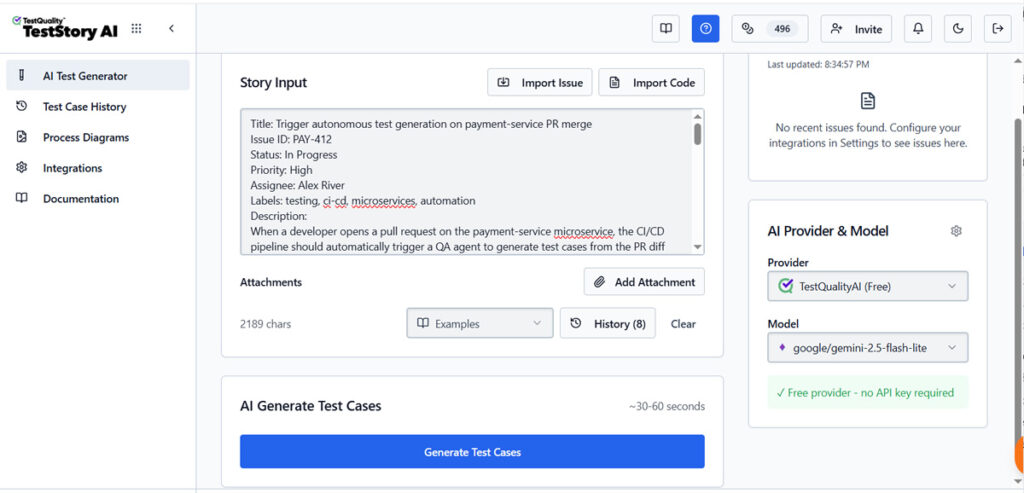
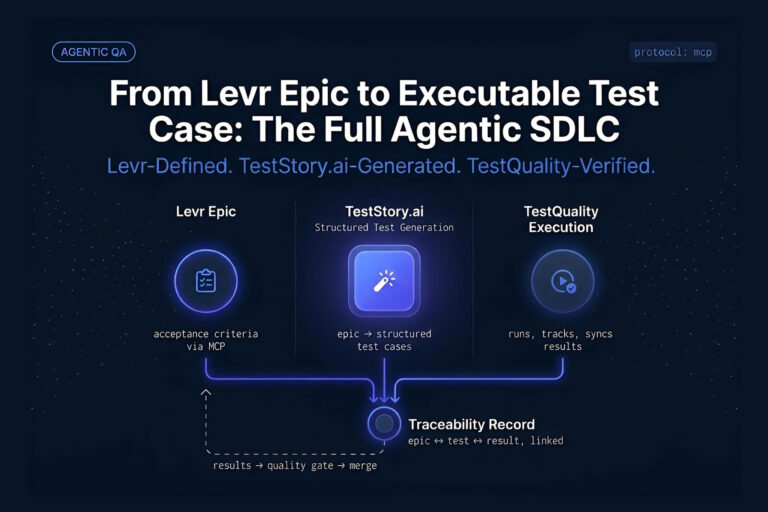
TestQuality fills this role directly. When teams use TestStory.ai , which reads project assets like user stories, epics, and source code to generate structured test cases, those cases sync into TestQuality.
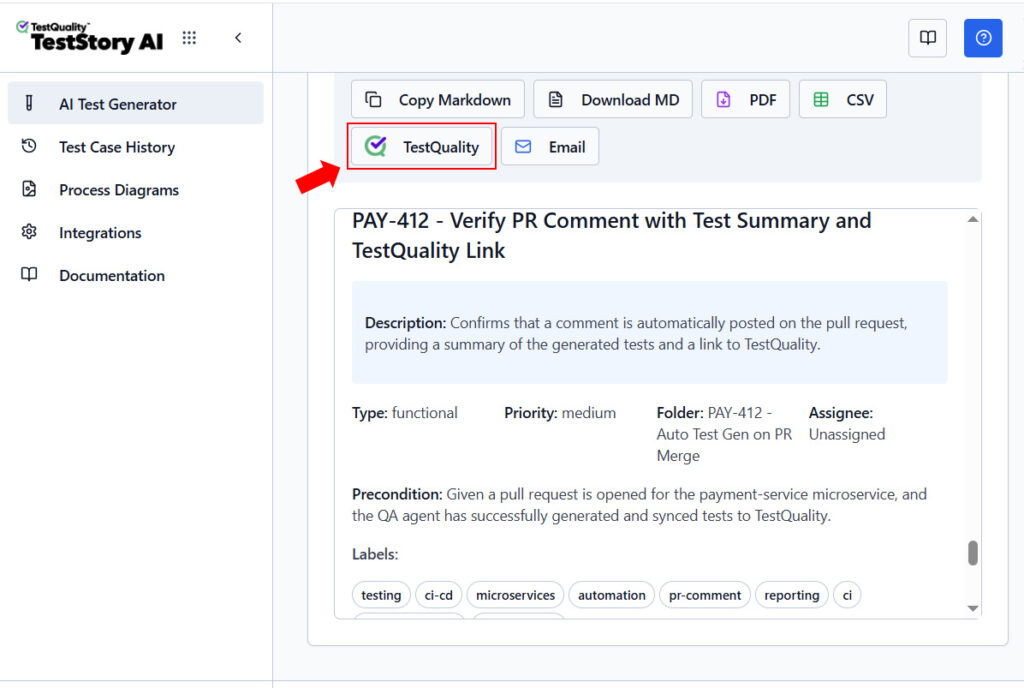
Once in TestQuality, QA engineers review, edit, and approve each case before it enters a test cycle. The platform records that human decision, tracks execution outcomes, and maintains full traceability from generation through to defect logging. When a confirmed defect is logged in TestQuality, its GitHub and Jira integrations sync the record to the team’s tracker automatically, closing the loop between test results, human review, and the development workflow.
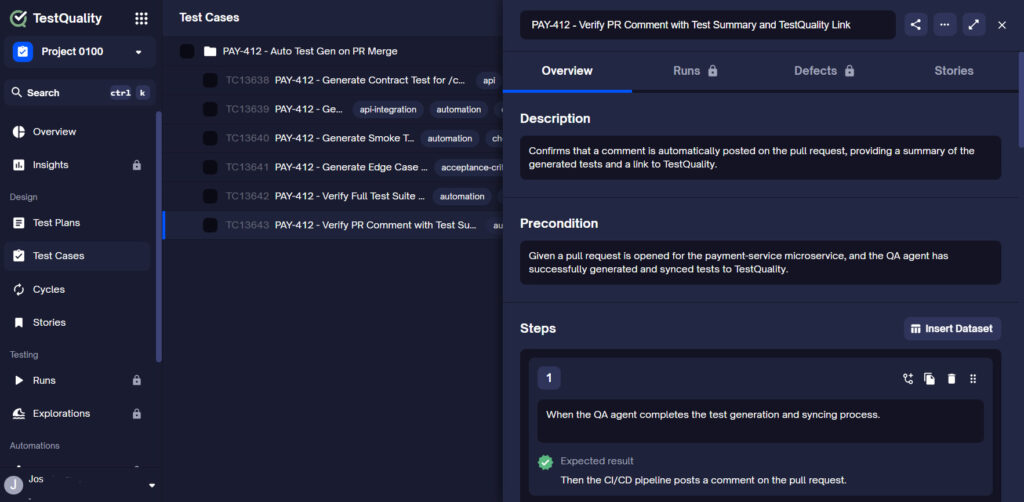
This structured workflow resolves the tension between AI test case generation and human test design by making both visible and accountable in one place.
How do you measure the right balance between human and AI testing coverage?
Teams measure balance by tracking defect escape rates, review cycle times, and the ratio of automated regression coverage to active exploratory sessions. The right equilibrium exists when AI absorbs the bulk of repetitive execution while humans direct their attention toward high-risk features, ambiguous requirements, and system boundary behavior.
The warning signs for imbalance are readable in either direction. If engineers are spending more time debugging broken generated scripts than testing the application, the AI is creating drag rather than reducing it. If QA engineers are still manually executing basic login flows for every release, available automation is being underused.
The leading indicator for a healthy AI and human oversight QA practice is production defect leakage rate, not test count. If critical business logic failures are escaping to production despite high automated coverage, that is a signal that the coverage is wide but shallow — and that human exploratory and architectural review need to be weighted more heavily. Volume of artifacts is not a proxy for quality. The measure is whether the right decisions are being made by the right intelligence at each stage of the pipeline.
QA Task Ownership: AI vs. Human
| AI-Delegable Testing Tasks | Human-Required Testing Decisions |
|---|---|
| Drafting boilerplate automation scripts | Defining test strategy, scope, and risk priorities |
| Generating test data variations | Interpreting vague or conflicting requirements |
| Summarizing error logs and failure patterns | Evaluating user experience and emotional friction |
| Executing repetitive regression suites | Identifying missing business logic or unstated constraints |
| Mapping basic positive/negative test paths | Assessing real-world deployment risk and readiness |
| Flagging API latency anomalies during exploration | Directing investigative pivots during exploratory sessions |
Technical Deep Dive FAQ
What is human in the loop testing?
Human in the loop testing is a QA methodology where AI systems handle high-volume, repetitive tasks — generating test cases, executing regression suites, summarizing logs — while human engineers retain authority over strategy, risk assessment, and final approval of test coverage. The model works by embedding deliberate review checkpoints into automated workflows so that no AI-generated artifact enters a CI/CD pipeline without a qualified engineer confirming it reflects correct business logic.
What is human in the loop AI, and why does it matter for QA teams specifically?
Human in the loop AI refers to any automated system where human judgment is structurally embedded at key decision points rather than applied only at the end. For QA teams, this matters because AI models generate statistically plausible outputs — not verified correct ones. In testing contexts, a generated test can be syntactically sound while asserting completely wrong behavior. Human review gates prevent these plausible-but-incorrect artifacts from reaching production undetected.
Can AI replace human QA testers entirely?
No. AI will continue absorbing repetitive scripting, data generation, and execution tasks, but it cannot replicate human empathy, contextual reasoning, or the ability to identify what is missing from a specification. Evaluating user experience, interpreting ambiguous requirements, performing investigative exploratory testing, and making risk-based deployment decisions all require a human QA professional. These are not tasks where AI is slower — they are tasks where AI lacks the underlying capability to produce reliable answers.
What are the main AI testing limitations engineering teams encounter in practice?
The most significant AI testing limitations include: inability to detect unstated business requirements, a tendency to generate test assertions that are structurally valid but logically incorrect, no capacity to evaluate user experience quality or emotional friction, and an inability to identify novel edge cases outside historical training patterns. Multi-agent systems face an additional risk — over 75% of their failures manifest as silent semantic errors that pass automated checks but violate business logic (Cemri, Pan et al., NeurIPS 2025).
How should QA teams validate AI-generated test cases before execution?
Review AI-generated test cases the same way you would review work from a junior contributor. Check whether each case reflects actual user intent, genuine business risk, and realistic failure modes — not just the wording of the requirement it was generated from. Look specifically for duplicated coverage, vague expected results, and missing edge cases around unstated constraints. A test management platform helps by keeping approved, reviewed cases separate from raw generated drafts, preserving an auditable record of the human sign-off.
Why is human QA still necessary for user experience testing even with comprehensive automation?
Software quality is ultimately judged by human interaction, and automated checks cannot evaluate experiential quality. An algorithm can verify that a form submission completes in 300ms. It cannot determine whether the error message shown on a failed validation is confusing, alarming, or likely to cause users to abandon the flow entirely. Assessing whether a workflow is mentally exhausting, whether terminology matches user expectations, or whether a handoff between systems creates friction requires lived human experience — not statistical prediction.
How does AI and human oversight QA integrate with agile sprint workflows?
In agile workflows, AI fits naturally into sprint planning as a test case drafting layer — generating initial coverage from user stories and epics that human testers then review and refine before the sprint begins. During the sprint, AI executes the established regression suite while QA engineers focus exploratory effort on newly developed features. Human review gates sit at pull request merge points and at sprint sign-off, ensuring that AI-generated artifacts are accountable to a qualified reviewer before they become canonical test coverage.
How do you prevent false confidence when AI is generating and executing tests in the same pipeline?
The most direct prevention is a structural rule: AI is never permitted to approve its own output. Every CI/CD pipeline involving AI-generated tests must include a human review gate before merge. Beyond pipeline governance, maintain an active exploratory testing practice specifically targeting areas where AI coverage is densest — this is where the semantic errors that pass automated checks are most likely to hide. Tracking production defect escape rates by feature area provides the clearest signal that automation confidence is being earned rather than assumed.
Key Takeaways
Keep the Speed. Keep the Skepticism.
The strongest QA teams combine automation gains with sharper human judgment — not one at the expense of the other.
Plausible ≠ correct: AI models generate statistically likely outputs, not verified truths. Over 75% of multi-agent failures are silent semantic errors that pass automated checks but violate business logic (Cemri, Pan et al., NeurIPS 2025).
Humans own the decisions that require understanding: Risk analysis, requirement interpretation, UX evaluation, and identifying missing business logic are not slower with AI — they are structurally out of reach for AI.
Closed-loop risk is real: A pipeline where AI generates, executes, and approves its own tests without human intervention is not automation — it is the most expensive way to ship false confidence.
Exploratory testing is not optional: Human red-teaming remains the only method for uncovering novel exploits and experience-layer failures that scripted automation cannot structurally reach (Gołębiowski, VirtusLab Blog).
Volume is not a proxy for coverage quality: 66% of developers report that correcting nearly-correct AI output is their biggest workflow bottleneck (Stack Overflow 2025). More tests generated does not mean more risk covered.
Governance infrastructure matters: A test management platform that preserves the human sign-off — alongside execution outcomes, defect records, and trend data — is what separates accountable AI-assisted QA from unchecked generation at scale.
The risk is not that machines test too little. It is that teams stop noticing what only humans can notice.
Start Free Today
Transition from Script-Writing to Outcome-Orchestration
TestStory.ai generates structured test cases from your user stories, acceptance criteria, or architecture diagrams — then syncs them directly into TestQuality for execution, tracking, and team collaboration. Human review decisions, pass/fail outcomes, and AI-generated results all converge in one governed system of record — so your team’s judgment is preserved alongside the speed.
✦ Get 500 TestStory.ai credits every month included with your TestQuality subscription — no extra cost.
No credit card required on either platform.