At a Glance
Why Traditional Automation Fails AI Systems — and What to Do Instead
Pass/fail is not enough when your system can hallucinate, drift, or refuse incorrectly.
The core shift: AI systems require evaluation across multiple quality dimensions — relevance, faithfulness, hallucination risk, toxicity, and retrieval grounding — not a single pass/fail assertion.
Golden datasets are the foundation: Structured prompt–expected-behavior pairs replace brittle assertions and enable repeatable regression across model versions.
LLM-as-a-judge closes the gap: Metrics like faithfulness and contextual recall require a judge model to score — a deterministic assertion cannot evaluate semantic quality.
Agentic Testing and QA turns AI output validation from a manual spot check into a repeatable, auditable pipeline — the same discipline traditional QA brought to deterministic software, now applied to systems that reason.
Agentic Testing and QA is the practice of evaluating AI-driven systems — chatbots, voice agents, and retrieval-augmented generation pipelines — using automated evaluators, golden datasets, multi-metric scoring, and LLM-as-a-judge models instead of relying solely on manual review or deterministic assertions. When a system can hallucinate facts, retrieve the wrong context, or refuse when it should answer, traditional pass/fail automation misses the failure entirely. The solution is a dedicated evaluation layer that calls each AI system through APIs, scores outputs across multiple dimensions including relevance, faithfulness, toxicity, and retrieval grounding, and produces auditable run history that your QA team can track across model versions and prompt changes.
What Is Agentic Testing and QA?
Agentic Testing and QA is the discipline of testing AI-driven systems — chatbots, RAG pipelines, and voice agents — using structured evaluation frameworks that score outputs across multiple quality dimensions rather than checking binary pass/fail conditions. Because AI systems produce probabilistic outputs, a single assertion cannot capture whether an answer is grounded, safe, relevant, or honest.
In a conventional web application, a test verifies that clicking a button produces a predictable result. In an AI application, the questions are fundamentally different: Did the model invent facts? Did it retrieve the right context? Did it respond safely to an adversarial prompt? Did it correctly refuse when it lacked enough information to answer? These questions require a different evaluation architecture — one built around metrics, datasets, and judge models rather than selectors and assertions.
Agentic Testing and QA addresses this gap by combining API-driven test automation, golden datasets, LLM-as-a-judge scoring, and multi-metric evaluation in a single reusable framework. The result is AI quality that can be measured, tracked, and regressed rather than subjectively reviewed sprint by sprint. Teams building on the agentic SDLC need this layer to ship AI products with confidence.
How Does an Agentic Testing Architecture Work?
A production-ready Agentic Testing and QA architecture separates the evaluation framework from the systems under test and communicates with each through stable APIs. This separation keeps test logic independent of application internals and makes the framework reusable across multiple AI products simultaneously.
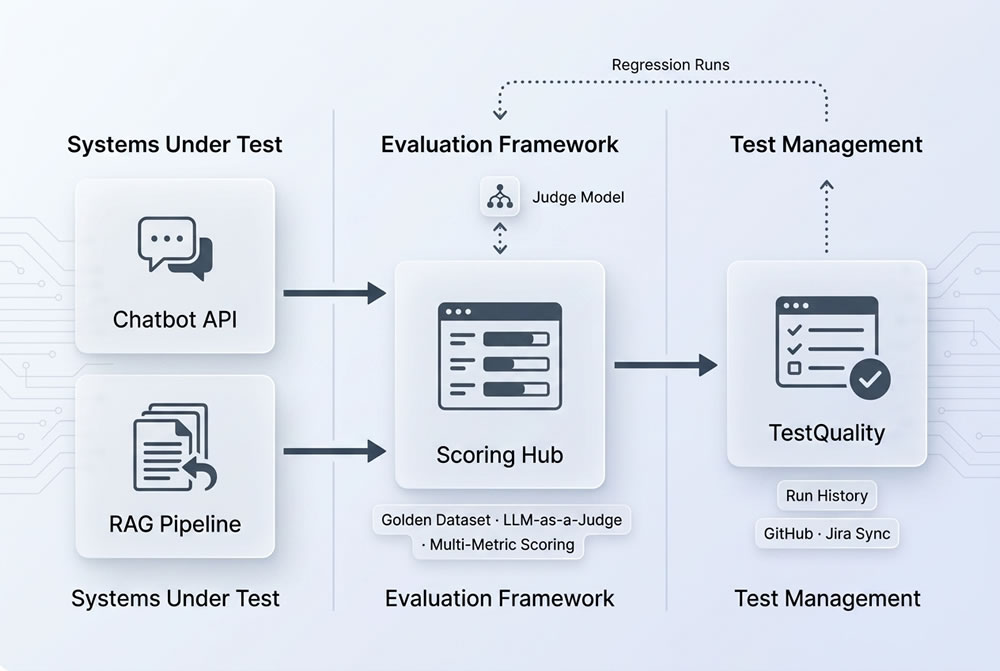
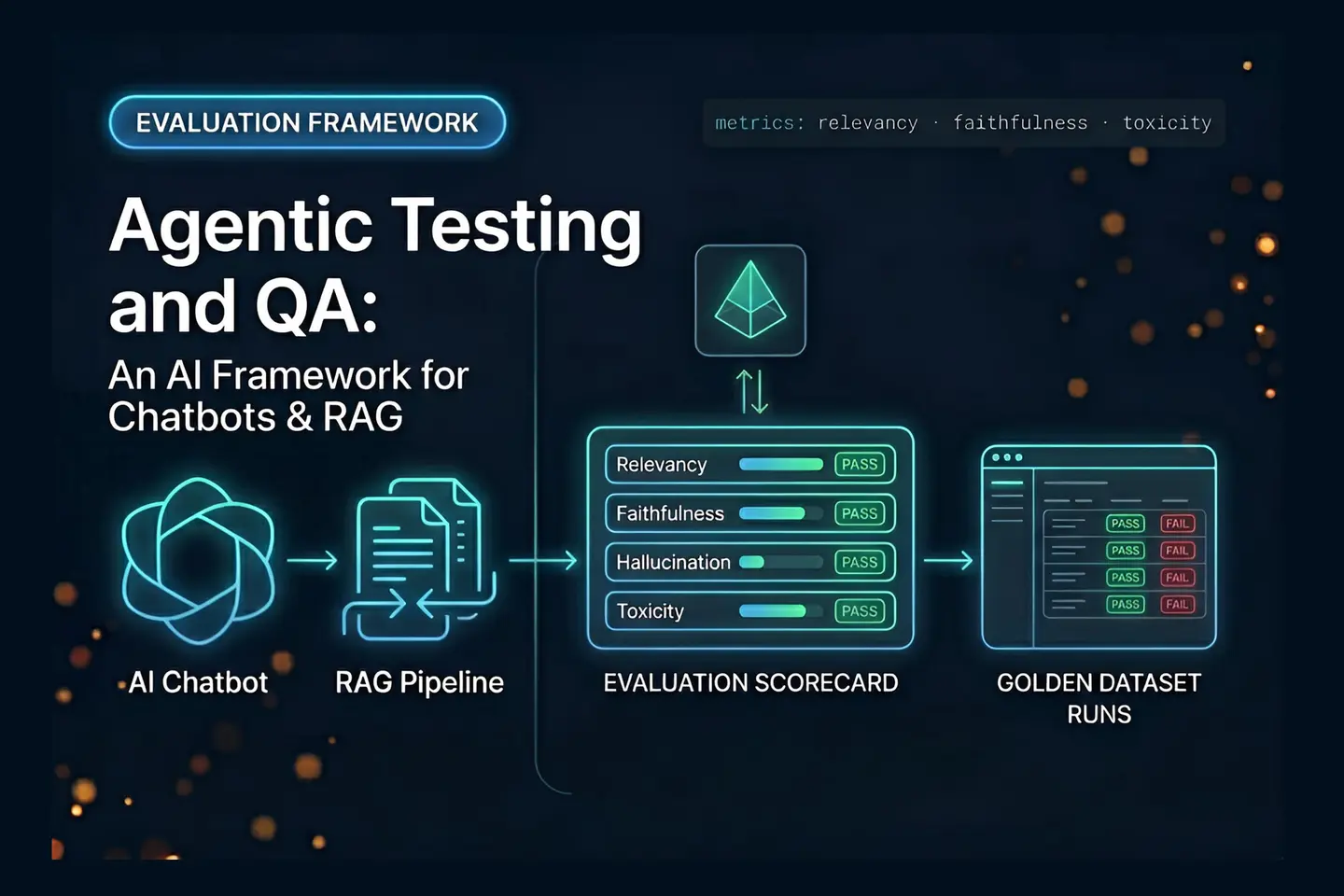
The architecture has three distinct components. The first is the chatbot application itself — an endpoint that accepts a user prompt and returns a generated response. The second is the RAG pipeline, which ingests documents, chunks them, stores vector embeddings, retrieves top-matching chunks for a query, and passes retrieved context to a language model to produce an answer. The third is the evaluation framework — a separate service that calls both systems, applies golden dataset inputs, scores the outputs using configured metrics, and writes results to a report or dashboard.
This design reflects a core Agentic Testing and QA principle: one evaluator service validating multiple AI systems in the same environment. Mixing test logic into the application under test makes both harder to maintain and produces evaluations that cannot be trusted as independent signals.
For RAG systems specifically, the evaluation layer needs visibility into more than just the final answer. It should be able to inspect which chunks were retrieved, how many chunks were stored after ingestion, and whether the answer is grounded in the returned context. A RAG explorer interface — one that exposes chunk count, top-K retrieval results, and source document mapping — makes debugging retrieval failures significantly faster. When a RAG system fails, the root cause is almost never obvious from the final answer alone: bad ingestion, weak chunking, poor embeddings, and incorrect vector search all produce similar-looking output failures.
What Metrics Matter in an AI Evaluation Framework?
Effective Agentic Testing and QA runs at least five distinct metrics per test case, because different AI failure modes are invisible to any single score. An answer can be relevant but still hallucinated; it can be grounded in retrieved context but phrased in a toxic way; it can be safe but refuse a question it should have answered.
The core metric categories for chatbot and RAG evaluation are answer relevancy (does the response address the prompt?), faithfulness (is every claim in the response grounded in retrieved context or known facts?), hallucination detection (did the model assert something not supported by its input?), toxicity (does the response contain harmful, biased, or unsafe language?), contextual recall (did the system retrieve and use the most relevant chunks?), and summarization quality (for RAG responses that condense multiple sources). Safety checks — testing that the system refuses or redirects adversarial prompts correctly — round out the suite.
Frameworks like DeepEval operationalize these categories as scoreable metrics with configurable thresholds. A framework supporting 15 or more metrics gives teams the granularity to separate failure modes cleanly. Different AI products fail in different ways, and collapsing all quality signal into a single score hides the information QA engineers need to debug and improve the system. [CITATION-1: DeepEval or RAGAS paper — paste URL from Notebook LM sheet]
What Are Golden Datasets and Why Are They Essential?
Golden datasets are the structured test data layer of an Agentic Testing and QA framework. Each entry defines the input prompt, the expected output or expected behavior, and where applicable, the supporting context the system should draw from. They function as the AI equivalent of expected results in a traditional test case.
Without a golden dataset, AI test results are subjective and impossible to compare across runs. With one, every change to the prompt template, retrieval configuration, or underlying model can be evaluated against the same baseline inputs and expected behaviors. That turns AI quality into a regression discipline rather than a per-release judgment call.
A useful golden dataset for a support chatbot might include known business policy questions with expected accurate answers, questions that should trigger a safe fallback when the model lacks enough information, and adversarial prompts designed to probe for toxic or unsafe responses. For a RAG pipeline, golden entries should include questions answerable directly from ingested documents, questions with only partial document support, and questions with no answer in the knowledge base — to verify that the system correctly declines rather than hallucinating. Independently, research on reference-free RAG evaluation metrics confirms that grounded-answer validation against retrieved chunks is the most reliable signal for RAG quality. [CITATION-2: RAGAS or Lewis et al. RAG paper — paste URL from Notebook LM sheet]
Storing these datasets in a test management platform like TestQuality — structured as test cases with inputs, expected outcomes, tags, and priorities — keeps them version-controlled alongside your other QA assets and makes traceability across business policies, safety checks, and retrieval validation possible at scale.
How Does LLM-as-a-Judge Scoring Work?
LLM-as-a-judge is the pattern of using a separate language model to score the outputs of an AI system under test against configured quality criteria. It is necessary for any metric that cannot be evaluated with a deterministic rule — which in AI testing is most of them.
A judge model receives the prompt, the system’s response, and optionally the retrieved context, and returns a score and reasoning for each configured metric. For faithfulness, it checks whether every factual claim in the response is supported by the retrieved chunks. For toxicity, it evaluates whether the language is harmful or unsafe. For answer relevancy, it scores whether the response genuinely addresses what was asked.
The practical requirement for a production judge setup is provider switching. Teams need to run the same evaluation suite against different judge models — cloud-hosted options like GPT-4 or Claude for quality benchmarking, local models like Ollama for cost control and offline validation, and alternative providers when one is unavailable. Hardcoding a single judge model creates cost risk for frequent regression runs and makes the framework brittle when a provider has downtime. A well-designed Agentic Testing and QA framework treats judge model selection as a configuration parameter, not a fixed dependency.
Try It Now
Generate Structured Test Cases for Your AI System in Seconds
Paste any user story or acceptance criterion into TestStory.ai and watch the orchestration layer generate structured, Gherkin-formatted test cases instantly — covering happy paths, edge cases, and the failure scenarios your team would typically miss. No account required.
No credit card required.
How Do You Structure Test Scenarios for Chatbot and RAG Evaluation?
Effective Agentic Testing and QA requires deliberate scenario design across both systems under test. The goal is to cover not just correctness but also restraint — the cases where the system should do nothing, refuse, or redirect rather than respond.
For chatbot evaluation, the scenario set should include known business policy questions with verifiable expected answers, unknown questions that should trigger a safe fallback response, aggressive or frustrated user prompts to test tone handling, prompts designed to expose toxic or unsafe model behavior, and domain-specific support questions that require accurate retrieval. Testing only the happy path misses the failure modes that matter most in production.
For RAG pipeline evaluation, scenarios should verify retrieval as well as generation. That means including questions answerable directly from ingested documents, questions with only partial document support, questions with no answer in the knowledge base, retrieval validation cases that inspect which chunks were returned, and grounded-answer cases that check whether the generated response is supported by retrieved context. A team connecting their RAG evaluation results to GitHub or Jira through TestQuality can tag failing retrieval scenarios directly to the engineering issues that need to be fixed — keeping QA findings traceable without leaving the existing workflow.
How Does TestQuality Support Agentic Testing and QA Workflows?
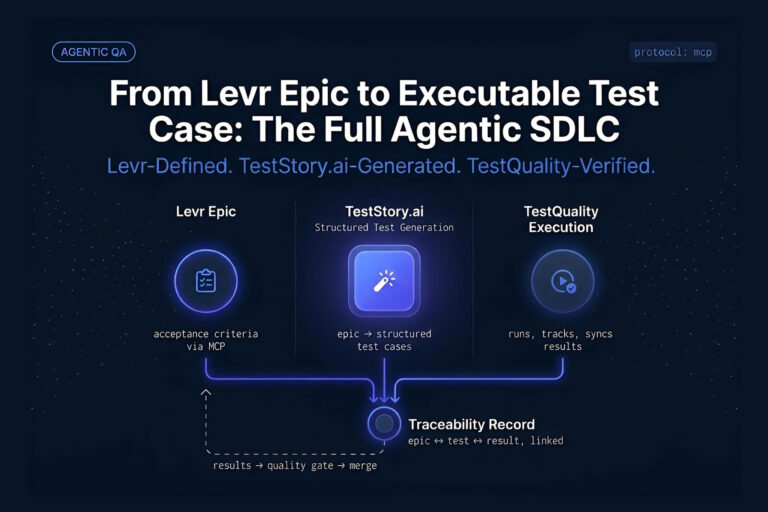
Before a golden dataset entry exists, someone has to write the prompt, define the expected behavior, and structure the test case. TestStory.ai handles that generation step: paste a user story or acceptance criterion and it produces structured, Gherkin-formatted test cases covering happy paths, edge cases, and failure scenarios — including the refusal and safety cases that manual authoring typically misses. Those generated test cases flow directly into TestQuality as managed assets, becoming the golden dataset your evaluation framework runs against.
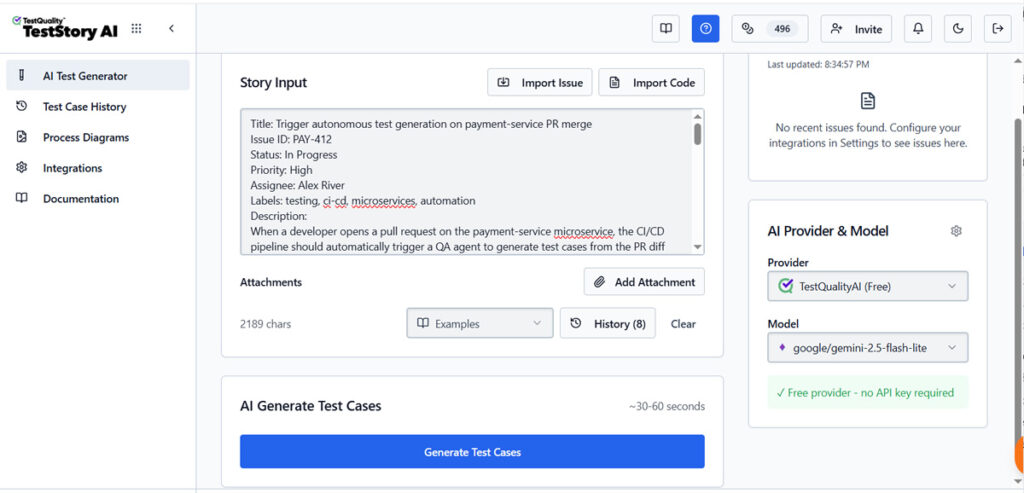
TestQuality brings test management discipline to Agentic Testing and QA by treating golden dataset scenarios as structured, version-controlled test cases rather than ad hoc scripts. Each golden prompt and its expected behavior maps to a test case with inputs, expected outcomes, tags, and priority, the same structure your team already uses for functional and regression coverage.
When an evaluation run completes, results upload into TestQuality via the CLI using the testquality upload_test_run command, which pushes JUnit XML output from your evaluation framework into a named project and test cycle. That makes AI quality runs part of the same run history your team reviews for Playwright, Selenium, and other automated suites. Pass/fail status, metric scores, and execution metadata flow into trend reports automatically once the CLI uploads the results.
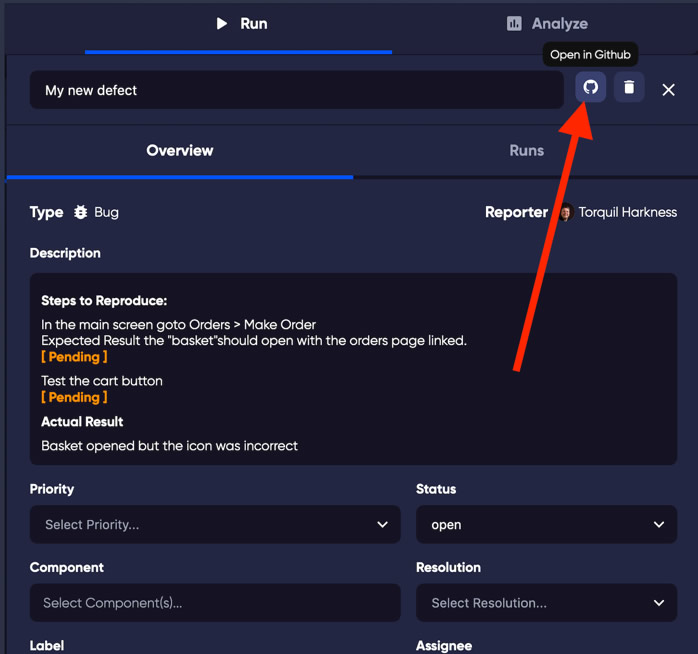
For defects surfaced by an evaluation run, a hallucination on a specific golden prompt, a retrieval failure on a known document question, a tester reviews the failure, confirms it represents a genuine quality regression, and logs the defect in TestQuality.
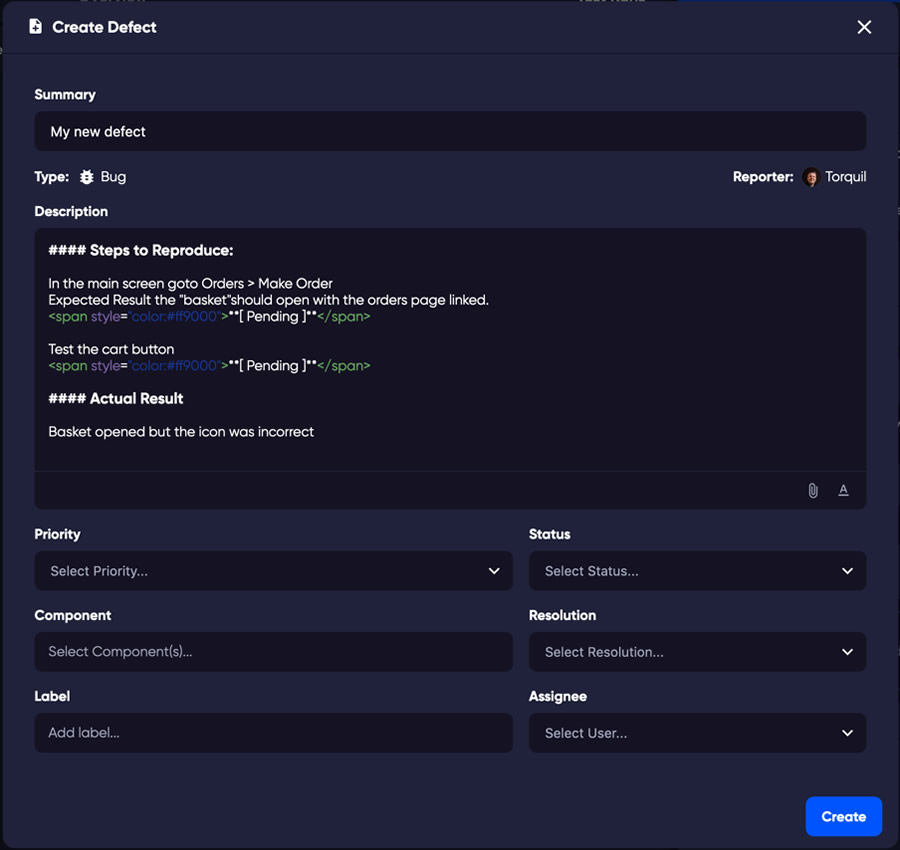
Once logged, TestQuality’s native GitHub and Jira integrations sync the defect record to the team’s tracker automatically. That keeps AI evaluation findings inside the same defect workflow as all other QA work, without requiring separate tooling or manual copy-paste between systems.
Teams can also use TestQuality’s exploratory testing features for manual spot-check sessions on AI outputs that automated metrics flag as borderline cases where a score is low but a human needs to confirm whether the failure represents a real regression or an acceptable model variance.
What Are the Most Common Mistakes in Agentic Testing and QA?
Most Agentic Testing and QA frameworks fail for one of six predictable reasons, and each one is avoidable with deliberate design choices made early.
Testing only the final answer is the most common mistake. When a RAG system fails, the root cause could be bad chunking, weak embeddings, incorrect vector search, or a generation error — and the final answer looks similar in all cases. Without inspecting retrieval details, the framework cannot diagnose the actual problem.
Skipping golden datasets makes results subjective and impossible to compare over time. Without expected behaviors defined in advance, there is no baseline to regress against when prompts, models, or retrieval settings change.
Mixing the application and the test framework together creates a setup that is harder to maintain and less realistic than testing through APIs. The evaluation service should communicate with each application through stable endpoints, exactly as a real user would.
Relying on a single metric hides failure modes. Relevancy alone does not catch hallucinations, toxicity, or weak retrieval grounding. A production Agentic Testing and QA suite runs multiple metrics per test case.
Ignoring refusal cases — prompts where the model should say it does not know rather than inventing an answer — leaves one of the most dangerous AI failure modes completely untested.
Hardcoding a single judge model creates cost risk and provider dependency. Judge model selection should be a configuration parameter from the start.
Technical Deep Dive FAQ What is Agentic Testing and QA? +
Agentic Testing and QA is the discipline of evaluating AI-driven systems — chatbots, RAG pipelines, and voice agents — using automated evaluators, golden datasets, multi-metric scoring, and LLM-as-a-judge models. Unlike traditional test automation, which checks deterministic outputs against expected values, Agentic Testing and QA scores probabilistic AI outputs across dimensions like relevance, faithfulness, hallucination risk, toxicity, and retrieval grounding to produce auditable, repeatable quality signals. What is a golden dataset in AI testing? +
A golden dataset is a structured collection of test inputs paired with expected outputs or expected behaviors, used as the baseline for evaluating an AI system. Each entry typically defines an input prompt, the expected model behavior or answer, and optionally the supporting context. Golden datasets function as the AI equivalent of expected results in a traditional test case and enable repeatable regression testing when models, prompts, or retrieval settings change. How does LLM-as-a-judge scoring work in practice? +
LLM-as-a-judge uses a separate language model to score the outputs of an AI system under test. The judge receives the original prompt, the system’s response, and optionally the retrieved context, then returns a numeric score and natural-language reasoning for each configured metric. This approach is necessary for semantic metrics like faithfulness, contextual recall, and summarization quality that cannot be evaluated with deterministic string-matching rules. The judge model is typically a separate, high-capability model and should be swappable across providers. Why is RAG retrieval validation more important than testing the final answer? +
In a RAG system, failures can originate at any point in the pipeline: bad document ingestion, poor chunking strategy, weak embeddings, incorrect vector search results, or generation errors after retrieval. The final answer looks similar across all these failure modes. Testing only the final answer means you cannot identify which stage failed or how to fix it. Effective RAG evaluation inspects chunk count after ingestion, top-K retrieval results for each prompt, source document mapping, and answer grounding relative to the retrieved context. What metrics should an AI evaluation framework include? +
A production Agentic Testing and QA framework should include at minimum: answer relevancy, faithfulness, hallucination detection, toxicity, contextual recall, summarization quality, and safety refusal checks. Each metric captures a distinct failure mode. A framework supporting 15 or more metrics gives QA engineers the granularity to separate failures cleanly — an answer can be relevant but still hallucinated, grounded but toxic, or safe but incorrectly refusing a valid question. Single-score evaluation hides all of this information. How does the TestQuality CLI integrate AI evaluation results into test management? +
The TestQuality CLI uses the testquality upload_test_run command to push JUnit XML output from an evaluation framework into a named project and test cycle. Once uploaded, pass/fail status, metric scores, and execution metadata flow into run history and trend reports. Defects confirmed by a tester are logged in TestQuality and synced automatically to GitHub or Jira through the native integrations. This keeps AI evaluation results inside the same test management workflow as all other QA coverage. What folder structure works best for an AI testing framework? +
A maintainable Agentic Testing and QA framework separates concerns across distinct directories: a providers folder for model integrations (OpenAI, Ollama, local options), a judge folder for LLM-as-a-judge configuration, a datasets folder for chatbot and RAG golden cases, a tests folder for metric-specific test execution files, a reports folder for JSON or dashboard-ready output, and an environment configuration file for API keys and model selection. This structure keeps the framework reusable across multiple target systems without requiring changes to core test logic. How should AI evaluation run results be tracked over time? +
AI evaluation results should be tracked as named test runs tied to a specific model version, prompt version, or retrieval configuration. Each run stores pass/fail status and metric scores per test case, enabling trend comparison when any variable changes. A dashboard that surfaces connected systems, metric pass rates, detailed per-case results, and full regression execution makes the framework operationally useful for QA teams. Without run history, it is impossible to know whether a model change improved or degraded quality across the full golden dataset.
Framework Comparison
Traditional Automation vs. Agentic Testing and QA
| Dimension | Traditional Automation | Chatbot Agentic Testing | RAG Agentic Testing |
|---|---|---|---|
| Output type | Deterministic | Probabilistic / generative | Probabilistic + retrieval-dependent |
| Assertion method | String / value match | LLM-as-a-judge scoring | LLM-as-a-judge + retrieval inspection |
| Test data format | Input/expected value pairs | Golden dataset (prompt + expected behavior) | Golden dataset + context + chunk validation |
| Metrics needed | Pass / fail | Relevancy, faithfulness, toxicity, safety | All chatbot metrics + contextual recall, grounding |
| Failure visibility | High — exact failure point | Medium — metric score + reasoning | Full pipeline — retrieval + generation stage |
| Regression baseline | Fixed expected values | Golden dataset per model version | Golden dataset per model + retrieval config |
| TestQuality integration | JUnit XML via CLI | JUnit XML via CLI + defect sync to GitHub/Jira | JUnit XML via CLI + defect sync to GitHub/Jira |
Key Takeaways
What Every QA Team Building AI Products Needs to Know
Six principles that separate repeatable AI quality from guesswork.
Separate the evaluator from the system under test: The evaluation framework must communicate with chatbot and RAG applications through stable APIs — mixing test logic into the application makes results untrustworthy and the framework impossible to reuse.
Golden datasets are non-negotiable: Without structured prompt–expected-behavior pairs, AI test results are subjective and cannot be compared across model versions, prompt changes, or retrieval configurations.
RAG testing must validate the full pipeline: Inspecting only the final answer misses failures caused by bad chunking, weak embeddings, or incorrect vector search — all of which produce similar-looking output failures.
Run at least five metrics per test case: An answer can be relevant but hallucinated, grounded but toxic, or safe but incorrectly refusing. Single-score evaluation hides every one of these failure modes.
Judge model switching is a design requirement, not an afterthought: Provider switching enables cost control on frequent runs, offline validation, and resilience when a single provider is unavailable.
Track runs over time in a test management layer: The TestQuality CLI uploads JUnit XML results from evaluation runs into named projects and cycles, keeping AI quality regressions inside the same workflow your team uses for all other automated coverage.
The teams that build reliable AI products are not the ones with the best models — they are the ones that measure quality systematically and regress against a defined baseline every time something changes.
Start Free Today
Transition from Script-Writing to Outcome-Orchestration
TestStory.ai generates structured test cases from your user stories, acceptance criteria, or architecture diagrams — then syncs them directly into TestQuality for execution, tracking, and team collaboration. Map your golden dataset scenarios to managed test cases, upload evaluation run results through the CLI, and sync every confirmed defect to GitHub or Jira automatically.
✦ Get 500 TestStory.ai credits every month included with your TestQuality subscription — no extra cost.
No credit card required on either platform.