At a Glance
Generative AI for QA: Where Generation Ends and Orchestration Begins
The real shift is not better prompts. It is better workflow design.
The verification gap: According to the Stack Overflow 2025 Developer Survey, 45.2% of developers now spend more time debugging AI-generated code than writing it manually — workflows have shifted from generation to validation.
Skills that rise: System architecture analysis, risk evaluation, trajectory-level agent auditing, and adversarial testing now define senior SDET value — not script volume.
The human-plus-agent model: McKinsey research identifies the traditional SDLC as being redesigned into a human-supervised agent pipeline — QA practitioners become orchestrators, not script authors.
Teams that treat AI as a single prompt box tend to automate fragments, not outcomes. The SDETs who thrive will be the ones who design the system around the agent, not the ones who type fastest into a chat window.
Generative AI for QA is the use of large language models to accelerate the creation and analysis of testing artifacts — drafting test cases, summarizing requirements, and generating synthetic test data. AI agents extend that capability into multi-step autonomous workflows that plan, delegate, and execute testing tasks across an entire delivery pipeline. For SDETs, the shift is not about learning to prompt more cleverly. It is about moving from artifact production to system design: knowing when to deploy a generation model, when to invoke an agent, and where human judgment is non-negotiable. This article maps exactly which SDET skills grow in value, which fade, and how to build a workflow that treats both humans and agents as deliberate contributors to quality.
What does generative AI actually do inside a QA workflow?
Generative AI operates as an advanced drafting layer inside the testing lifecycle. It analyzes project documentation, extracts candidate test scenarios, and produces initial test steps at speed — but it lacks the contextual judgment to finalize risk-based decisions. Every output requires human review before it enters a test suite.
In practical terms, when a product manager delivers a dense set of requirements or user stories, an SDET can feed those inputs to a language model and immediately receive a structured baseline of test scenarios. That process — often called generative AI test case generation — eliminates the blank-page delay that typically costs the first day of a sprint. It also handles tasks that are difficult to sustain manually at scale: summarizing multi-hundred-page compliance documents, converting legacy defect logs into structured patterns, and generating diverse synthetic datasets for edge-case coverage.

The critical limitation is that bulk generation is not the same as bulk accuracy. According to the Stack Overflow 2025 Developer Survey, 45.2% of developers report that debugging AI-generated code now takes longer than writing it from scratch, which means the productivity gain at the drafting stage can be erased downstream if outputs go unreviewed. Models produce plausible-looking test steps that may target non-existent features, write assertions that are too vague to catch real failures, or miss negative paths entirely.
The practical discipline is treating AI output as raw material, not a deliverable. Understanding how AI test case builders are reshaping QA roles starts with this distinction, the model accelerates the first draft; the SDET is still responsible for what ships.
How are AI agents different from traditional test automation tools?
Traditional test automation executes static, pre-written scripts against a predictable environment. AI agents, by contrast, interpret a testing goal, decompose it into sub-tasks, and adapt their execution plan in response to what they observe — navigating unexpected UI changes, generating test prerequisites on the fly, and coordinating work across multiple specialized sub-agents.
Conventional AI test automation — self-healing selectors, visual regression algorithms, smart wait logic — still operates within the boundary of a predefined test suite. If the application flow changes, a human must update the script. AI agents operate differently: they receive a high-level objective such as “verify the guest checkout path” and determine the steps themselves. They can locate new DOM elements without hardcoded locators, interact with pop-ups that were never anticipated during test design, and pass state between sub-tasks without manual plumbing.
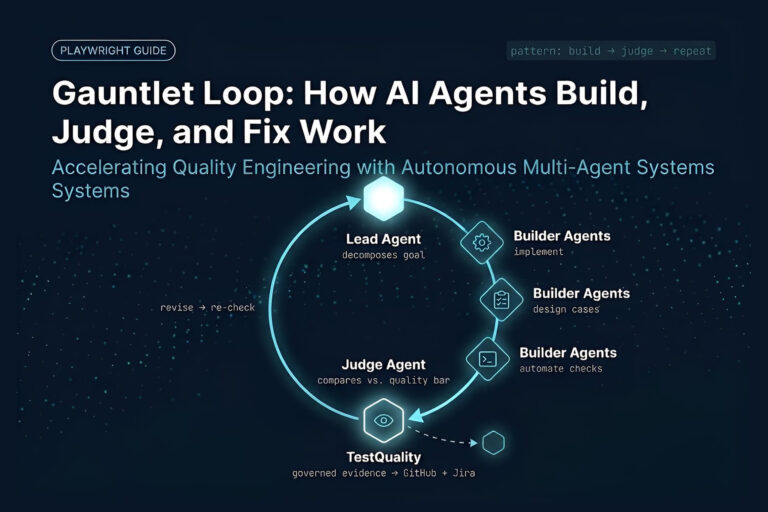
This shift is more than a tooling upgrade — it is a redesign of the QA role. As Schneider et al. note in McKinsey’s “Seven shifts to become AI-centric in software,” the traditional product development lifecycle is being restructured into a human-plus-agent model, pushing QA practitioners to transition from script authors into agent managers. Independently, that framing aligns with what is already visible in production: teams designing multi-agent pipelines where one agent parses the diff, another proposes test coverage, and a third executes and reports — with an SDET in the supervisory seat.
That trajectory is what makes autonomous software testing a practice concern, not a theoretical one. The architecture decisions being made today determine how much of that pipeline is governable and auditable versus opaque.
Which SDET skills become more valuable as AI handles routine test generation?
As routine test drafting gets delegated to models, the SDET’s value concentrates in system architecture analysis, risk prioritization, and agent oversight. The daily workflow shifts from writing boilerplate code to auditing AI reasoning, managing complex test data environments, and designing verification pipelines that can be trusted at scale.
The clearest emerging skill is trajectory-level evaluation. Gołębiowski, writing in the VirtusLab Blog (“How to Test and Evaluate Agentic Systems for Reliability”), argues that QA engineers can no longer limit their review to final outputs — they must scrutinize the agent’s internal planning and tool selections step by step. An agent may arrive at a correct final state via a reasoning path that would fail in a slightly different context. Catching that requires understanding how the agent thinks, not just what it produces.
Beyond evaluation, SDET skills 2026 increasingly require:
Risk-based test strategy. AI generates coverage broadly; humans must decide what actually matters relative to business impact. Prioritizing a critical payment path over a low-traffic settings screen requires contextual judgment that no model reliably provides.
Test data architecture. Agents depend on well-structured input environments. Building deterministic, version-controlled test data pipelines, and knowing when synthetic data is safe versus when production-like data is required, is a skill set that scales with agent adoption.
Multi-agent orchestration. Designing how specialized agents communicate, how failures are contained, and how human approval gates are placed inside a pipeline is engineering work that directly determines whether an autonomous QA system improves quality or produces noise.
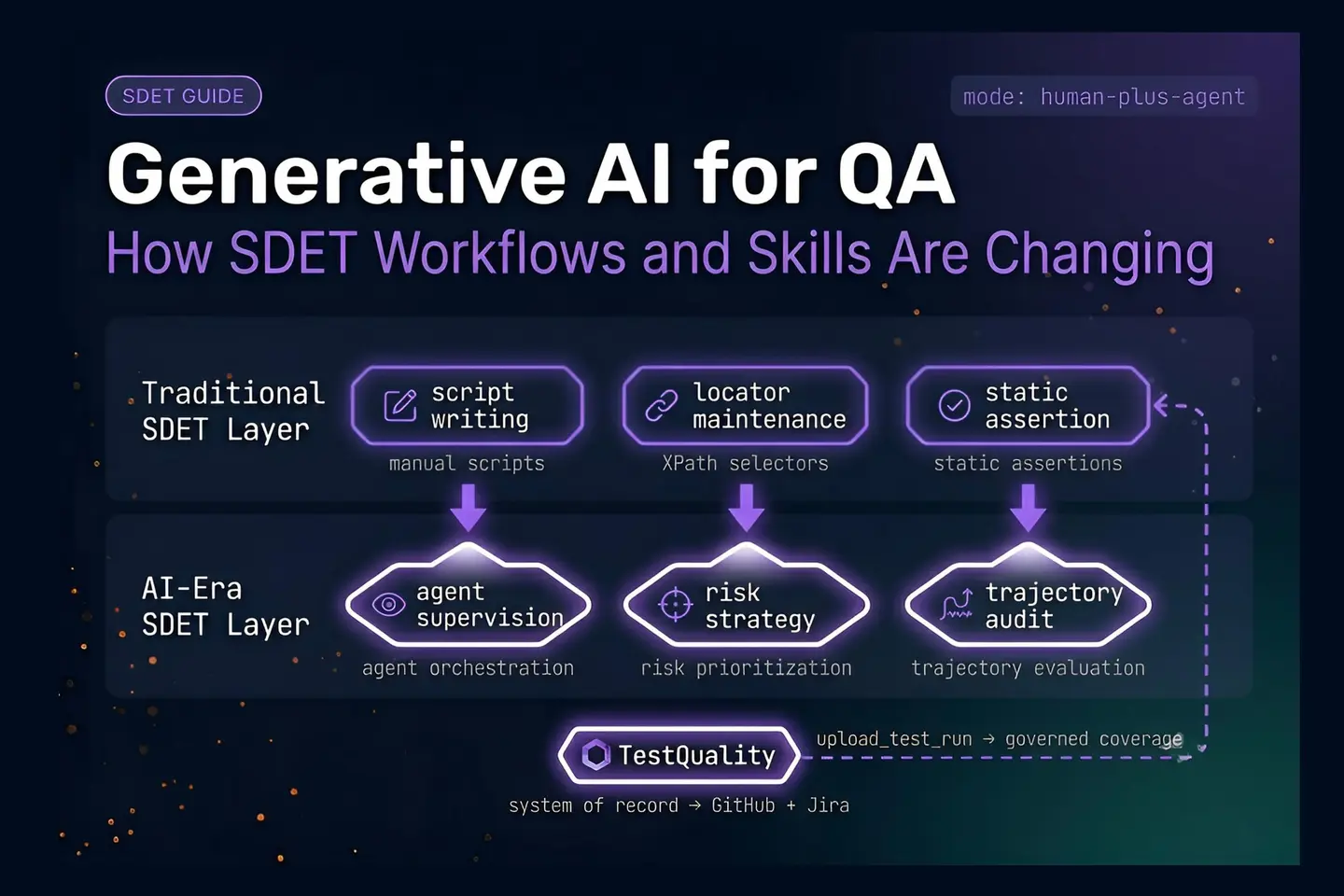
The comparison table below summarizes where SDET skills are migrating.
| Skill Area | Traditional SDET Focus | AI-Era SDET Focus |
|---|---|---|
| Test Creation | Manually writing step-by-step scripts from requirements | Prompting generation models and reviewing the logic of their output |
| Maintenance | Updating broken locators and hardcoded test data | Updating system prompts and agent behavioral constraints |
| Validation | Checking assertions against static expected results | Trajectory-level auditing of agent planning and tool selection |
| Architecture | Building monolithic test automation frameworks | Orchestrating multi-agent environments with governed handoff points |
| Strategy | Maximizing total test case count and coverage metrics | Risk-based prioritization, adversarial simulation, and coverage governance |
Which SDET skills become less relevant and why?
Manual test script composition and repetitive locator maintenance are losing strategic value. Because large language models can translate acceptance criteria into structured test steps within seconds, engineering time spent on mechanical script writing is increasingly misallocated. The model does this faster, and the SDET’s judgment is better deployed reviewing the output.
The most direct casualty is boilerplate automation code. Page object model scaffolding, standard setup and teardown methods, and positive-path Playwright or Selenium syntax are structurally predictable tasks, exactly the kind of work language models handle with acceptable accuracy. Organizations already using automated test case generation are not replacing their SDETs; they are redeploying them from production to review, which means engineers whose entire value proposition is script-writing speed will find that position commoditized.
Locator maintenance is the second pressure point. As agents increasingly interact with the DOM via accessibility trees and visual reasoning rather than hardcoded XPath or CSS selectors, the skill of manually tracking and repairing brittle element identifiers has a narrowing shelf life. This does not mean selectors disappear tomorrow — legacy codebases will need them for years — but it does mean SDET careers built entirely on locator management are not compounding in value.
The skills that remain durable are the ones that require genuine software engineering reasoning: understanding system integration risks, designing non-obvious test scenarios, and making tradeoff decisions about what coverage is worth the cost to maintain.
How do you evaluate AI-generated test cases before trusting them?
Reviewing AI-generated test cases requires checking for three failure modes: hallucinated features that do not exist in the application, missing negative and boundary paths, and expected results too vague to catch a real defect. Every generated scenario should be cross-referenced against actual acceptance criteria before it enters a test suite.
When working with AI test case generation tools, the first review gate is business alignment. Language models generate statistically plausible scenarios, which is not the same as generating scenarios that reflect how a specific user actually interacts with a specific product. It is common for outputs to emphasize happy paths, skip complex state transitions (such as session timeout mid-transaction), and produce expected results that are too broad to be useful as pass/fail criteria.
The second review gate is specificity. A generated expected result like “verify the user is logged in” must be hardened to something like “confirm the authentication token is present in session storage and the dashboard renders the user’s profile name within two seconds.” Vague assertions provide the appearance of coverage without the substance.
The third gate is prioritization. AI-generated suites treat all scenarios as equally important. The QA professional must manually tag critical-path tests, demote low-risk UI checks, and eliminate redundancy before any execution run begins. Removing this step means executing high volumes of tests that generate noise rather than signal — a false confidence problem that is arguably worse than insufficient coverage.
Try It Now
See Generative AI Test Case Generation in Practice
Paste any user story into TestStory.ai and watch the orchestration layer generate structured, Gherkin-formatted test cases instantly — covering happy paths, edge cases, and the failure scenarios your team would typically miss. No account required.
No credit card required.
What does a human-plus-agent QA workflow look like in practice?
In a human-plus-agent workflow, the SDET shifts from execution to supervision. Agents parse requirements, propose test strategies, and interact directly with the application under test. The human’s role is to review proposed trajectories before high-risk actions run, investigate anomalies the agents cannot resolve autonomously, and make the risk decisions that determine what gets approved for release.
In day-to-day terms, when a pull request opens, a specialized agent reads the code diff, identifies application areas likely to be affected, and triggers a sub-agent to draft targeted integration tests for those areas. The SDET receives a proposed test plan with the agent’s reasoning visible — they review the logic, adjust scope parameters if needed, and approve the execution phase. They are not passive observers; they are the judgment layer that determines whether the agent’s plan correctly models the risk.
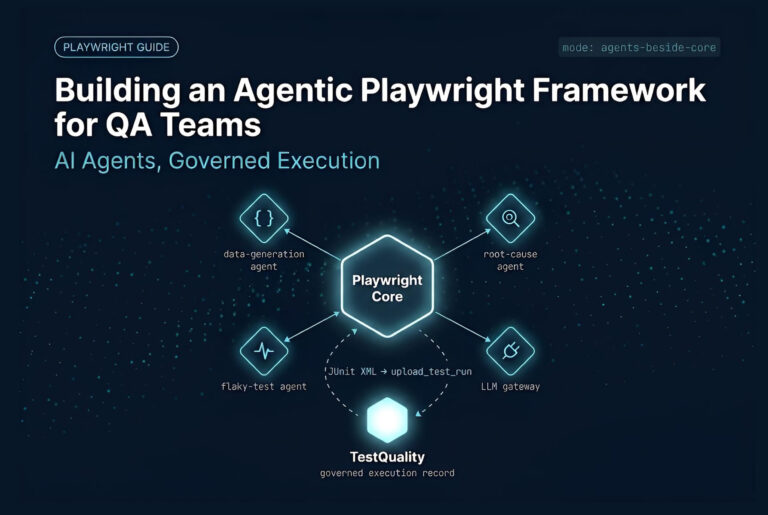
This is also where adversarial skills become essential. Independently, Paul writes in the Maxim AI Blog (“Multi-Agent System Reliability”) that QA engineers in autonomous QA environments must actively apply adversarial testing strategies (fuzzing, timing perturbation, and network partition simulations) to surface coordination failures that are unique to multi-agent systems. When multiple agents hand work to each other, failure modes are not individual test failures but emergent system behaviors: race conditions, incomplete state handoffs, and agents that fail silently rather than escalating.
The human role in this model is not to run more tests. It is to break the automated system deliberately and verify that it fails in a way the team can govern.
Where do test management and traceability fit when AI generates most of your test cases?
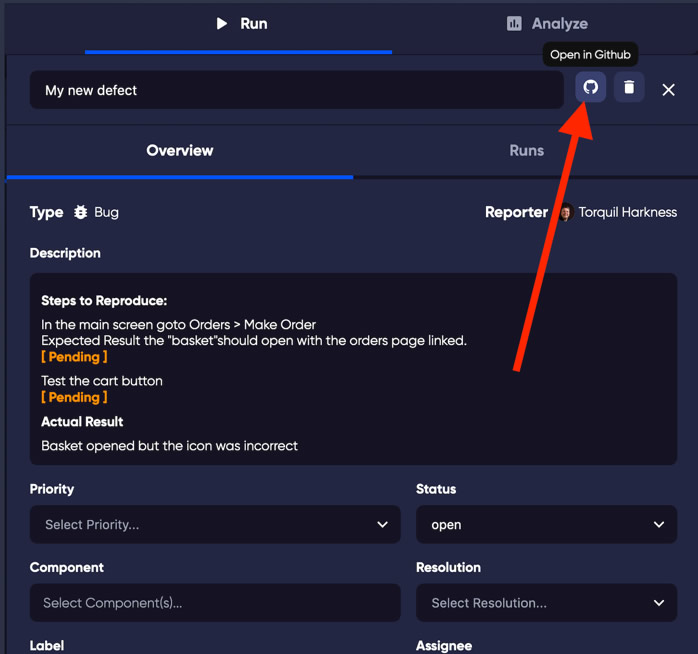
When AI increases artifact volume by an order of magnitude, a structured system of record stops being optional. Test management platforms organize AI-generated drafts, maintain version history, map scenarios to specific requirements, and preserve traceability by connecting test executions to defects in GitHub and Jira — without which high-volume generation creates unauditable noise rather than governed coverage.
The volume problem is real. A generation model can produce hundreds of test cases in minutes. Without a centralized platform to review, categorize, and execute that output, teams quickly lose visibility into what they have actually tested, which version of a scenario is current, and whether coverage maps to actual business requirements or to hallucinated features.
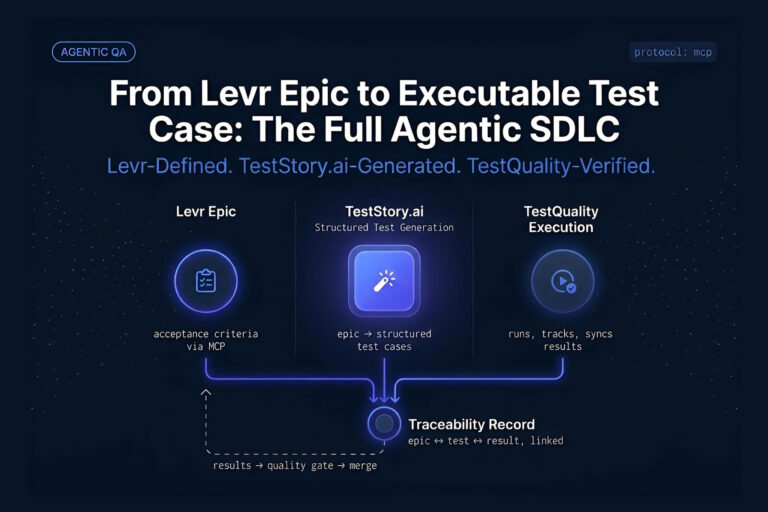
This is where TestQuality operates as the system of record. Once test cases are generated, they need a home that supports version control, run scheduling, and direct linkage to external trackers. Specifically: Playwright outputs JUnit XML results; the TestQuality CLI uploads those results into a named project and test cycle using the testquality upload_test_run command; run history and trend data populate automatically post-ingestion; and once a tester confirms a genuine defect, TestQuality’s GitHub and Jira integrations sync that defect record to the team’s tracker automatically.
The upstream generation layer is TestStory.ai, which produces structured test cases directly from project assets (user stories, epics, issues, source code, and repositories) and syncs them into TestQuality.
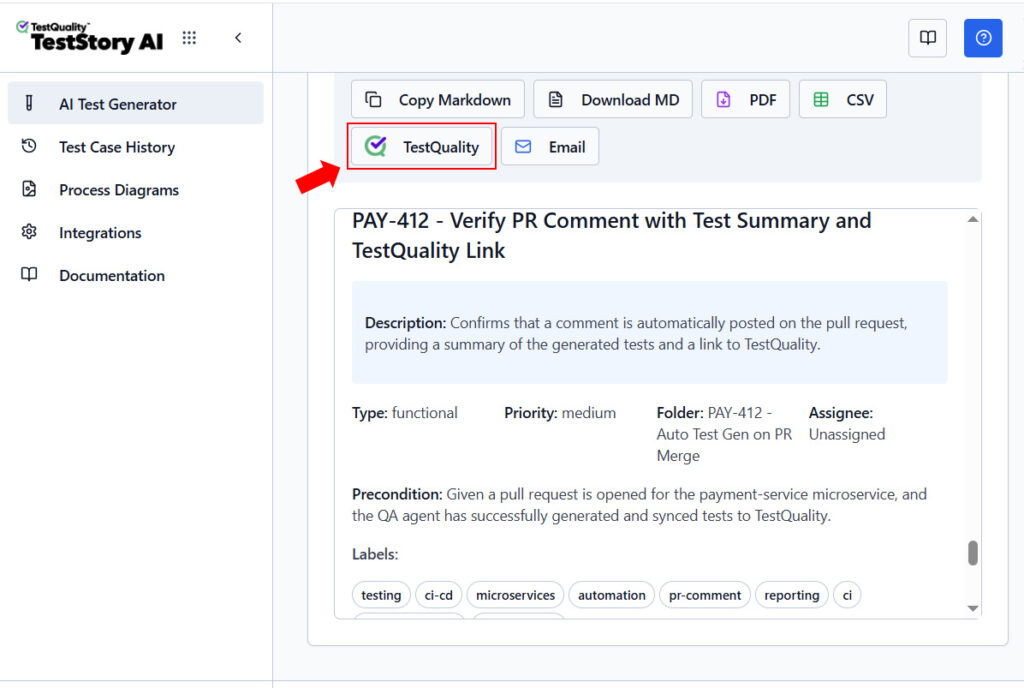
TestStory.ai also connects with MCP-compatible agentic tools including Cursor, Claude Code, VS Code with Copilot, and Roo, which means developers can generate tests from directly inside their IDE and have them route into TestQuality for formal governance. Using an AI test case generator for Jira workflow ensures every AI-proposed scenario is traceable to a business requirement before it influences a release decision.
This is the architecture distinction that matters for agentic QA: generation is fast, but traceability is what makes it trustworthy.
How should SDETs approach learning generative AI tools without losing core testing fundamentals?
SDETs should build AI skills in layers — starting with bounded generation tasks before progressing to workflow orchestration — and apply each layer to real projects rather than isolated demos. The core risk is not moving too slowly; it is learning tool mechanics without building the evaluation judgment that determines when those tools are safe to trust.
The first layer is artifact analysis: use language models to summarize complex requirements, extract scenarios from long documents, and flag gaps in acceptance criteria. This is low-risk and immediately valuable, and it builds the pattern-recognition skills needed to spot when a model is producing plausible-but-wrong output.
The second layer is supervised generation: draft test scenarios with AI assistance, then methodically review each output against actual product behavior. Paying close attention to what the model consistently misses (negative paths, state dependencies, integration edge cases) trains the critical review instinct that higher-autonomy workflows require.
The third layer is agent workflow design: experiment with building simple multi-step pipelines, focusing on how data passes between tasks and how the system handles failure. Reviewing AI test case generation tools at this stage is useful for understanding what the current generation of tools actually does versus what vendor marketing claims. Throughout all three layers, the foundational QA principles (risk analysis, boundary value thinking, traceability discipline), must remain the anchor. Generative AI is a mechanism for executing a testing strategy. It cannot replace the strategy.
Engineers approaching agentic QA as a discipline will find useful framing in the broader agentic SDLC guide, which covers how the human-plus-agent model applies across the full build-test-verify cycle.
Technical Deep Dive FAQ
What is generative AI for QA?
Generative AI for QA is the use of large language models to accelerate the creation and analysis of testing artifacts. Common applications include drafting initial test cases from user stories, extracting candidate scenarios from requirements documents, generating synthetic test data, and summarizing lengthy compliance or technical documentation. It acts as a drafting layer inside the testing lifecycle — one that requires human review and editorial judgment before any output is trusted as part of a governed test suite.
How do AI agents differ from generative AI in a testing context?
Generative AI responds to a single prompt with a single output — a list of test cases, a summary, a code snippet. AI agents operate across a workflow: they interpret a broader goal, decompose it into sub-tasks, interact with application interfaces, adapt their execution plan based on what they observe, and hand state between steps without human intervention at each transition. The distinction matters because enterprise QA requires multi-step coordination, not just isolated artifact generation.
Will generative AI replace QA engineers and SDETs?
No. Generative AI shifts what QA engineers do, not whether they are needed. Because language models lack genuine business context, risk judgment, and the ability to evaluate whether their own output is trustworthy, human QA professionals remain essential for reviewing generated artifacts, designing complex testing strategies, managing multi-agent pipelines, and making the tradeoff decisions that determine what gets approved for release. The role changes from artifact author to system overseer.
What are the most effective use cases for generative AI in QA right now?
The highest-confidence applications today are: extracting test scenarios from user stories and acceptance criteria, summarizing lengthy technical or compliance documentation, generating baseline automation code for well-defined positive paths, and producing diverse synthetic test data for edge-case coverage. These tasks share a common trait — they are structurally predictable, involve high volume, and benefit from speed rather than deep contextual judgment, which is where language models perform most reliably.
Why does workflow design matter more than prompt engineering for enterprise QA?
Prompt engineering produces isolated outputs that solve fragments of the testing process. Workflow design connects those fragments into a continuous, governed pipeline. Enterprise QA requires a coordinated sequence of actions: requirements analysis, scenario derivation, test suite organization, execution scheduling, defect linkage, and release reporting. A well-crafted prompt does not replace that chain. Designing the workflow that strings AI outputs into a coherent process is the engineering challenge that actually scales to production.
What are the main risks of relying on AI for test case generation?
The primary risks are: hallucinated features (the model describes application behavior that does not exist), missing negative and boundary test paths (models skew toward happy-path coverage), and expected results too vague to catch real failures. If AI-generated suites go unreviewed, teams end up executing high volumes of tests that create a false sense of coverage while leaving genuine application vulnerabilities untested. The volume itself becomes a liability — more tests producing less signal.
How do you integrate generative AI into an existing QA process without disrupting it?
Start with bounded, low-risk tasks: use AI to draft initial test scenarios from Jira tickets or user stories, then route those drafts through your existing review process before they enter a test cycle. Once the team develops review fluency, introduce agentic tools for repetitive execution tasks, with human approval gates on high-risk actions. The goal is not to replace the existing process immediately — it is to identify which steps benefit most from AI speed and which require human judgment to remain trustworthy.
What is trajectory-level evaluation and why do SDETs need to learn it?
Trajectory-level evaluation means reviewing not just the final output of an AI agent, but the reasoning steps, tool selections, and intermediate decisions the agent made to get there. An agent can reach a correct result via a reasoning path that would fail in a slightly different scenario — catching that requires understanding the agent’s decision logic, not just its conclusion. As agents take on more autonomous testing tasks, this auditing skill becomes the primary quality control mechanism for SDET practitioners.
Key Takeaways
What This Means for Your QA Career and Your Team
Generative AI is a drafting layer. Agent design is the engineering challenge.
Verification is the bottleneck: Stack Overflow’s 2025 survey found 45.2% of developers spend more time debugging AI-generated code than writing it — the productivity gain from generation is only realized if review discipline is applied.
Trajectory-level auditing is the new core skill: Reviewing an agent’s reasoning path — not just its final output — is now the primary quality control mechanism in autonomous QA pipelines.
Script writing is commoditized, architecture is not: Boilerplate automation code is a delegation target; multi-agent orchestration design, risk-based coverage strategy, and test data architecture retain durable SDET value.
Adversarial testing scales with agent adoption: Multi-agent systems introduce emergent failure modes — race conditions, silent handoff failures, incomplete state — that require deliberate chaos injection, not just traditional assertion checks.
Volume without traceability is a liability: AI can generate hundreds of test cases per sprint; without a system of record linking them to requirements, defects, and run history, high-volume generation creates auditable noise rather than governed coverage.
Layered learning protects fundamentals: Building AI skills from bounded generation tasks toward full agent orchestration — applying each layer to real projects — preserves the risk analysis and traceability judgment that no model currently replaces.
The SDETs who compound their value through this transition will not be the ones who adopted AI the fastest. They will be the ones who built the judgment to know when the agent is wrong.
Start Free Today
Transition from Script-Writing to Outcome-Orchestration
TestStory.ai generates structured test cases from your user stories, acceptance criteria, or architecture diagrams — then syncs them directly into TestQuality for execution, tracking, and team collaboration. Stop managing the volume problem manually; let the generation layer handle drafts while your team governs what ships.
✦ Get 500 TestStory.ai credits every month included with your TestQuality subscription — no extra cost.
No credit card required on either platform.