Automation testing tools are the quality engine of a modern DevOps pipeline, and picking the right mix decides whether you ship fast or ship broken.
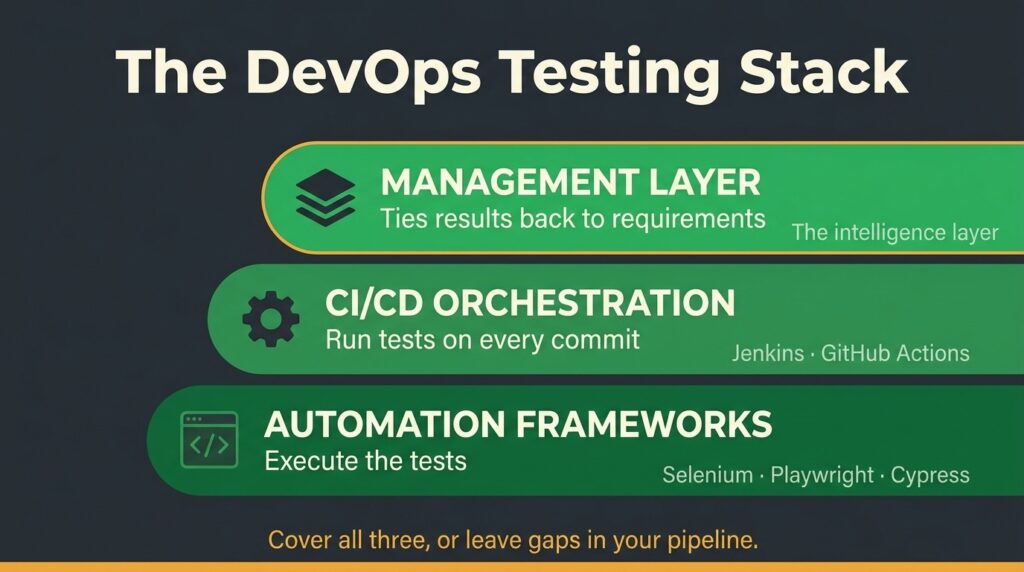
- Frameworks, CI, and management are three different layers. Selenium, Playwright, and Cypress execute tests; Jenkins and GitHub Actions orchestrate them; a test management layer ties results back to requirements.
- PLG tools let you start for free today. Open-source frameworks and free-tier CI cover most of a small team's needs before a single invoice.
- Enterprise platforms buy scale and governance. Self-managed CI, low-code coverage, and massive cloud device grids matter once you're testing across dozens of environments.
- AI changed the 2026 stack. Test generation, self-healing, and QA Agents are now table stakes, not novelties.
Don't chase the longest feature list. Build the smallest stack that covers every stage of your pipeline, then let automation do the boring work.
Shipping code multiple times a day sounds great until a broken build slips into production. Automation testing tools close that gap inside a DevOps pipeline. They run checks on every commit so your team catches regressions before users do. The fastest teams already treat automation software testing as non-negotiable, and the pressure is climbing. DevOps research shows AI is pushing more code into pipelines than teams can manually review, which raises the risk of every release and makes automated quality checks a survival requirement. This 2026 edition breaks down the tools worth your attention, split into free, product-led picks you can start today and enterprise platforms built for scale.
What Makes Automation Testing Tools Essential for DevOps Pipelines in 2026?
DevOps rewired how software moves from a developer's laptop to production. When you're deploying daily or hourly, the old model of tossing a build over the wall for a week of manual QA instantly falls apart. Test automation fills that hole by automatically validating every change, giving developers feedback in minutes instead of days. If you're still nailing down what test automation software actually is, this primer is a solid starting point before you pick tools.
The demand shows up in the numbers too, with the automation testing market projected to reach roughly $92 billion by 2030 at a 17.3% growth rate, driven largely by teams wiring quality gates into CI/CD.
The trap most teams fall into is treating "automation testing tools" as one shopping list. In reality, a healthy pipeline runs different kinds of checks at different stages, and each stage calls for a different category of tool. Mapping tools to pipeline stages keeps you from stacking redundant products or leaving gaps where bugs sneak through.
Here's a simple way to think about where each category earns its place in the pipeline:
| Pipeline stage | What you're testing | Tool category |
| Commit / pre-merge | Unit and fast component checks | Unit frameworks, linters |
| Build / integration | API and integration behavior | API tools, CI orchestration |
| Pre-release | End-to-end and cross-browser flows | UI automation frameworks, cloud grids |
| Every stage | Traceability, results, reporting | Test management and orchestration layer |
Notice that last row. Execution and orchestration tools generate a flood of results, and without a layer that unifies them against your requirements, you're left stitching pass/fail data together by hand. That's a theme we'll come back to.
How Do You Choose Automated Testing Tools for Your Pipeline?
Before comparing logos, get honest about your constraints. Your language stack, team skill level, release cadence, and budget matter more than any "best tool" ranking, and the right choice for a five-person startup rarely matches what a 200-engineer org needs. If you want deeper insights, our guide on how to choose a test automation framework walks through the technical criteria in detail.
A few filters cut through the noise:
- CI/CD integration depth. If a tool needs custom glue code to run in your pipeline, it'll rot. Look for native plugins for Jenkins, GitHub Actions, GitLab CI, and CircleCI.
- Language and framework fit. The best automation software testing setup speaks your team's language, whether that's Java, Python, TypeScript, or C#.
- Pricing model. Product-led tools let you start for free and expand; enterprise platforms charge upfront but deliver governance and scale.
- A home for results. Frameworks execute, but you still need one place where manual and automated results live with traceability back to requirements.
Build your shortlist by focusing on those four angles front he start.
Which Are the Top Automation Testing Tools for DevOps Pipelines?
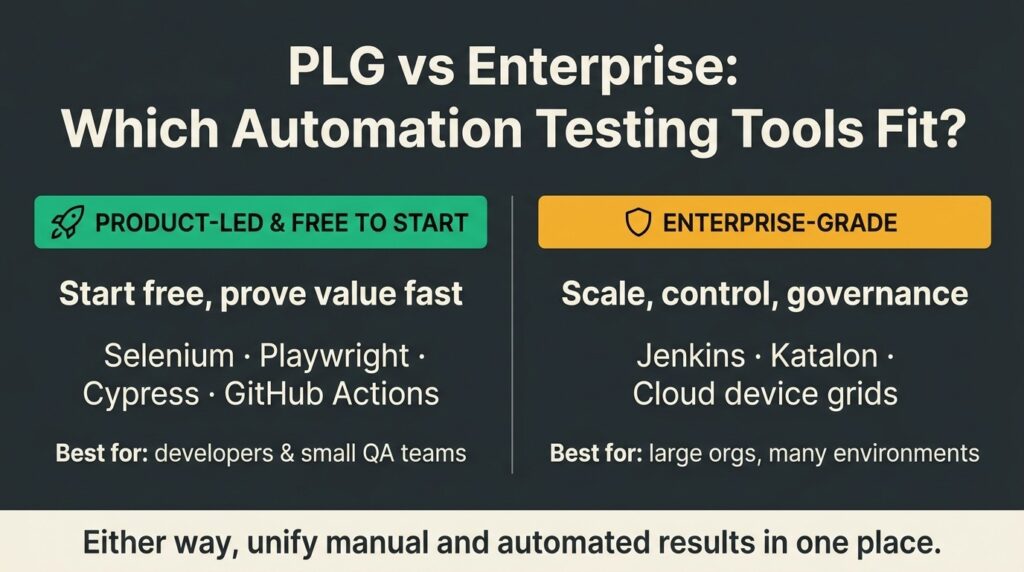
We've grouped the picks by how teams adopt them. The first group is product-led and free to start, ideal for developers and small QA teams who want to prove value before spending a dollar. The second is enterprise-grade, built for organizations testing across many environments with heavier governance needs. Mobile-heavy teams should also keep Appium in mind, since it extends this same open-source approach to native and hybrid apps.
Product-Led and Free-to-Start Automation Testing Tools
These tools let you clone a repo, write a test, and wire it into your pipeline the same afternoon. No procurement, no sales call.
Selenium remains the open-source workhorse of web test automation. It supports Java, Python, C#, Ruby, and JavaScript, runs across every major browser, and plugs into Jenkins and GitHub Actions with ease. Selenium Grid handles parallel execution when suites grow, though teams do pay for that flexibility with more driver management and flakiness than newer tools.
Playwright is the framework most new projects reach for in 2026. Built by Microsoft, it delivers fast execution, built-in auto-waits that kill a whole class of flaky failures, and a single API across Chromium, Firefox, and WebKit. Its adoption has exploded because it integrates cleanly with every major CI platform out of the box. If you're weighing options, our Playwright versus Selenium breakdown digs into the tradeoffs.
Cypress wins developer hearts with its debugging experience. Time-travel snapshots, real-time reloads, and clear error messages make it a favorite for JavaScript and TypeScript teams building single-page apps. It's UI-focused rather than a full-stack solution, but for frontend confidence, it's hard to beat.
GitHub Actions is the orchestration layer that lives inside your repo. Workflows trigger on pushes, pull requests, and releases, so tests run automatically without a separate CI server to babysit. A marketplace of thousands of reusable actions and a generous free tier make it the default starting point for teams already on GitHub, and it's widely adopted across professional development teams.
TestQuality sits at the management and orchestration layer that ties the tools above together. It's built around native GitHub integration and real-time, bidirectional Jira sync, so test results link straight to issues and pull requests for shift-left workflows. Its integration engine ingests automated results from Selenium, Playwright, Cypress, Jenkins, and GitHub Actions through a flexible CLI and REST API, and its active test plans turn planning documents into a living system that drives execution. On the AI side, its TestStory.ai capability uses QA Agents to generate test cases from requirements and automatically analyze results. A free test plan builder plus a 14-day trial with no credit card makes it easy to try before scaling.
Enterprise-Grade Automation Testing Software
Once you're coordinating testing across many teams, browsers, and compliance requirements, the calculus shifts toward scale, control, and support. This is where heavier automation testing software earns its price tag.
Jenkins is the self-managed backbone of countless enterprise pipelines. With more than 1,800 plugins, it integrates with nearly anything and gives you total control over the build environment, which regulated industries often require. The cost is operational: you own the servers, upgrades, scaling, and security. For teams wiring automation into Jenkins, our post on test automation in CI/CD covers the rollout patterns that keep pipelines fast.
Katalon offers a low-code path to automation across web, mobile, API, and desktop testing in one platform. Its record-and-playback and AI-assisted features lower the barrier for teams with mixed skill levels, and it scales into enterprise-grade reporting and orchestration. It's a strong fit when you need broad coverage without staffing a large framework-engineering team.
Sauce Labs solves the environment problem. Its cloud grid runs your tests against thousands of real browser, device, and operating-system combinations in parallel, which is exactly what you need when "works on my machine" isn't good enough. It integrates with the major CI systems and pairs naturally with frameworks like Selenium and Playwright, so you keep your existing scripts while gaining massive execution scale.

What Role Does AI and Autonomous Testing Play in the 2026 Stack?
The biggest shift is the arrival of AI across the testing lifecycle. A large share of code is now written or heavily assisted by AI coding agents, and manual QA simply can't verify that volume fast enough. The bottleneck moved from writing code to trusting it.
Three AI capabilities are reshaping how teams evaluate automation testing tools. First, AI test generation turns requirements, user stories, and Gherkin scenarios into runnable cases in seconds, which you can explore with a free AI test case builder. Second, self-healing scripts automatically adjust to minor UI changes, cutting the maintenance burden that sinks so many automation efforts. Third, and most important, modern test management is moving from a passive repository to an active intelligence layer, where QA Agents proactively suggest tests, flag coverage gaps, and orchestrate execution across the pipeline.
Frequently Asked Questions
What's the difference between an automation framework and a CI/CD tool? A framework like Selenium or Playwright is the engine that actually runs your tests. A CI/CD tool like Jenkins or GitHub Actions schedules those tests, triggers them on code events, and gates deployments based on results. They work together rather than replacing each other, and most pipelines need both, plus a management layer to make sense of the output.
Which automation testing tools are best for small teams? Start product-led. Pair an open-source framework that matches your stack (Playwright for most new web projects, Cypress for JavaScript frontends) with GitHub Actions for CI and a free test plan builder for organization. You can cover the essentials without any upfront spend and add enterprise tooling later.
Do I still need a test management tool if I already use Selenium and Jenkins? Usually yes. Frameworks and CI generate results, but they don't unify manual and automated testing, tie results to requirements, or give you traceability across a project. A management and orchestration layer turns scattered pass/fail data into a clear picture of quality.
Are free automation testing tools good enough for production pipelines? Absolutely. Selenium, Playwright, Cypress, and free-tier CI run in serious production pipelines every day. The upgrade to paid platforms is usually about scale, cross-environment coverage, governance, and support rather than raw capability.
Ship Faster Without Breaking Things
The winning move in 2026 is to assemble a lean stack where frameworks execute, CI orchestrates, and an intelligent layer ties it all back to your requirements so nothing falls through the cracks. With the right architecture, your pipeline becomes a genuine quality gate instead of a checkbox that teams learn to ignore.
As an AI-powered QA platform, TestQuality unifies your manual and automated results, syncs in real time with GitHub and Jira, and puts QA Agents and TestStory.ai to work generating and maintaining tests for both human-written and AI-generated code. Start your free TestQuality trial and give your DevOps pipeline the quality engine it deserves.