Key Takeaways
Picking the wrong test automation framework is a decision that compounds over time. Choose based on your team's stack, not industry hype.
- Selenium, Cypress, and Playwright each serve distinct team profiles; matching the framework to your language proficiency and application type is more important than following popularity trends.
- CI/CD integration requirements, parallel execution needs, and BDD/Gherkin support are the three technical criteria that most consistently separate a good framework fit from a costly mismatch.
- Agile teams benefit from lightweight, developer-friendly frameworks with fast feedback loops; enterprise environments demand scalability, multi-language support, and governance-friendly reporting.
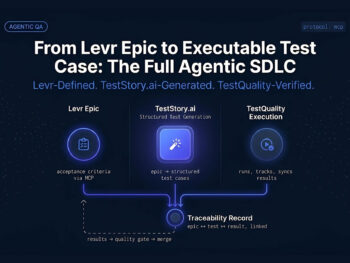
- AI-driven test management and agentic workflows are reshaping how teams approach framework selection. By generating tests automatically using context from Jira issues or GitHub defects, teams drastically reduce the overhead of writing and maintaining tests, regardless of which framework they choose.
Before committing to any framework, run a proof of concept against your actual CI/CD pipeline, not a demo environment.
Choosing a test automation framework used to feel like picking a car: there were a few obvious options, most people picked the most popular one, and you lived with the consequences. In 2026, the landscape looks more like a fleet decision. You have more specialized tools, higher stakes, and a pipeline that breaks badly if you get the fit wrong.
According to the 2024 Stack Overflow Developer Survey, 76% of developers are using or planning to use AI tools in their workflow. That shift is rippling into how QA teams think about automation testing software: what they automate, how they structure their entire testing architecture, and how that architecture holds up at speed. Framework selection is no longer a set-it-and-forget-it decision. It directly affects deployment frequency, test reliability, and how fast your team can respond when something breaks in production.
This guide gives you a clear, criteria-based approach to making the right call for your team's specific context in 2026, whether you're scaling up a CI/CD pipeline, getting started with test automation software, transitioning from manual testing, or evaluating whether your current stack still makes sense.
What Is a Test Automation Framework, and Why Does Your Choice Matter?
When teams ask how to choose the right test automation framework, the first step is understanding what one actually is. It's the architectural system that governs how your tests are written, organized, executed, and maintained over time. It sets the rules for coding standards, test data handling, reporting, and how results feed back into your development workflow.
The distinction matters because teams often conflate frameworks with tools. Selenium is a browser automation engine. Playwright is a testing framework. Cypress blurs both lines. Understanding what layer you're choosing at helps you avoid stacking redundant solutions or leaving critical gaps, especially around reporting and CI/CD integration.
The downstream impact of a poor framework choice is significant. Teams commonly report that a 500-test suite in the wrong framework can take two to four engineer weeks to migrate. A 1,000-test Selenium suite takes longer still. The wrong choice at 50 tests becomes an expensive technical debt problem at 500. That's why knowing how to choose the right test automation framework before you build out your suite is worth the upfront analysis time.
What Types of Test Automation Frameworks Should You Know?
Before comparing specific tools, it helps to understand the structural types of frameworks that exist across the industry. Most modern implementations blend several of these together.
Linear (record-and-playback) frameworks are quick to spin up but produce brittle tests that break with minor UI changes. They're useful for quick validation, not scalable automation.
Modular frameworks divide the application under test into independent, reusable modules. Each module has its own test scripts, which reduces dependencies and makes maintenance more targeted.
Data-driven frameworks separate test logic from test data, letting you run the same scenario with dozens of input variations without duplicating code. This is the right approach for login flows, form validation, and any test that benefits from parameterization.
Keyword-driven frameworks use action keywords to define test steps, making it easier for non-developers to contribute to the test suite. Robot Framework is the most prominent example in this category.
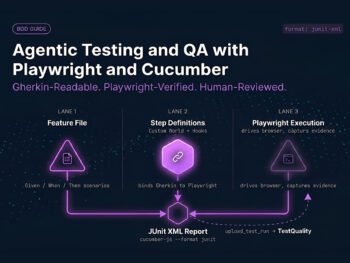
BDD frameworks use Gherkin syntax to write test scenarios in plain English, bridging the communication gap between business stakeholders and engineering teams. Cucumber, SpecFlow, and Behave are the most common execution engines. If your team is already doing Behavior-Driven Development with Gherkin, a BDD framework adds significant value by turning acceptance criteria directly into executable tests. Modern AI-powered test management tools enhance this workflow by allowing QA agents to auto-generate these BDD/Gherkin scenarios straight from your user stories.
Hybrid frameworks combine multiple approaches, typically data-driven logic within a modular structure. In 2026, hybrid is effectively the default for teams with mature automation practices, since no single approach handles all application layers equally well.
How Do You Choose the Right Test Automation Framework for Agile Teams?
Agile teams have a specific set of priorities that should drive framework selection: fast feedback, low maintenance overhead, and tight integration with the developer workflow. Selecting the right test automation tools for this context means prioritizing frameworks that run in-process, provide clear debugging output, and connect directly to your version control events.
For web application testing in an agile context, the two frameworks that consistently surface as best fits are Cypress and Playwright. Both offer in-browser or near-browser execution that eliminates many of the timing issues that plague older WebDriver-based approaches. Cypress is particularly attractive for JavaScript-heavy teams because of its developer experience: real-time reloading, time-travel debugging, and automatic waiting reduce the friction of writing and fixing tests.
Playwright has gained significant ground as the preferred framework for new projects. Its support for Chromium, WebKit, and Firefox in a single API is a meaningful advantage for teams that need cross-browser coverage without managing separate configurations. Python and TypeScript are both well-supported, which broadens its appeal beyond JavaScript-only teams.
The key agile-specific criteria to evaluate:
- Feedback speed: How quickly does the framework return results after a commit? Slow feedback loops kill agile velocity.
- Developer adoption curve: If developers won't write tests, the framework doesn't matter. Choose something your team will actually use.
- Integration with your version control: A framework that surfaces results directly in GitHub pull requests has a meaningful advantage for shift-left testing workflows.
If your team is comparing Playwright and Cypress in detail, the decision usually comes down to language preference and cross-browser requirements.
What About Enterprise and Large-Scale Testing Needs?
Enterprise environments introduce variables that simply don't exist at the small team level: multi-language codebases, multiple application types, compliance and audit requirements, and test suites that may span hundreds of thousands of cases. Teams trying to figure out how to choose the right test automation framework at enterprise scale face a different set of tradeoffs than a startup team of five engineers.
Selenium remains the enterprise anchor. Its W3C-standard WebDriver API and multi-language support give it long-term stability guarantees that matter for multi-year platform decisions, and its existing footprint in large organizations is vast. For enterprises with significant Selenium investment, the practical move is to preserve it for established test suites and route new projects toward Playwright or Cypress rather than attempting a wholesale migration.
Robot Framework deserves mention for enterprise contexts where non-technical team members are expected to write or review tests. Its keyword-driven syntax produces human-readable test cases and its library ecosystem is broad enough to cover web, API, and desktop testing in a single framework.
| Framework | Best For | Language Support | Cross-Browser | BDD Support | CI/CD Fit |
|---|---|---|---|---|---|
| Selenium | Enterprise, multi-language stacks | Java, Python, C#, JS, Ruby | Excellent | Via Cucumber | Good (manual setup) |
| Playwright | Modern web, cross-browser, agile | JS/TS, Python, Java, C# | Excellent | Via Cucumber | Excellent (built-in) |
| Cypress | JS-first teams, fast feedback | JS/TS only | Chromium-primary | Via Cucumber | Excellent |
| Robot Framework | Non-dev contributors, keyword-driven | Python | Good | Built-in | Good |
| Cucumber/BDD | BDD workflows, acceptance testing | Multiple | Via Selenium/Playwright | Native | Good |
Selenium vs. Cypress vs. Playwright: Which Framework Fits Your Team?
This is the comparison most teams are actually trying to make when they search for guidance on how to choose the right test automation framework. Here's the honest breakdown.
When Should You Choose Selenium?
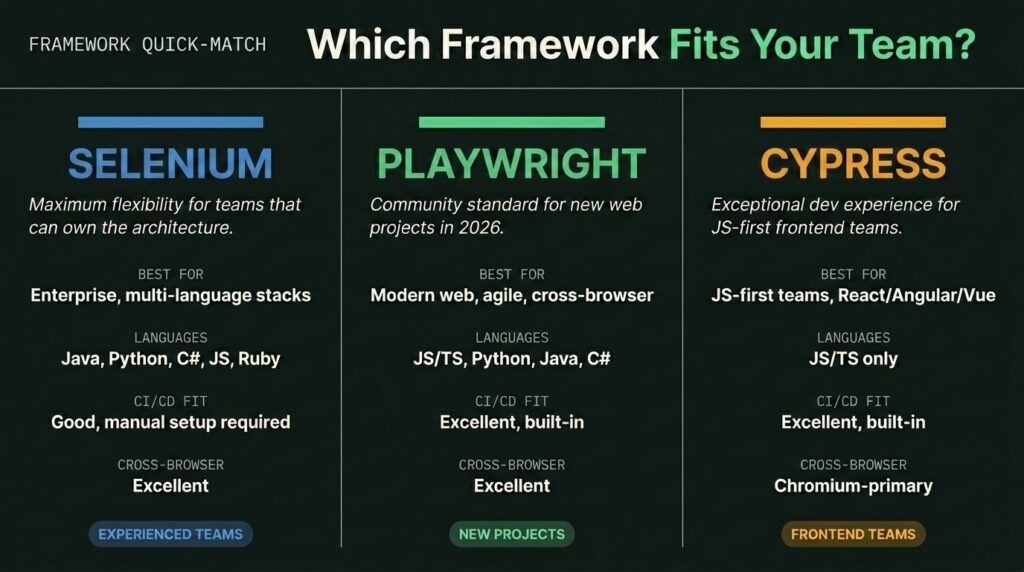
Selenium is the right choice when you need maximum flexibility and have the engineering discipline to build your own framework architecture around it. It doesn't prescribe how you structure tests, manage data, or generate reports. That's a feature for experienced teams and a significant liability for everyone else. If your team works primarily in Java, has a large existing test suite in Selenium, or needs to test on browsers that other frameworks don't support, staying with Selenium is often the pragmatic choice.
When Should You Choose Playwright?
Playwright has become the community standard recommendation for new projects. It covers all major browsers in a single API, supports multiple languages including Python and TypeScript, and integrates cleanly with every major CI/CD platform without additional configuration. The parallel execution is built in, and the tooling around trace viewing and debugging has matured considerably. For teams starting fresh or evaluating Playwright for regression testing, it's the highest-value starting point in 2026.
When Should You Choose Cypress?
Cypress earns its place for JavaScript and TypeScript teams building modern frontend applications, particularly those using React, Angular, or Vue. The developer experience is genuinely exceptional. The dashboard, the time-travel debugger, and the tight integration with the JavaScript ecosystem make it easy for developers to own test creation alongside feature work. The limitations, primarily JavaScript-only and Chromium-primary browser support, are real, but they're non-issues for teams that fit the profile.
How Does CI/CD Integration Factor Into Your Framework Decision?
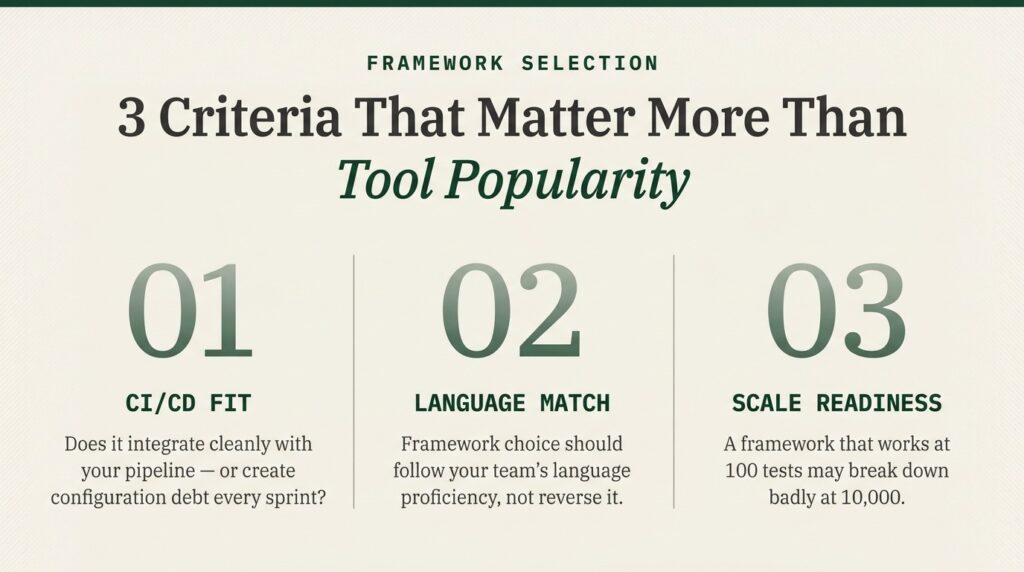
CI/CD fit is a core selection criterion, not a nice-to-have. A framework that runs beautifully on a developer's machine but creates configuration headaches in your pipeline will accumulate technical debt every sprint.
The key questions to ask when evaluating any test automation framework against your CI/CD environment:
- Does it produce test results in a standard format (JUnit XML, JSON) that your test management platform can consume automatically?
- Does it support parallel execution natively, or does parallelization require third-party plugins and additional configuration?
- How does it handle browser binaries and dependencies in a containerized CI environment?
Playwright and Cypress both handle CI/CD integration with minimal friction out of the box. Selenium in CI environments typically requires managing browser drivers, configuring grids for parallel execution, and handling more infrastructure overhead. That overhead is manageable at enterprise scale with dedicated DevOps support, but it's a real burden for smaller teams.
The test automation tools DevOps guide covers the distinction between automation frameworks and CI/CD orchestration platforms (Jenkins, GitHub Actions, CircleCI) in more depth. Understanding that separation prevents one of the most common mistakes in framework evaluation: conflating what executes the tests with what schedules and reports on them.
What Role Does AI Play in Modern Framework Selection?
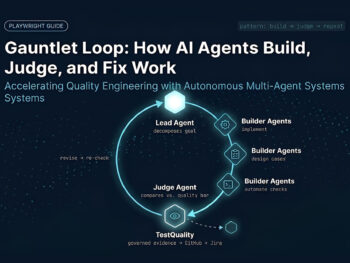
AI is changing the framework selection calculus in ways worth paying attention to. The most immediate impact is on test creation. By leveraging powerful QA agents, teams can now produce Gherkin scenarios, test cases, and automation scripts automatically. These agentic workflows pull context directly from test stories, Jira issues, or GitHub defects, generating comprehensive software testing coverage in a fraction of the time traditional authoring requires , accelerating software quality for both human and AI-generated code. This reduces the maintenance burden argument that has historically driven teams toward simpler, lower-overhead frameworks.
The second impact is self-healing tests. Frameworks and test management platforms are increasingly using AI to detect when a UI element has changed and update test selectors automatically, rather than flagging a test failure for manual investigation. This capability is most valuable in fast-moving frontends where locators break regularly.
The third impact is on the decision itself. Teams that previously chose simpler frameworks to reduce the cognitive load of test writing now have more headroom to adopt more capable frameworks, because AI handles a significant portion of the initial scaffolding.
This is why knowing how to choose the right test automation framework in 2026 means evaluating AI compatibility alongside language support and CI/CD fit. The question has shifted from "which framework is easiest to write?" to "which framework integrates best with the AI tooling that makes writing easier?"
A platform that can generate test cases from requirements automatically and output them in BDD format gives teams a structural advantage, regardless of which underlying framework they've standardized on.

7 Questions to Ask Before Choosing a Test Automation Framework
Before committing to any framework, run through these questions with your team. The answers will narrow the field quickly.
- What language does your team write in? Framework choice should follow language proficiency, not reverse it. A Python-first team should start with Playwright (Python) or pytest, not Cypress.
- What type of application are you testing? Web UI, mobile, API, desktop, and microservices all have different framework requirements. Not all test automation tools cover all application types, and stacking the wrong tools for your layer creates maintenance overhead fast.
- How frequently are you deploying? Teams releasing multiple times per day need a framework with minimal CI setup friction and clean parallel execution. If your deployment cadence is slower, a heavier setup is more tolerable.
- Do you have non-developers contributing to testing? If yes, a keyword-driven framework like Robot Framework, or a BDD framework with Gherkin syntax, reduces the barrier to contribution.
- What does your CI/CD stack look like? Some frameworks integrate seamlessly; others require significant configuration investment. Validate against your actual pipeline, not a vendor demo.
- How large will your test suite become? A framework that works at 100 tests may create serious maintenance problems at 10,000. Evaluate scalability and parallel execution before you hit that wall.
- What does test reporting look like? Knowing which tests passed or failed is table stakes. Understanding trends, flakiness rates, and coverage gaps requires a test management layer that aggregates results from your framework.
Frequently Asked Questions
What is the most popular test automation framework in 2026? There's no universal answer. It depends on your application type and stack. Playwright is the current community recommendation for new web projects. Selenium holds the largest installed base in enterprises. Cypress leads in JavaScript-first development teams. For mobile, Appium is the standard. The full breakdown with decision criteria is covered in the Selenium vs. Cypress vs. Playwright section above.
How long does it take to switch test automation frameworks? Migrating a suite of around 500 tests from one framework to another typically takes two to four engineer weeks, based on widely-reported community estimates. A 1,000-test Selenium migration takes considerably longer. The practical implication is that framework selection is a significant commitment, and the cost of a wrong choice compounds as your suite grows. This is why running a proof of concept against your actual pipeline, before committing, is strongly recommended.
Can you use multiple test automation frameworks in the same project? Yes, and this is increasingly the norm for mature engineering teams. A common pattern is to use Playwright or Cypress for end-to-end browser tests, Jest or pytest for unit testing, and a dedicated API testing tool for service-layer validation. The key is ensuring all frameworks produce results in a format that your test management platform can aggregate, so you maintain a single source of quality truth across your entire testing strategy.
What's the difference between a test automation framework and automation testing software? A test automation framework is the structural layer that defines how tests are written, organized, and executed. Automation testing software is a broader category that includes frameworks, test management platforms, CI/CD orchestration tools, and test reporting tools. Most teams use all of these together. Choosing a framework without considering how it fits into your broader automation testing software ecosystem is one of the most common mistakes in QA tooling decisions.
How does BDD/Gherkin affect framework selection? If your team is using Behavior-Driven Development, framework selection should account for native BDD support or first-class integration with Cucumber, SpecFlow, or Behave. Gherkin-format test scenarios are human-readable enough for business stakeholders to review, and they integrate well with test management platforms that support traceability from requirements to test results. BDD adds a layer of collaboration value that compensates for its additional tooling overhead in most cross-functional team contexts.
Stop Choosing Frameworks in Isolation: Start With Your AI-Powered QA Platform
Knowing how to choose the right test automation framework is only part of the problem. The other part is what happens after you choose: managing the results, tracking coverage, connecting test outcomes to requirements, and maintaining visibility across automated and manual tests in a single workflow.
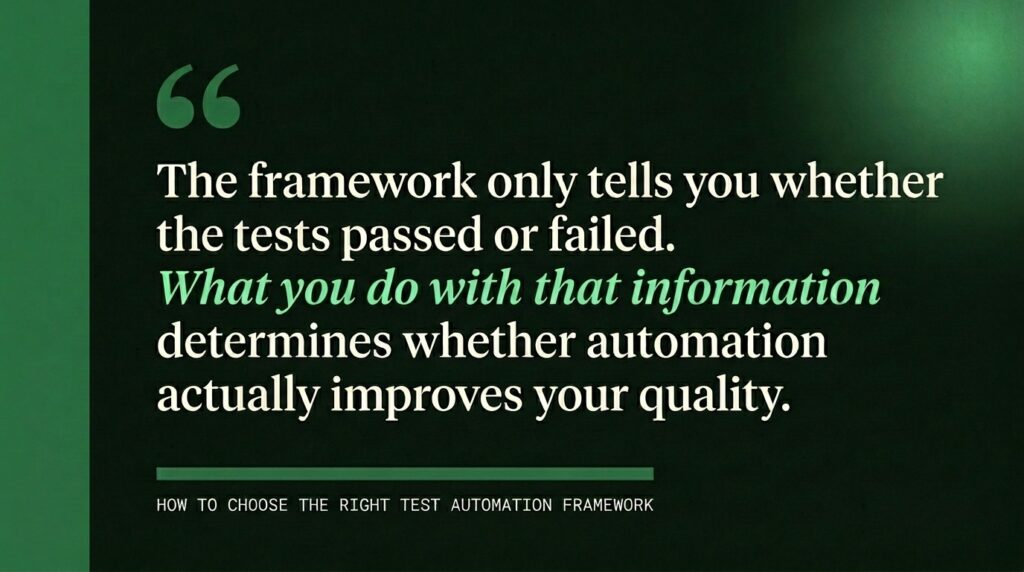
Framework selection matters. But the framework only tells you whether the tests passed or failed. What you do with that information, how you track it over releases, connect it to user stories, and feed it back into your development process, determines whether automation actually improves your quality or just generates a lot of data nobody acts on.
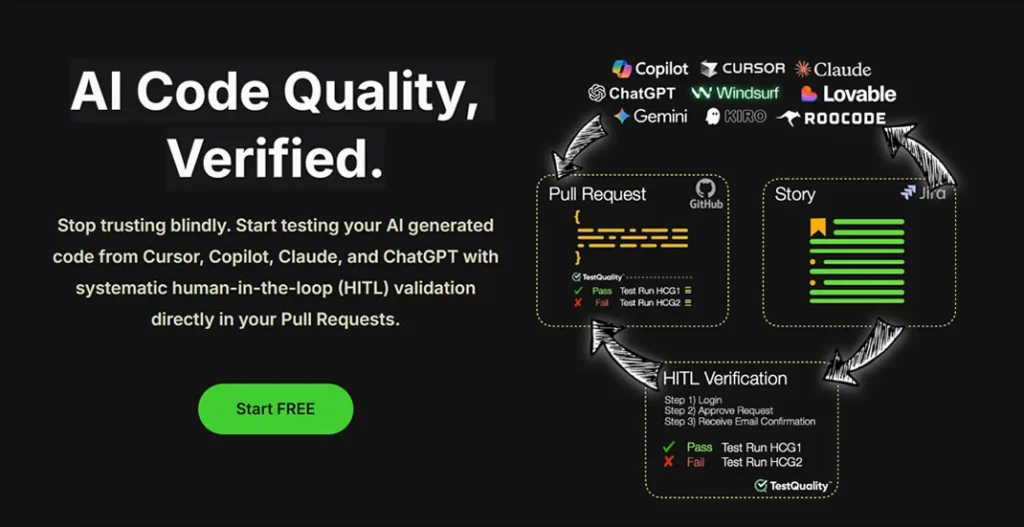
TestQuality is an AI-powered test management platform built for exactly this workflow. You can leverage TestQuality’s powerful QA agents to create and run test cases, and analyze test results automatically from a chat interface or your agentic workflows—accelerating software quality for both human and AI-generated code, 24/7.
It integrates natively with GitHub and Jira, pulling in results from Selenium, Playwright, Cypress, and virtually every other framework into a unified view. Furthermore, with TestStory.ai, our free test case builder, you can instantly generate comprehensive test cases and BDD/Gherkin scenarios using direct context from your test stories, Jira issues, or GitHub defects.
Start your free trial to bring your automation framework results and AI-driven testing under one intelligent layer.