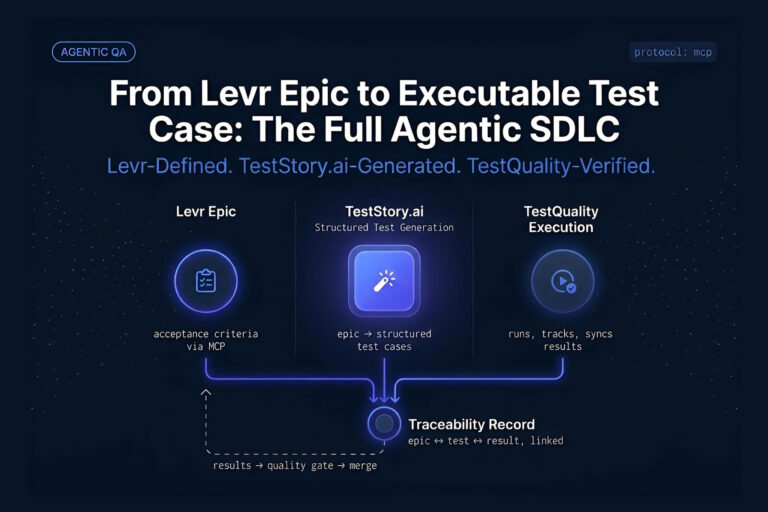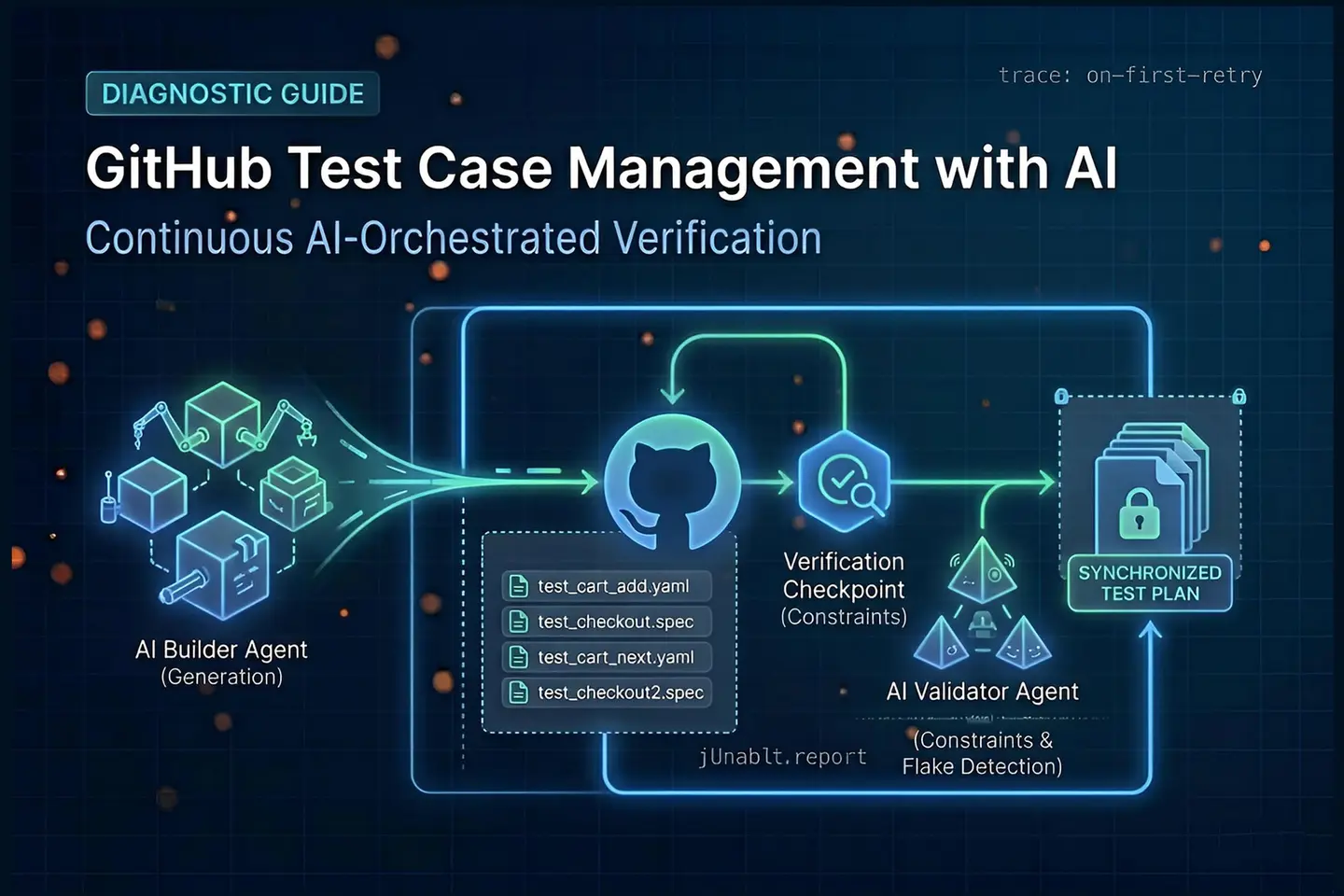
Key Takeaways
The Delivery Gap Is Where Quality Is Won or Lost
Agentic test management is the bridge between AI-generated code and production-ready software.
The productivity paradox is real: Code throughput is up 59% year-over-year, but main-branch success rates fell to a five-year low of 70.8% in CircleCI’s 2026 report.
Most teams aren’t there yet: JetBrains’ 2025 survey found 73% of teams are not using AI in CI/CD, citing cost and security concerns.
Agentic CI changes the building blocks: MCP servers, pipeline triggers, and sandboxed execution let agents act on repositories without bypassing human review.
“The organizations that will succeed are not the ones writing the most code, but those whose delivery systems can process the most change without breaking.” — Thoughtworks
GitHub test case management with AI is the practice of orchestrating test case authoring, execution, and triage through agentic workflows that live inside the GitHub ecosystem — pull requests, status checks, Actions, and the repository itself. It pairs an AI agent that generates and maintains test cases with a test management layer that links those cases to commits, PRs, and merge gates. The goal is closing the delivery gap: the widening distance between how fast AI writes code and how fast pipelines can validate it.
That gap is the central problem of 2026. There is a real tension in the data. JetBrains’ 2025 developer survey reports that 73% of teams are not using AI in their CI/CD pipelines, citing cost and security concerns. At the same time, CircleCI’s 2026 State of Software Delivery Report shows AI-generated code is so pervasive elsewhere in the SDLC that main-branch success rates have dropped to a five-year low of 70.8%, while average code throughput is up 59% year-over-year. Most teams are still on the sidelines. The teams that have moved are now dealing with a different problem: too much change moving too fast through pipelines that were never designed to absorb it.

GitHub test case management with AI is what bridges those two realities. It’s the operational discipline that turns agentic coding from a productivity gain into a delivery gain.
Why does GitHub need a dedicated test management layer in the AI era?
GitHub needs a dedicated test management layer because pull requests, Actions logs, and commit status checks were designed to track whether tests ran — not to manage what those tests cover, which acceptance criteria they verify, or whether a failure represents a real defect. Without that layer, AI-generated code outruns validation.
Traditional GitHub-native testing handles the deterministic half well. Unit tests pass or fail, coverage reports get attached to PRs, and Actions enforces required checks before merge. But that machinery breaks down once AI starts generating tests at the same rate it generates code. You end up with thousands of cases nobody owns, redundant coverage of trivial paths, sparse coverage of edge cases, and no traceability from a failing assertion back to the user story or acceptance criterion it was supposed to validate.
This is the gap a test management layer fills. It links every test case to the requirement it verifies, every run to the PR that triggered it, every defect to the commit that introduced it, and every flaky failure to a quarantine list with an owner. It turns the noise of high-velocity AI output into a structured record that humans and agents can both query. For deeper background on how this fits the broader autonomous testing stack, see our Agentic QA architecture overview.
The shift is not adding AI to QA. It’s giving AI a place to put its work where the rest of the team can see it, audit it, and trust it.
What does AI-powered test case management on GitHub actually look like?
AI-powered test case management on GitHub combines two layers: an AI agent that generates structured test cases from requirements, and a test management platform that stores those cases, runs them against PRs, and links results back to commits. The output is GitHub-native traceability for every change.
The agent layer is where tools like TestStory.ai sit. Paste a user story, an acceptance criterion, or a PRD section into TestStory.ai and it produces Gherkin-formatted cases covering happy paths, edge cases, and the failure scenarios most teams would skip. The cases are structured, executable, and ready to sync. Industry data on AI test generation puts accuracy at meaningful levels — BrowserStack reports 97% accuracy on AI-generated cases derived from product requirement documents, with a 90% acceleration in authoring time and 50% improvement in coverage. The pattern is now well-validated; the question is where the output lives.
That’s where TestQuality comes in. TestQuality is the test management layer with native GitHub integration. It ties test cases to repositories, runs to pull requests, and defects to commits. When TestStory.ai generates a Gherkin case, it lands in TestQuality. When a developer opens a PR, TestQuality can attach the relevant cases as a quality gate. When a build fails, the result is visible in both the GitHub PR view and the TestQuality dashboard.
The mechanism is deliberate. Test frameworks like Playwright, Cypress, Selenium, and JUnit output results in JUnit XML format. The TestQuality CLI uploads those results into a named project and test cycle with testquality upload_test_run. Pass/fail status, test names, and execution metadata flow into run history automatically. Defect logging from a failed run stays manual — a tester confirms whether the failure is a genuine defect or acceptable variance — and once logged, the GitHub integration syncs it to the team’s tracker.
This is the foundation that makes context engineering for AI agents operationally useful in a GitHub workflow rather than a whiteboard concept.
How do agentic workflows fit into GitHub test case management?
Agentic workflows fit GitHub test case management by giving AI agents bounded, auditable ways to act on the repository — generating tests, triaging failures, fixing flaky cases — without bypassing human review. The building blocks are Model Context Protocol (MCP) servers, pipeline triggers, and sandboxed execution.
Three primitives define current-generation agentic CI. MCP servers give agents fine-grained access to platform APIs. An agent connected to GitHub through an MCP server can query logs, annotate builds, comment on PRs, and read issue history without inventing API calls or hallucinating endpoints. Pipeline triggers are inbound webhooks that invoke workflows in response to events — a PR label, a moved ticket, a failed build. Sandboxed execution runs agents in isolated Docker containers with read-only permissions by default. Write operations route through “safe outputs” — draft comments, draft PRs — that require human approval before they take effect.
The practical examples are already in production. GitHub code-review bots analyze PR branches to surface non-obvious bugs. PR build fixers respond when a build fails on a linter or environmental error: the agent uses an MCP server to query the failure logs, identifies the root cause, clones the repository, implements a fix, and pushes a new branch for the developer to review. Nothing merges without a human approving it.
TestQuality’s pull request testing feature is the practical bridge for the test management half of this pattern. When a PR is linked to a story in TestQuality, the platform can auto-trigger associated test runs, and if new commits are pushed to the branch, the relevant runs re-trigger automatically. The TestQuality CLI handles result upload, attachment, and defect linking from local environments or CI/CD pipelines — so the same mechanism that works on a developer’s laptop also works inside a GitHub Actions runner without configuration drift.
For the agent state side of this — how an agent remembers what it tested last week and what it learned from failures — see our companion piece on agentic memory architecture.
Traditional vs. Agentic GitHub Test Management
| Dimension | Traditional GitHub Testing | Agentic Test Management |
|---|---|---|
| Test case authoring | Manual, written by QA engineers | AI agent generates from user stories and PRDs |
| PR validation | Status checks from CI runs | Status checks + linked test cycles + acceptance criteria coverage |
| Flaky test handling | Reactive — engineers notice and disable | Statistical detection, quarantine, owner assignment |
| Failure triage | Engineer reads logs manually | Agent surfaces root cause via MCP, human approves fix |
| Cost model | Fixed (CI minutes) | Metered (tokens) + CI minutes — needs governance |
| Human role | Author, reviewer, executor | Orchestrator, approver, defect confirmer |
Try It Now
Generate GitHub-Ready Test Cases From Any User Story
Paste any user story into TestStory.ai and watch the orchestration layer generate structured, Gherkin-formatted test cases instantly — covering happy paths, edge cases, and the failure scenarios your team would typically miss. No account required.
No credit card required.
What are the cost and governance trade-offs of AI-powered test management?
The main trade-off is unpredictable metered cost. AI agents consume tokens for every reasoning step, and a workflow that fires on every PR can quietly accumulate large bills. Governance requires per-SKU budgets, token-economy metrics, and explicit policies for when an agent’s budget gets exhausted mid-task.
GitHub’s engineering team developed the Effective Tokens (ET) metric to solve the visibility half of this problem. ET normalizes consumption across model tiers using multipliers — Haiku at 0.25x, Sonnet at 1.0x, Opus at 5.0x — and weights output tokens four times more heavily than input tokens. The result is a single number that tracks genuine efficiency rather than raw token counts, which fluctuate based on codebase size and prompt structure. Independently, GitHub’s platform now offers SKU-level budgets that separate “Copilot premium requests” (chat) from “Copilot coding agent premium requests.” Leaders can set distinct ceilings so that if an autonomous agent burns through its budget, basic developer chat tools stay active.
The policy decision underneath the metrics is harder. Engineering leaders have to pick between alert-only mode, which preserves productivity but risks runaway bills, and hard-stop mode, which gives a definite spending ceiling but can leave a complex agent task partially completed. There’s no universally correct answer — alert-only works for teams with mature cost-monitoring habits, hard-stop works for teams that prefer predictable invoices over completed work.
Practitioners reduce spend through three tactics. MCP tool pruning removes unused tool registrations from agent contexts — a single unused tool schema can add 10–15 KB of overhead per LLM turn. CLI substitution replaces expensive reasoning steps with deterministic commands; fetching a PR diff via the gh CLI is far cheaper than having an agent call an MCP tool for the same data. Prompt caching at the provider level saves up to 90% on input tokens for repeated system prompts. None of these are exotic — they’re the boring, deterministic optimizations that turn agentic CI from a research project into something a finance team will sign off on.
How does agentic test management handle flaky tests on GitHub?
Agentic test management handles flaky tests through statistical detection, automatic quarantine, and owner assignment via the team’s tracker. Instead of reacting after a flaky test breaks a build, the system identifies intermittent failure patterns from historical run data and routes them out of the critical path before they cost engineering hours.
Atlassian’s open-sourced approach is the most documented version of this. Their Flakinator tool uses Bayesian inference to calculate a flakiness score between 0 and 1 for every test in a large repository. The score draws on historical pass/fail patterns, duration variability, and retry frequency. Tests crossing a threshold get quarantined automatically and assigned via Jira tickets with pre-set due dates to the team that owns the code under test. In one quarter, Atlassian’s system recovered more than 22,000 builds that would otherwise have failed on flake. Flaky tests reportedly cause as much as 21% of master-branch build failures in repositories at that scale.
The deeper capability is self-healing locator repair. When a UI test fails because a button moved into a new component, the agent identifies the locator drift, suggests a new selector based on screen context, and proposes a patch. The human approves or rejects. AI-driven test selection layers extend this further by using historical defect patterns to recommend running only the most relevant tests for a given code change — faster feedback, less exposure to unrelated flakes.
The governance question this raises is the hard one: what happens when an AI auto-quarantines a flaky test that was actually catching a real intermittent bug? The answer for most teams is a human-in-the-loop policy. Quarantine is an action the agent can take. Permanent deletion or disabling is not — that requires a confirmed owner review, ideally with the defect tracked in TestQuality so the quarantine reason is auditable. Treat the agent’s confidence score as a triage signal, not a verdict.
How does TestQuality plus TestStory.ai fit GitHub-native teams?
TestQuality plus TestStory.ai fits GitHub-native teams as a two-layer system: TestStory.ai is the QA agent that generates structured test cases, TestQuality is the management platform that stores those cases, runs them against PRs, and links every result to a commit, branch, and tracker ticket. The CLI is the connector.
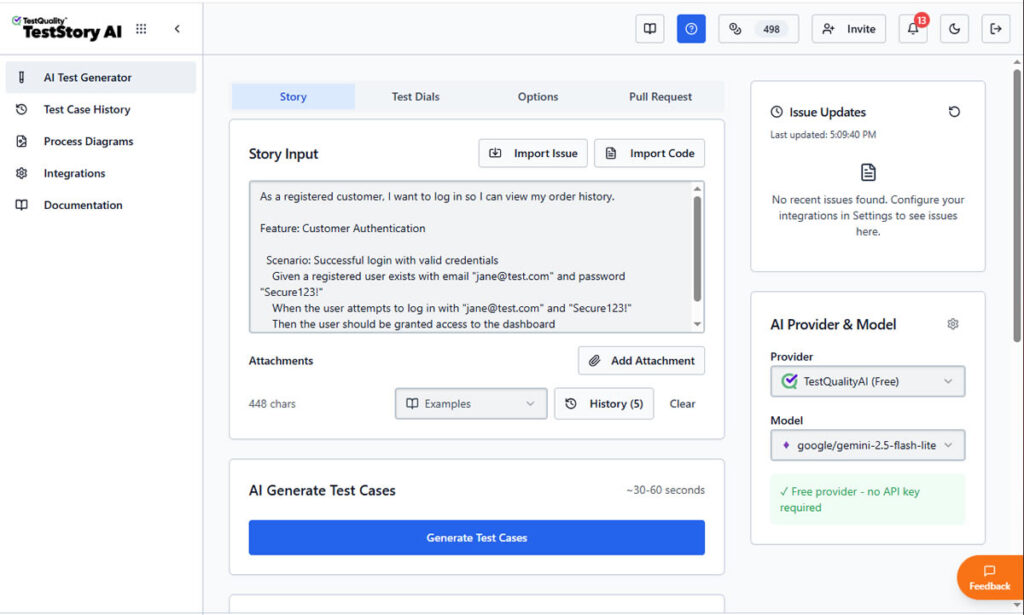
The flow is concrete. A product manager writes a user story in Jira or a GitHub issue. TestStory.ai consumes that story and produces Gherkin-formatted test cases covering the acceptance criteria, edge cases, and likely failure modes.
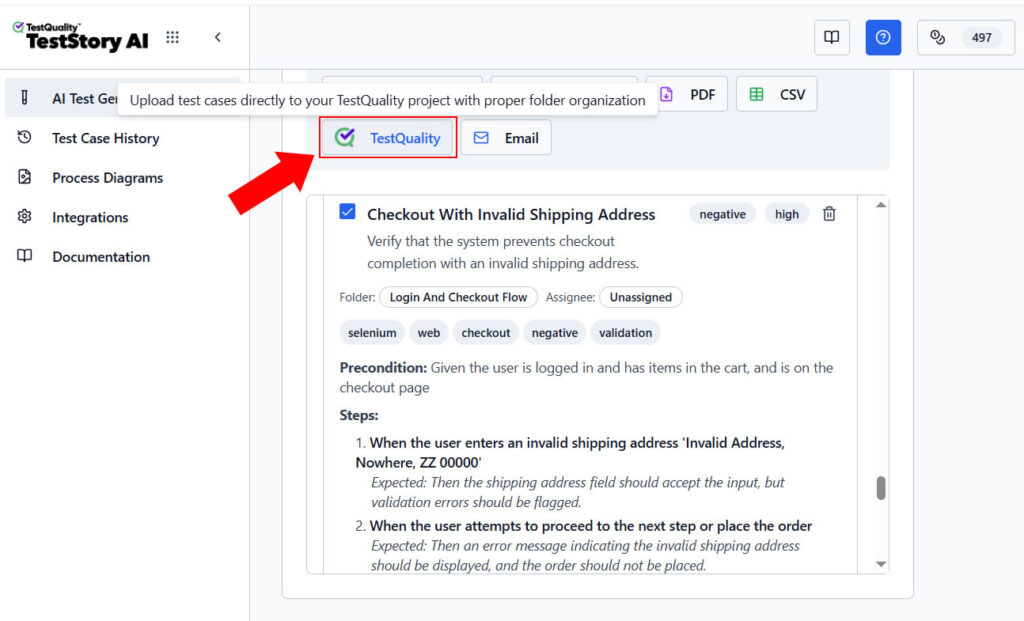
The cases land in TestQuality, organized by project and cycle. When a developer opens a PR linked to that story, TestQuality’s pull request testing feature attaches the relevant cycle. Playwright, Cypress, Selenium, or JUnit runs the suite and outputs JUnit XML. The TestQuality CLI uploads results with testquality upload_test_run into the named project and cycle. Pass/fail status, test names, and execution metadata flow into run history automatically. If a failure looks real, a tester confirms the defect, attaches a screenshot, and TestQuality’s GitHub integration syncs the defect record to the repository’s issue tracker.

The deliberate manual step is defect confirmation. The CLI handles upload, attachment, and defect linking from local environments or CI/CD pipelines, but distinguishing a genuine defect from a flake or an acceptable change benefits from a human reviewer rather than auto-ticketing every failure. That’s the human-in-the-loop boundary, and it’s a feature, not a limitation — it’s what keeps the tracker free of noise and the team’s trust in test results intact.
For teams adopting this pattern from a legacy manual test suite, the migration path is incremental. Start with the most-changed area of the codebase, generate cases for the next sprint’s user stories with TestStory.ai, link them to PRs through TestQuality, and let the agent layer accumulate context as it goes. This is the operational form of the agentic SDLC — build, test, verify — applied to a GitHub-native team.
Technical Deep Dive FAQ
What is GitHub test case management with AI?
GitHub test case management with AI is the practice of orchestrating test case authoring, execution, and triage through agentic workflows that operate inside the GitHub ecosystem. It pairs an AI agent that generates and maintains structured test cases with a test management platform that links those cases to pull requests, commits, and merge gates. The objective is closing the delivery gap between AI-accelerated code generation and the slower pace of validation, so that high-velocity output reaches production with traceable, auditable quality evidence rather than just passing status checks.
What does agentic CI mean in 2026?
Agentic CI is the evolution of static pipeline-as-code into composable primitives that allow AI agents to take bounded actions on a repository — running tests, fixing builds, triaging failures, generating test cases — while keeping human reviewers in the loop. The defining components are Model Context Protocol servers that give agents API access, pipeline triggers that invoke workflows from external events, and sandboxed execution environments that run agents in isolated containers with read-only defaults and safe outputs requiring human approval before any write operation.
How does TestQuality connect to GitHub Actions?
TestQuality connects to GitHub Actions through its command-line interface. Test frameworks like Playwright, Cypress, Selenium, or JUnit are configured to output results in JUnit XML format. Inside a GitHub Actions workflow, the TestQuality CLI runs the testquality upload_test_run command to push those XML results into a named TestQuality project and test cycle. Pass and fail status, test names, and execution metadata flow into TestQuality automatically. The CLI also handles attachment upload and defect linking, so the same mechanism works identically from a developer laptop and from a CI runner.
What is the Effective Tokens metric and why does it matter?
Effective Tokens is a normalized cost metric developed by GitHub’s engineering team to track agentic CI spend across different AI model tiers. The formula applies multipliers — Haiku at 0.25x, Sonnet at 1.0x, Opus at 5.0x — and weights output tokens four times more heavily than input tokens. The result is a single figure that reflects genuine efficiency rather than raw token counts, which vary widely based on codebase size and prompt design. ET matters because workflows running on every pull request can quietly accumulate enormous API bills without a normalized metric to expose where the spend is going.
How do teams migrate a legacy manual test suite into an AI-augmented GitHub workflow?
Migration is incremental rather than wholesale. The recommended path is to identify the most-changed area of the codebase, point the AI agent at the user stories for the next sprint, generate Gherkin-formatted cases for those stories, and link the cases to pull requests through the test management layer. Legacy manual cases stay in place during the transition — the goal is not deletion but coverage convergence. Over several sprints, the agent layer accumulates context about the codebase, and teams gradually retire redundant or low-value manual cases while preserving the ones that catch real defects.
What happens when an AI agent auto-disables a flaky test that was catching a real bug?
A well-designed human-in-the-loop policy separates quarantine from deletion. An agent can quarantine a flaky test automatically based on statistical evidence of intermittent failure, removing it from the critical path. Permanent disabling or deletion requires a confirmed owner review. The quarantine reason, evidence, and confidence score are logged in the test management layer so the action is auditable. If the test was catching a real intermittent bug, the owner review surfaces that during triage, the test goes back into the active suite, and the underlying defect gets logged. The agent’s role is triage, not final verdict.
Which AI models perform best for technical agent workflows in 2026?
Recent production-scenario evaluations of major large language models in 2026 identified a clear top tier for technical workflows. Claude Haiku scored 87% overall and processed large context loads of 50+ schemas effectively despite a 200,000-token context window. Claude Sonnet achieved the highest reliability and consistency scores at 98% and 97%, never exceeding timeouts in evaluations. Gemini 2.5 Flash emerged as the balanced value option at 78% overall performance for roughly one-sixth the cost of premium options. Notably, the same evaluations found 70% of models could not complete technical capability analysis within reasonable production timeframes.
What is the practical difference between alert-only and hard-stop budget modes?
Alert-only mode notifies administrators when an agent’s budget is exhausted but allows the workflow to continue, preserving developer productivity at the cost of unpredictable overage charges. Hard-stop mode imposes a definite spending ceiling — once the budget is exhausted, the agent stops mid-task even if that leaves a complex operation partially completed. Most engineering organizations adopt a hybrid: alert-only for high-value coding agents working on critical paths, hard-stop for exploratory or non-essential workflows. The choice is fundamentally about whether the team prefers predictable invoices or guaranteed task completion.
What’s next for GitHub test case management with AI?
The trajectory is toward autonomous validation — pipelines that learn over time which tests catch real regressions and which generate noise, embedding intelligence directly into the delivery environment so teams can absorb AI-generated change without overwhelming human reviewers. The era of static YAML pipelines is ending. Delivery engineering is taking its place.
What that looks like operationally in 2026: AI agents authoring test cases from user stories with auditable confidence scores. Test management platforms linking every case to commits, PRs, and acceptance criteria. MCP-mediated agent actions on repositories with sandboxed execution and safe-output approval gates. Statistical flakiness detection with owner-assigned quarantine queues. Per-SKU budget controls and Effective Tokens telemetry. Human reviewers acting as orchestrators and defect confirmers rather than executors.
None of this is hypothetical. The components exist, the case studies are documented, and the cost-control practices are now well-understood enough to deploy with predictable economics. The teams that move first will be the ones whose delivery systems can process the most change without breaking — and that’s the only definition of competitive advantage that matters once code generation is no longer the bottleneck.
Key Takeaways
What to Operationalize First
Closing the delivery gap is the work of the next two years.
Productivity paradox in numbers: Code throughput +59% YoY; main-branch success rate at 70.8%, a five-year low (CircleCI 2026).
Adoption is still early: 73% of teams aren’t using AI in CI/CD (JetBrains 2025) — the gap is opportunity, not crisis.
The CLI is the connector: JUnit XML output plus testquality upload_test_run is the seam that makes GitHub Actions and TestQuality interoperate.
Flake governance recovers real time: Atlassian’s Flakinator approach recovered 22,000+ builds in a single quarter through statistical quarantine and owner assignment.
Cost control is now a deployable practice: MCP tool pruning, CLI substitution, and prompt caching can reduce input-token spend by up to 90%.
Human-in-the-loop is a feature: Defect confirmation and permanent test disabling stay with humans; agents handle triage, quarantine, and surface-level fixes.
The teams that win in 2026 aren’t the ones writing the most code. They’re the ones whose delivery systems absorb the most change without breaking.
Start Free Today
Move from Script-Writing to Outcome-Orchestration on GitHub
TestStory.ai generates structured test cases from your user stories, acceptance criteria, or architecture diagrams — then syncs them directly into TestQuality for execution, tracking, and team collaboration. Link every case to a PR, every result to a commit, every defect to a tracker ticket, and close your delivery gap without slowing AI-accelerated code generation.
✦ Get 500 TestStory.ai credits every month included with your TestQuality subscription — no extra cost.
No credit card required on either platform.