At a Glance
Selenium vs Playwright in 2026, decided by architecture, not hype
A methodology-driven comparison — benchmarks, BiDi, MCP, and migration math.
Speed gap is real: Playwright executes actions in 1–2 seconds via WebSocket/CDP versus Selenium’s 3–5 seconds via HTTP/WebDriver, with parallel suite runs roughly 3x faster in published benchmarks.
Adoption has flipped in JS: The State of JavaScript 2025 Testing survey records Playwright at 50% usage and Selenium at 10% among JS developers — a near-inversion in three years.
Selenium has not stood still: WebDriver BiDi adds native network interception, console listening, and parallel execution — invalidating the most common 2022-era anti-Selenium arguments.
Framework choice is no longer modern vs legacy. It is a question of what your application is built on, what your team optimizes for, and how much sunk capital you would discard to switch.
The selenium vs playwright debate has shifted faster than most engineering teams have updated their evaluation matrices. Most published comparisons still cite a 2022-era Selenium that cannot intercept network requests, run native parallel tests, or read console logs — claims invalidated by WebDriver BiDi adoption. Meanwhile, Playwright has moved past simple speed advantages into native AI test agents and a Model Context Protocol server. For QA engineers, SDETs, and engineering managers planning 2026 automation strategy, the real question is not which tool is “better.” It is which architecture aligns with your application stack, team composition, and existing CI investment. This guide answers that with benchmarks, migration evidence, and decision criteria.
The methodology here is simple: every claim is sourced, contested numbers are flagged, and Selenium’s genuine 2026 strengths get equal weight to Playwright’s. Where benchmarks disagree, both numbers appear. Where outdated arguments still circulate, this article corrects them. The goal is a defensible decision — not vendor cheerleading.
What is the difference between Selenium and Playwright in 2026?
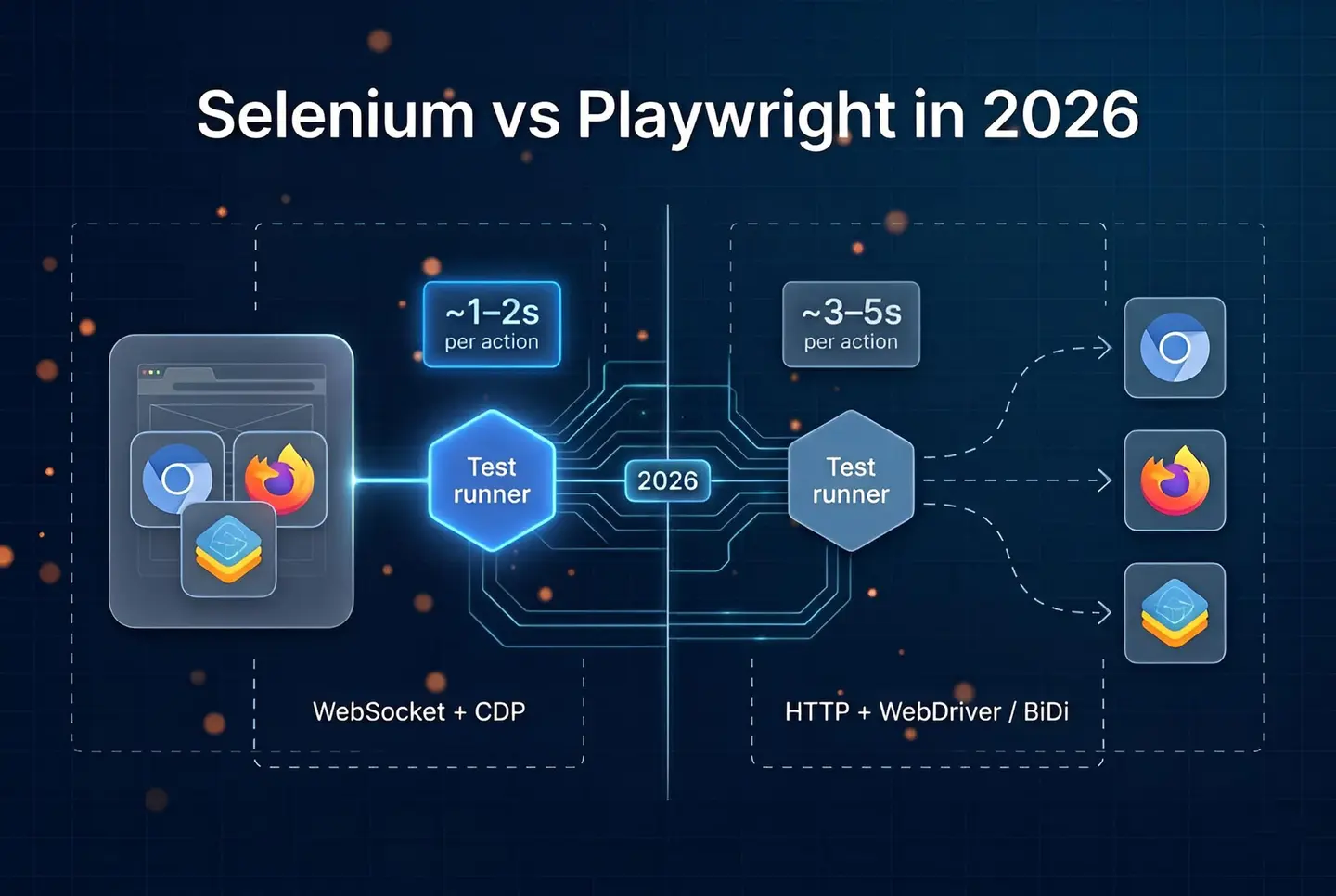
Selenium and Playwright are both open-source browser automation frameworks, but they communicate with browsers differently. Selenium uses HTTP commands through the WebDriver protocol against locally installed branded browsers. Playwright uses a single persistent WebSocket via the Chrome DevTools Protocol against bundled browser binaries it ships and patches itself.

That single architectural difference cascades into nearly every comparison axis. WebSocket plus CDP gives Playwright sub-second action latency, native event listening without polling, and tight integration between UI actions and network mocking. WebDriver gave Selenium two decades of language bindings, browser vendor support, and grid infrastructure — but at the cost of HTTP round-trips per command. Selenium 4’s WebDriver BiDi protocol introduces a bidirectional channel that closes much of this gap, though the API ergonomics still trail Playwright’s developer experience.
The second major difference is browser handling. Playwright bundles patched Chromium, Firefox, and WebKit — guaranteeing version consistency across CI environments, but creating a coupling problem for any application that embeds its own Chromium runtime. Selenium drives whichever real browser is installed on the machine, which is why it remains the only viable option for testing actual Apple Safari, Internet Explorer 11, or applications built on the Chromium Embedded Framework where browser version must match exactly.
What does the selenium vs playwright market share look like in 2026?
The selenium vs playwright market share picture splits cleanly along ecosystem lines. In the JavaScript world, Playwright has overtaken every alternative. Across enterprise Java and C# codebases, Selenium still dominates by sheer installed base. Greenfield projects in 2026 lean Playwright; existing investments rarely justify migration.
The State of JavaScript 2025 Testing survey, the largest consistent longitudinal dataset in the JS ecosystem, places Playwright usage at 50% among respondents, with Cypress at 47% and Selenium at 10%. Three years earlier, those positions were essentially reversed. npmtrends data confirms the trajectory: Playwright download volume now exceeds both Cypress and selenium-webdriver, while the selenium-webdriver package has flatlined at the bottom of the JS testing pack.
Independently, the broader picture is more nuanced. Selenium’s WebDriver bindings remain dominant in Java, Python, C#, and Ruby — languages where Playwright either lags in feature parity or has no binding at all. The selenium vs playwright adoption 2026 trend is unambiguous for new web-centric work, but for organizations with hundreds of thousands of lines of Selenium scaffolding wired into Jenkins, Selenium Grid, and Java CI, the migration ROI is often negative. This same dynamic plays out across the broader agentic QA pillar, where modern tooling layers sit on top of incumbent frameworks rather than replacing them.
Why is Playwright better than Selenium for modern web applications?
For modern single-page applications, Playwright’s advantages compound: faster action execution, native auto-waiting that eliminates the most common cause of flakiness, lightweight browser contexts for parallelization, and post-mortem debugging tools that make headless failures investigable. The architectural choices align directly with how 2026 web apps actually behave.
Execution speed and parallel scaling
Playwright communicates with browsers through one persistent WebSocket connection, executing each action in roughly 1–2 seconds. Selenium’s traditional HTTP-based WebDriver translates each command into an HTTP request, taking approximately 3–5 seconds per action. Independent 2026 benchmarks from Autonoma’s published comparison show why QA teams are leaving selenium: a 50-test sequential suite finishing in 3 minutes 20 seconds on Playwright versus 8 minutes 45 seconds on Selenium. With four parallel workers, Playwright completes in 52 seconds while Selenium takes 2 minutes 50 seconds. Per-test throughput lands around 1,200 tests per hour for Playwright versus 600 for Selenium in QA Routine’s 2026 measurements.
One contested data point worth flagging: a separate benchmark video reports Playwright slower than Selenium on a specific run, which contradicts both its own narration and the broader consensus across five independent sources. Treat single-run benchmarks skeptically — variance across CI environments matters more than any one number.
Reliability and the auto-waiting advantage
The architectural advantages of playwright over selenium that matter most in production reduce to one mechanism: auto-waiting. Before interacting with an element, Playwright automatically verifies the element is attached to the DOM, visible, stable (not animating), and enabled. Selenium requires developers to write explicit WebDriverWait conditions or fall back to fragile Thread.sleep calls. Selenium’s most common explicit waits only check visibility — meaning an element can be visible but disabled, and the test fails anyway.
The reliability impact is measurable. In a 100-run benchmark, Playwright achieved a 94% pass rate with 4% flake versus Selenium’s 84% pass rate with 12% flake. A separate migration study reported 75% fewer flaky tests after switching. Legacy Selenium suites have historically tolerated up to 20% non-defect failure rates from environmental synchronization alone — a tax that compounds at scale.
Debugging and developer experience
Playwright’s Trace Viewer captures DOM snapshots, network requests, and console output during the test run, then plays them back as a stepped post-mortem. Codegen records interactions and generates accessibility-first locators by default. Combined, they make headless failures investigable rather than mysterious. Selenium relies on console logs and headless screenshots — the experience one practitioner described as figuring out failures felt like trying to teach a cat to bark. Playwright’s promise-based API and built-in expect() assertions also produce cleaner code than Selenium’s findElement().sendKeys() pattern paired with external assertion libraries like JUnit or TestNG.
For teams investigating intermittent failures, the deeper diagnostic work covered in why Playwright tests are flaky still applies — but the baseline reliability is meaningfully higher. Visual regression workflows benefit similarly, though visual regression with Playwright carries its own caveats around full-page screenshot resource cost.
When is Selenium still the right choice?
Selenium remains the correct choice for embedded desktop applications, strict branded-browser compliance testing, hybrid native-plus-web workflows, legacy browser support, and Ruby-first teams. These are not edge cases — they describe a substantial portion of enterprise testing reality, and Playwright’s architectural choices actively work against them.
Mohammad “Hib” Aid, Principal Software Engineer at Hexagon, evaluated both frameworks for a complex Chromium Embedded Framework desktop application and stayed on Selenium. Because Playwright bundles its own patched Chromium, his team could not match the framework’s browser version to the exact Chromium engine running inside their application — they had to hunt for older Playwright versions, and bypassing default download behavior required manual edits to Playwright’s core cr_browser.js library that got overwritten on every framework update. Selenium’s decoupled WebDriver let them target the exact embedded environment without per-release patching.
The same logic applies anywhere browser fidelity matters. Playwright’s “WebKit” is not actual Apple Safari, and its “Firefox” is a patched build. For organizations with regulatory or branded browser compliance obligations, Selenium is the only viable option. The same is true for Internet Explorer 11 testing (still required in some financial and government contexts) and for any team that has standardized on Ruby — Playwright has no Ruby binding.
The BiDi protocol invalidates older anti-Selenium arguments
Many comparison articles still claim Selenium cannot intercept network requests, lacks console log access, and cannot run parallel tests without a Selenium Grid. In 2026 these claims are false. WebDriver BiDi enables native console log listening, network interception, and network condition emulation directly in Selenium. Modern Selenium integrations with JUnit 5 support thread-safe parallel execution without standalone Grid infrastructure. Playwright’s API for these features is more ergonomic, but Selenium’s underlying capability gap has been closed.
Try It Now
Stop maintaining selectors. Start orchestrating outcomes.
Paste any user story into TestStory.ai and watch the orchestration layer generate structured, Gherkin-formatted test cases instantly — covering happy paths, edge cases, and the failure scenarios your team would typically miss. No account required.
No credit card required.
How does Cypress fit into the cypress vs playwright vs selenium decision?
Cypress occupies a third architectural position: it runs inside the browser event loop rather than driving the browser externally. This delivers best-in-class frontend developer visibility and time-travel debugging, but it introduces structural limits — restricted WebKit support, no multi-tab workflows, and a slower per-test execution profile than Playwright on complex apps.
In QA Routine’s 2026 per-test execution measurements, Playwright averages roughly 4 seconds, Cypress around 5 seconds, and Selenium approximately 9 seconds. Cypress remains a strong choice for component-level testing and frontend teams who prioritize the live browser inspector experience. As one practitioner summarized the dynamic: Playwright is powerful, Cypress is delightful. Selenium retains the edge over both when legacy browsers, native OS interactions via WinAppDriver, or actual Safari fidelity are mandatory. Each framework solves a different problem — choosing without naming the problem first leads to migration regret.
| Dimension | Playwright | Selenium |
|---|---|---|
| Architecture | WebSocket + Chrome DevTools Protocol | HTTP + WebDriver, BiDi added in v4 |
| Action Latency | ~1–2s per action | ~3–5s per action |
| Waiting Strategy | Native auto-waiting (attached, visible, stable, enabled) | Explicit/implicit waits, manual configuration |
| Parallel Execution | Native via lightweight BrowserContexts | Native via JUnit 5 threads or Selenium Grid |
| Network Interception | Native API | Native via WebDriver BiDi (Selenium 4+) |
| Browser Coverage | Bundled Chromium, patched Firefox, WebKit | Real Chrome, Firefox, Safari, Edge, IE11 |
| Language Bindings | JS/TS, Python, Java, .NET | Java, Python, C#, Ruby, JS |
| Debugging | Trace Viewer, UI Mode, Codegen | Console logs, screenshots, Selenium IDE |
| Embedded Desktop (CEF/Electron) | Version coupling problems | Decoupled WebDriver, exact version match |
| AI Integration (2026) | Native Planner/Generator/Healer agents, MCP server | No first-party AI agents; community integrations only |
What does a realistic Selenium-to-Playwright migration cost?
A realistic migration is not a weekend project. Practitioner case studies converge on a pattern: 3 days to migrate a small suite, 2–4 weeks for a medium suite, 6+ months for million-line codebases. Speed gains are real, maintenance drops meaningfully, but brittle selectors and UI fragility do not disappear after switching frameworks.
Tom Piaggio, Co-Founder of Autonoma, migrated his team’s regression suite after spending 40% of sprint time fixing broken Selenium tests. Setup time fell from 2 hours to 30 minutes. Suite execution dropped from 45 minutes to 12 minutes. But Piaggio is direct about the limit: Playwright provides less maintenance, not zero maintenance. UI changes still break selectors. Angela Alvka migrated 30 complex E2E tests in three working days and confirmed auto-waiting eliminated her manual explicit waits, though she noted the smaller Playwright community made finding solutions for niche bugs harder than Selenium’s two-decade Stack Overflow footprint.
The maintenance cost reduction is tangible but not transformational. A 2026 benchmark covering a 5-engineer QA team estimated Selenium maintenance at roughly $82,500 annually (41% of sprint time) versus Playwright at roughly $60,000 annually (30% of sprint time). At extreme scale, the picture changes again: Kareem at Thunders reported that updating roughly a million lines of Playwright code during a brand redesign took six months. UI testing fragility is a fundamental of the discipline, not a framework defect — a reality the agentic QA architecture treats as a first-class design constraint.
How are AI test agents and MCP changing the 2026 landscape?
Playwright’s most significant 2026 divergence from Selenium is its move into native AI integration. Releases v1.52 through v1.59 added per-project worker control, weighted sharding, timeline reporting, screencast overlays, and — most consequentially — experimental documentation for first-party AI test agents and an official Model Context Protocol server.
The agent set is structured rather than free-form: a Planner that autonomously explores an application URL and produces a Markdown test plan covering edge cases; a Generator that consumes Planner output to write functional Playwright scripts; and a Healer that diagnoses and repairs failing tests caused by strict mode violations or minor UI drift. Each agent has a narrow, specialized role rather than acting as a general-purpose autonomous tester — a design pattern consistent with the orchestration discipline outlined in the Agentic SDLC guide and the context engineering framework.
The Playwright MCP server is a separate but related signal. Instead of feeding LLMs pixel-heavy screenshots or massive HTML DOMs, it provides deterministic accessibility snapshots at roughly 200–400 tokens per snapshot — making Playwright the most token-efficient option for LLM-driven browser automation. Practitioner skepticism remains: Ben Fellows, Founder of Loop QA, has flagged that persistent contextual windows for these agents can be expensive and slow at enterprise scale, and is “waiting to see it work” before committing. Selenium has no equivalent first-party offering in 2026.
Which framework should you choose in 2026?
Choose based on application architecture and team optimization function, not benchmarks alone. Playwright wins for greenfield modern web apps, JavaScript-first teams, and projects bottlenecked by CI execution time. Selenium wins for embedded desktop apps, branded browser compliance, hybrid native workflows, legacy browser support, and large existing investments in Java or C# Selenium infrastructure.
Choose Playwright if any of the following apply: you are building a greenfield web application using React, Vue, or Angular; your primary bottleneck is CI execution time; your team is JavaScript or TypeScript first; your suite suffers from timing-driven flakiness; you want unified UI and API testing without external libraries; or you plan to integrate AI test agents into your generation or self-healing pipeline.
Choose Selenium if any of the following apply: you are testing an embedded desktop application built on CEF or Electron that requires precise Chromium version matching; your compliance regime mandates testing on actual Apple Safari or unpatched Firefox; your test suite combines web views with native OS interactions through WinAppDriver; you need to support Internet Explorer 11; your team is standardized on Ruby; or your existing Selenium suite is large, functional, and deeply integrated into Java or C# CI infrastructure where migration ROI is negative.

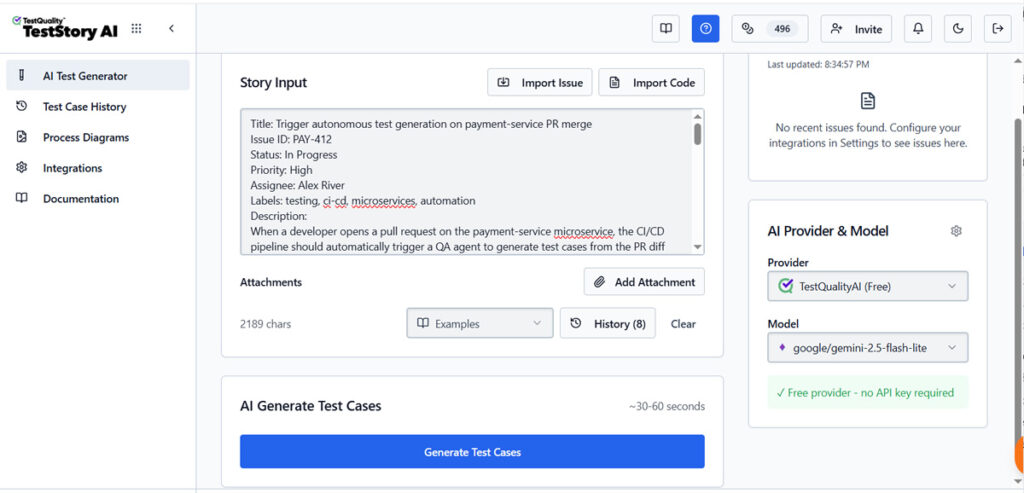
For test management on top of either framework, the choice is independent. TestQuality integrates natively with GitHub and Jira for run tracking, defect linkage, and traceability — and TestStory.ai sits above either Playwright or Selenium as the agentic test case generation layer, not a replacement for execution frameworks. Teams running mixed Playwright and Selenium estates in parallel are common in 2026; the management plane does not need to mirror the execution plane.
Technical Deep Dive FAQ
What is Playwright and how does it differ from Selenium?
Playwright is an open-source browser automation framework released by Microsoft in 2020 that drives Chromium, Firefox, and WebKit through a single WebSocket connection using the Chrome DevTools Protocol. Selenium is the older WebDriver-based framework that drives locally installed branded browsers through HTTP commands. The architectural difference produces faster action execution, native auto-waiting, and tighter UI plus network testing integration in Playwright, while Selenium retains broader real-browser fidelity and language coverage including Ruby and legacy IE11.
Is Selenium still relevant in 2026?
Selenium remains highly relevant in 2026, particularly for enterprise Java and C# codebases, embedded desktop applications using the Chromium Embedded Framework, hybrid web-and-native workflows via WinAppDriver, and any environment requiring actual Apple Safari or Internet Explorer 11. WebDriver BiDi added in Selenium 4 provides native network interception, console listening, and parallel thread-safe execution, closing many of the feature gaps cited in older comparison articles. JavaScript ecosystem usage has declined, but global installed base across all languages remains substantial.
Why is Playwright considered better than Selenium for modern web apps?
Playwright is considered better than Selenium for modern web applications because its WebSocket plus CDP architecture executes actions in 1–2 seconds versus Selenium’s 3–5 seconds, its built-in auto-waiting verifies elements are attached, visible, stable, and enabled before interaction, and its lightweight BrowserContexts enable native parallelization without grid infrastructure. Independent benchmarks show 94% pass rates with 4% flake on Playwright versus 84% pass rates with 12% flake on baseline Selenium suites. Trace Viewer and Codegen also produce a substantially better debugging and test-authoring experience for SPA-heavy apps.
What does the WebDriver BiDi protocol change about Selenium?
WebDriver BiDi is a bidirectional W3C protocol adopted in Selenium 4 that enables native console log listening, network request interception, network condition emulation, and event-driven browser communication without polling. It invalidates several common anti-Selenium arguments still circulating in older comparison articles, including the claims that Selenium cannot intercept network traffic, lacks native console access, or requires Selenium Grid for parallel execution. Combined with JUnit 5 thread-safe parallelization, BiDi closes most of Selenium’s underlying capability gap, though Playwright’s API ergonomics for these features remain more concise.
How does Cypress compare to Playwright and Selenium in 2026?
Cypress runs inside the browser event loop rather than driving the browser externally, which produces best-in-class frontend developer visibility and time-travel debugging but limits its capabilities. WebKit support is restricted, multi-tab workflows are not supported, and per-test execution lands around 5 seconds — between Playwright’s roughly 4 seconds and Selenium’s roughly 9 seconds. Cypress is strong for component testing and frontend-team workflows. Playwright wins on multi-tab apps and free WebKit. Selenium wins on legacy browsers and native OS interaction. Each solves a different problem.
How long does a Selenium-to-Playwright migration realistically take?
Migration timelines scale with suite size and complexity. Documented practitioner cases show 30 complex end-to-end tests migrated in 3 working days, regression suites converted in roughly 3 days with execution time falling from 45 minutes to 12 minutes, medium suites of 100–300 tests typically requiring 2–4 weeks of conversion plus stabilization, and at extreme scale, around a million lines of Playwright code taking 6 months to update through a brand redesign. Brittle selectors and UI fragility persist after migration — they are a property of UI testing, not the framework.
Why is Selenium better than Playwright for embedded desktop applications?
Selenium is better than Playwright for embedded desktop applications because its decoupled WebDriver lets engineers target the exact Chromium version running inside the application under test. Playwright bundles its own patched Chromium, which forces version coupling between the framework and the embedded runtime. Hexagon’s Chromium Embedded Framework evaluation documented a recurring pattern: hunting for older Playwright versions to match the app’s internal engine, plus manual edits to Playwright’s core cr_browser.js library that got overwritten on each framework update. Selenium plus WinAppDriver also delivers cleaner hybrid web-plus-native workflows.
What are Playwright’s native AI test agents and the MCP server?
Playwright’s experimental AI agents introduced in v1.59 include a Planner that explores application URLs and outputs Markdown test plans, a Generator that consumes Planner output to write Playwright scripts, and a Healer that diagnoses and repairs failing tests caused by strict mode violations or UI drift. The Playwright Model Context Protocol server provides deterministic accessibility snapshots at roughly 200–400 tokens each for LLM-driven browser automation, replacing pixel-heavy screenshots or full HTML DOMs. Practitioner skepticism around context window cost and enterprise scale remains active in 2026 production deployments.
Key Takeaways
The 2026 selenium vs playwright decision in six bullets
Architecture, not hype, decides the right framework for your stack.
Speed differential is consistent: Playwright ~1–2s per action vs Selenium ~3–5s; 50-test suite runs roughly 3x faster on Playwright in published 2026 benchmarks.
Reliability advantage is auto-waiting: 94% pass / 4% flake on Playwright vs 84% pass / 12% flake on Selenium baseline in a 100-run benchmark.
JS ecosystem has flipped: State of JavaScript 2025 places Playwright at 50% adoption versus Selenium at 10% among JS developers.
Selenium has modernized: WebDriver BiDi delivers native network interception, console listening, and parallel execution — most older anti-Selenium arguments are now false.
Migration math is meaningful but not magical: 5-engineer QA team maintenance falls from ~$82,500 to ~$60,000 annually; brittle selectors persist after migration.
Selenium still wins specific architectures: embedded CEF apps, branded-browser compliance, IE11, hybrid native workflows via WinAppDriver, and Ruby-first teams.
The right answer is not which framework is best — it is what your team optimizes for. Selenium gives you control at the cost of time. Playwright gives you speed at the cost of bundled-runtime constraints. Both are highly capable in 2026.
Start Free Today
Whichever framework you pick, manage the test cases that drive it.
TestStory.ai generates structured test cases from your user stories, acceptance criteria, or architecture diagrams — then syncs them directly into TestQuality for execution, tracking, and team collaboration. Whether your team runs Playwright, Selenium, or both in parallel, the management layer stays consistent across frameworks, languages, and CI environments.
✦ Get 500 TestStory.ai credits every month included with your TestQuality subscription — no extra cost.
No credit card required on either platform.