Opening Definition
A 90-day Agentic Testing and QA roadmap is a structured learning plan that combines daily JavaScript and TypeScript practice with hands-on Playwright automation and AI-assisted testing skills. It is built around three 30-day phases — language fundamentals, Playwright fundamentals, and advanced framework plus AI-oriented work — and assumes about one hour of practice per day. The goal is not to read about automation but to build it, with steady GitHub commits, small projects, and a portfolio that holds up to a hiring conversation. For teams blending manual and automated work along the way, TestQuality provides the test management layer where cases, runs, and CI results stay connected.
At a Glance
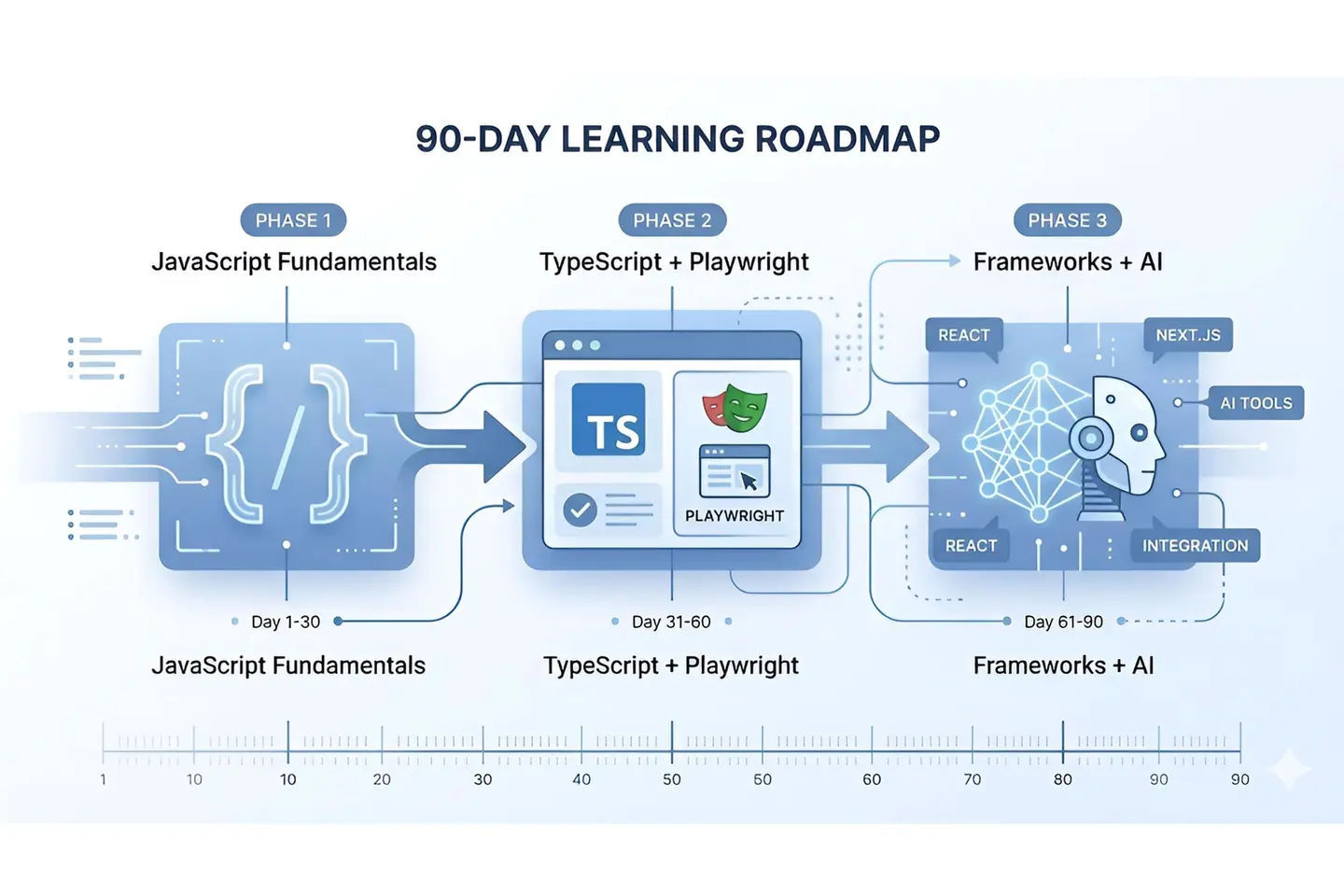
The 90-Day Playwright Roadmap
Three phases, daily practice, projects that hold up to scrutiny.
Phase 1 (Days 1–30): JavaScript fundamentals — variables, functions, async, Git, and writing code every day rather than reading about it.
Phase 2 (Days 31–60): TypeScript and Playwright fundamentals — locators, assertions, fixtures, and test organization.
Phase 3 (Days 61–90): Framework design (Page Object Model, BDD), Docker and CI/CD, and AI-assisted testing workflows.
Operational fit: Pair the roadmap with TestQuality for blended manual-to-automated test management with native GitHub and Jira integration.
Playwright is the execution backbone. AI is the assistant for scale, maintenance, and analysis. The roadmap teaches both, in that order.
What is Agentic Testing and QA?
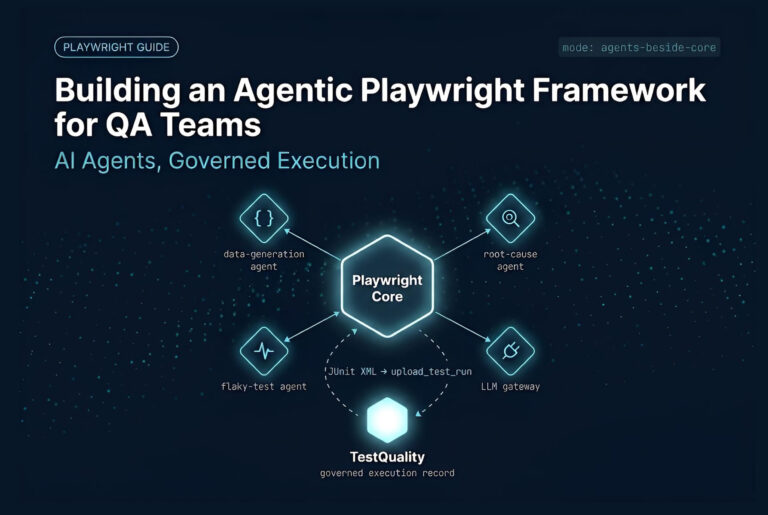
Agentic Testing and QA is a testing approach that combines traditional automation with AI-driven assistance for reasoning, analysis, and workflow support. Playwright provides the deterministic execution layer; AI agents handle drafting, flaky-test triage, failure investigation, and framework maintenance — extending what a single QA engineer can cover.
- AI-assisted test creation.
- Flaky test analysis.
- Failure investigation support.
- Automated code generation assistance.
- Framework enhancement with AI tools and agents.
- Integrating testing with agentic workflows and dashboards.
In this model, Playwright is the automation foundation, while AI expands how tests are designed, maintained, analyzed, and scaled.
Why Does Playwright Matter for Modern QA?
Playwright matters because the question for QA engineers in 2026 is no longer whether to learn automation — it is which stack to invest in. Playwright supports fast cross-browser execution, modern handling of dynamic content, and a developer-style workflow that lines up well with how engineering teams already work.
Playwright was created by Microsoft and launched in January 2020, and according to the official Playwright site it now drives Chromium, Firefox, and WebKit with a single API for tests, scripts, and AI agents. The project has accumulated more than 75,000 GitHub stars and over 20 million npm downloads to date.
A practical roadmap for Agentic Testing and QA should therefore start with Playwright, then expand into:
- JavaScript fundamentals.
- TypeScript fundamentals.
- Playwright basics and advanced concepts.
- Framework patterns such as Page Object Model.
- BDD tools such as Cucumber.
- Docker, Jenkins, and GitHub Actions.
- AI tooling and agent-oriented testing workflows.
Which Playwright language should you choose?
For someone starting fresh, the most practical choice is TypeScript with a brief stop in JavaScript first. The staged path — JavaScript fundamentals, then TypeScript, then Playwright with TypeScript — works because it builds language confidence before adding type safety and project structure on top.
If you already know Java or Python, that background still helps. Playwright supports both languages officially. But for a roadmap targeting modern Agentic Testing and QA, TypeScript is the practical default because it aligns with how most teams are using Playwright in production.
What Does the 90-Day Roadmap Look Like Phase by Phase?
The 90-day roadmap splits into three 30-day phases — language base, Playwright fundamentals, and advanced framework plus AI work. Each phase has a target outcome rather than a topic checklist: at the end of phase one, you write code daily; at the end of phase two, you ship complete test scripts; at the end of phase three, you have framework projects on GitHub.
Days 1 to 30: Build your JavaScript base
Your first month is about coding confidence. Many testers struggle with automation not because the tools are too hard but because programming fundamentals are weak.
Topics:
- Variables, data types, and operators.
- Conditions and loops.
- Functions.
- Arrays and objects.
- Scope and closures.
- Promises and async concepts.
- Error handling.
- Modules.
- Basic file and project structure.
- Git and GitHub basics.
Target: write code every day, not just read about it.
Days 31 to 60: TypeScript and Playwright fundamentals
In month two, connect language knowledge to browser automation.
Topics:
- TypeScript basics and typing.
- Interfaces and type safety.
- Playwright installation and setup.
- Locators and selectors.
- Assertions.
- Navigation and waits.
- Fixtures.
- Test organization.
- Handling forms, tables, and dynamic elements.
- Basic reporting and debugging.
Target: create small but complete test scripts for common user flows.
Days 61 to 90: Advanced frameworks and AI-oriented QA skills
The final month is where Agentic Testing and QA becomes visible. Playwright is still the foundation, but the work expands into framework design, integrations, and AI-assisted workflows.
Topics:
- Advanced Playwright framework structure.
- Page Object Model.
- Cucumber or BDD-style organization.
- Docker for test execution.
- Jenkins pipelines.
- GitHub Actions integration.
- Selenium-to-Playwright migration thinking.
- Flaky test analysis workflows.
- AI tools for code assistance and test support.
- Agent, MCP, and RAG-related concepts as they apply to QA workflows.
How Much Time Do You Need Each Day?
A sustainable plan matters more than a perfect one. A practical target is one hour per day with a minimum of four to five hours per week, sustained across the full 90 days. That cadence is enough to build real skill if the time is spent writing and shipping code rather than passively watching tutorials.
What Practice Rule Actually Makes the Roadmap Work?
The hardest part of a roadmap like this is not the topic list — it is daily repetition. A strong practice model for Agentic Testing and QA is small, frequent, and visible: ten exercises a day, every commit pushed to GitHub, weekly review of weak areas, and steady tracking of what got done.
Over 90 days, that compounds into hundreds of exercises. Even at half the theoretical rate, the gap between someone who shipped real code daily and someone who watched videos is enormous by day 90.
What counts as a daily exercise:
- Writing a JavaScript function.
- Typing a TypeScript interface.
- Automating a login form in Playwright.
- Writing assertions for a table.
- Creating a Page Object class.
- Running a test in CI.
- Containerizing execution with Docker.
- Using AI assistance to refactor test code.
- Documenting a flaky test scenario.
- Pushing completed work to GitHub.
What Projects Should You Build?
Projects turn isolated learning into demonstrable skill. A 90-day Agentic Testing and QA roadmap should produce several small and medium projects rather than one giant framework — variety is what makes a portfolio convincing to a hiring manager skimming your GitHub.
Good project categories:
- Basic UI automation flows (login, registration, checkout, search).
- Data-driven tests for multiple user inputs.
- Page Object Model framework.
- Cucumber plus Playwright setup
- Dockerized Playwright execution.
- GitHub Actions or Jenkins pipeline integration.
- Selenium-to-Playwright migration sample.
- Flaky test detection or failure review workflow.
- AI-assisted test analyzer or reporting helper.
What makes a project portfolio-worthy:
- Clear folder structure.
- Readable naming.
- Good documentation.
- Git history that shows progress.
- Repeatable execution steps.
- At least some advanced concepts beyond raw scripts.
Skip the blank-page problem on test case design.
Generate structured test cases from your user stories or acceptance criteria — then sync them straight into TestQuality for execution.
Try the Free AI Test Case Builder →How Does AI Actually Fit Into Agentic Testing and QA?
AI should not replace basic test engineering skills. It should amplify them. In a Playwright-based roadmap, AI is most useful for drafting test code, refactoring repetitive patterns, explaining failures, analyzing flaky tests, producing notes and summaries, and accelerating framework component work.
More advanced Agentic Testing and QA work also explores:
- Agents for autonomous or semi-autonomous task execution
- MCP (Model Context Protocol) for tool connectivity and workflow orchestration
- RAG (Retrieval-Augmented Generation) for context-aware retrieval in QA analysis or support workflows
Microsoft’s official Playwright MCP server gives AI agents structured browser control through accessibility snapshots — meaning agents can drive a real browser the same way a Playwright script does, but reasoning over each step. That is the bridge between deterministic Playwright execution and agentic workflows.
The principle stays the same: Playwright is the execution backbone. AI is the assistant for scale, maintenance, and analysis.
How Do You Migrate from Selenium to Playwright Without Carrying Bad Habits?
If you already know Selenium, you do not start from zero — but you do need to avoid pasting old habits into a new stack. The biggest failure mode is using Playwright as if it were Selenium with different syntax, which produces a slow, fragile suite that gets none of Playwright’s actual benefits.
A practical migration path:
- Map your current Selenium suite by feature area.
- Identify high-value flows to rebuild first.
- Learn Playwright locators and assertions properly.
- Recreate a few core tests using Playwright patterns, not Selenium style.
- Introduce framework structure only after basics are stable.
- Connect the new suite to CI.
- Gradually retire duplicated coverage.
Playwright’s native getByRole, getByLabel, and auto-waiting model is what makes the suite faster and less flaky. Keeping CSS-path locators and explicit sleep() calls because that is how the Selenium tests were written defeats the migration.
What Are the Common Mistakes That Slow Down Learning?
Most people fail to learn automation because they make the roadmap too complicated, too passive, or too disconnected from real practice. The pattern is consistent across teams and individuals — and every one of these mistakes is avoidable with daily commits and honest review.
The common failure modes:
- Watching too much, building too little.
- Skipping JavaScript fundamentals.
- Jumping into advanced frameworks too early.
- Ignoring GitHub and version control.
- Trying too many tools at once.
- Using AI without understanding the generated code.
- Not doing enough exercises.
- Stopping after the first 90 days.
According to the Stack Overflow Developer Survey 2024, 76% of developer respondents are using or planning to use AI tools in their development process — including for test-adjacent tasks. The competitive pressure for QA is not “should I use AI” but “do I understand the code AI is generating well enough to ship it.” That gap is exactly what a fundamentals-first roadmap closes.
How Does This Work in TestQuality?
Agentic Testing and QA is not only about writing Playwright code. It involves organizing tests, tracking runs, reporting failures, and keeping manual and automated work connected — and that is where a test management platform earns its place.
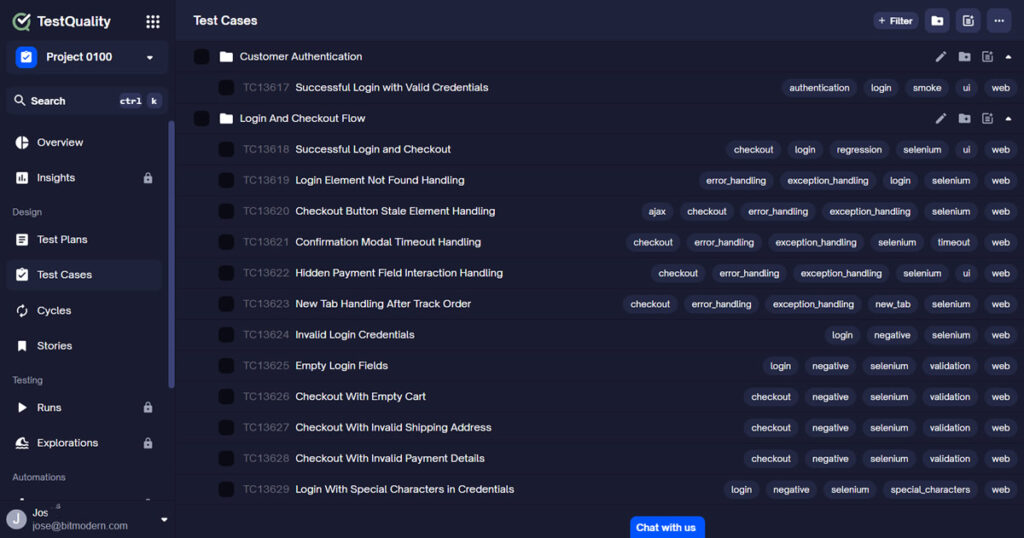
TestQuality serves as the system of record for cases and runs while a Playwright suite grows alongside it.
A practical workflow inside TestQuality:
- Create test cases for manual and exploratory coverage.
- Group them into runs or cycles for the current release.
- Connect Playwright results from CI through the integration layer.
- Track pass, fail, and blocked outcomes in one place.
- Use built-in reports for trends, defect patterns, and flaky test visibility.
- Link cases to the GitHub pull requests and Jira issues they cover.
The native GitHub and Jira integrations are what make the loop close. Test cases stay linked to the issues, branches, and pull requests they verify, rather than living in isolation in a CI dashboard or a separate tracker.
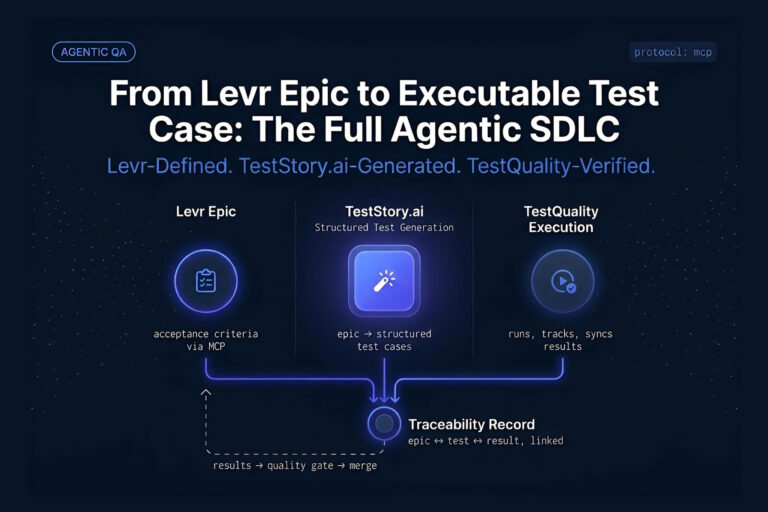
For teams leaning further into Agentic Testing and QA, TestStory.ai — included with every TestQuality subscription — generates structured test cases from user stories, acceptance criteria, or architecture diagrams, then syncs them directly into TestQuality. It pairs naturally with a Playwright suite: TestStory.ai handles the case-design work, Playwright handles the execution, and TestQuality holds the system of record.
The handoff looks like this in practice:
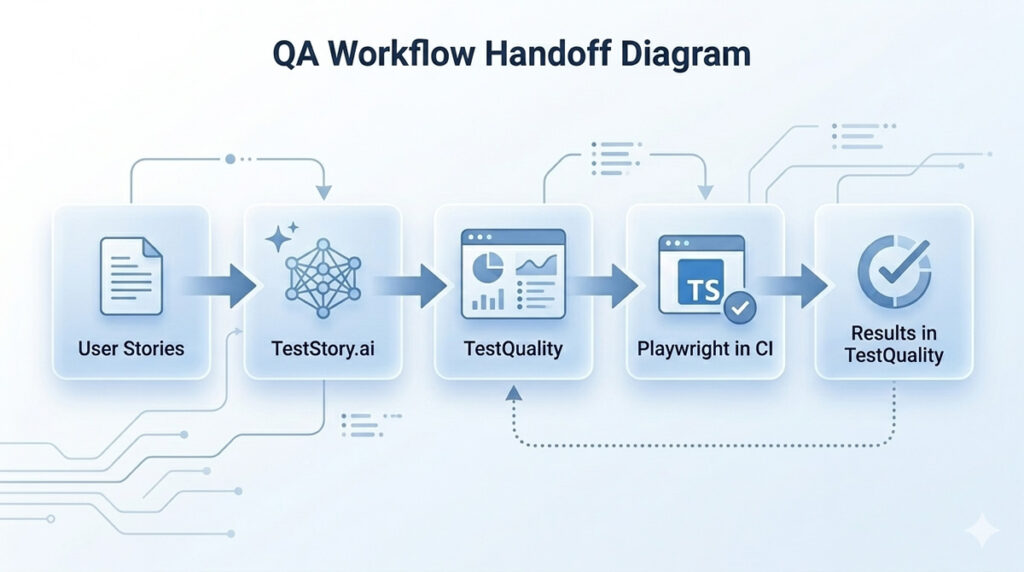
TestQuality in practice: If you are learning Playwright while still supporting manual QA, create your test cases in TestQuality, execute manual runs, and connect Playwright results through CI as the suite matures. See doc.testquality.com for the current workflow.
What Does a Simple Weekly Plan Look Like?
A simple weekly plan splits the 90 days into four-week blocks tied to the three phases. Weeks 1–4 cover JavaScript and daily exercises; weeks 5–8 introduce TypeScript and Playwright fundamentals; weeks 9–12 layer in framework structure, Docker, CI/CD, and AI-assisted workflows. The plan is deliberately repetitive — that is how it works.
Weeks 1 to 4
- Study JavaScript basics.
- Write 10 small exercises per day.
- Push code to GitHub.
- Build comfort with syntax and problem solving.
Weeks 5 to 8
- Learn TypeScript basics.
- Start Playwright projects.
- Create test scripts for common user flows.
- Practice selectors, assertions, and waits.
Weeks 9 to 12
- Refactor into framework structure.
- Add Page Object Model.
- Experiment with Cucumber if needed.
- Integrate Docker, Jenkins, or GitHub Actions.
- Explore AI-assisted testing use cases.
What Should You Do After the 90 Days?
The roadmap should not end at day 90 — that is where long-term growth begins. After the initial path, the work is to expand framework coverage, add more real-world scenarios, improve reporting and maintenance, explore flaky test analysis, and build stronger feedback loops between test results and release decisions.
Steady automation skill, plus smarter analysis, plus stronger execution systems — that is the real shape of Agentic Testing and QA.
Technical Deep Dive FAQ
What is Agentic Testing and QA?
Who created Playwright and how does it differ from Selenium?
Is Playwright a good choice for beginners in Agentic Testing and QA?
How long does it take to learn Playwright for QA automation?
Should manual testers learn JavaScript before Playwright?
Why is TypeScript often recommended with Playwright?
What AI skills are useful in Agentic Testing and QA?
Can Selenium testers move to Playwright easily?
How do agent-generated tests fit into a CI/CD pipeline with TestQuality?
Key Takeaways
A 90-Day Plan That Compounds
Daily practice, real projects, governed handoff.
Phased structure works: JavaScript first, then TypeScript and Playwright, then advanced framework and AI work — in that order.
Daily exercises matter more than topic lists: Ten small reps a day plus GitHub commits beat any tutorial binge.
AI amplifies, it does not replace: Use AI for drafting, refactoring, and analysis — never to ship code you do not understand.
Selenium experience is an asset, not a template: Migrate by adopting Playwright’s native patterns, not by translating old code.
Test management closes the loop: Use TestQuality with native GitHub and Jira integration to connect manual cases, Playwright runs, and CI results in one place.
Playwright is the execution backbone. AI is the assistant for scale and analysis. Test management is where it all stays governed. Skip any one of the three and the system breaks.
About the Author
Jose Amoros is part of the TestQuality marketing team, focused on agentic QA, AI-powered test management, and the operational handoff between AI-generated test artifacts and governed execution workflows. He writes regularly about CI/CD integration, Gherkin/BDD practices, and shift-left testing.
Further Reading
- Playwright official site — by Microsoft
- Playwright GitHub repository
- Playwright MCP server — for AI agent browser control
- Stack Overflow Developer Survey 2024 — AI adoption among developers
- TestQuality features overview
- TestQuality documentation
- TestQuality blog
- Source attribution: This article was inspired by educational material from The Testing Academy on the 90-day Playwright roadmap, adapted into a standalone written guide focused on Agentic Testing and QA.
Start Free Today
Transition from script-writing to outcome-orchestration.
TestStory.ai generates structured test cases from your user stories, acceptance criteria, or architecture diagrams — then syncs them directly into TestQuality for execution, tracking, and team collaboration.
Get 500 TestStory.ai credits every month included with your TestQuality subscription — no extra cost.
No credit card required on either platform.