Key Takeaways
TestRail and Zephyr dominate name recognition, but neither is the right fit for every QA team in 2026.
- TestRail's costs scale quickly, its interface is aging, and teams running modern DevOps workflows often hit friction with its architecture.
- Zephyr locks teams inside Jira, which works well for some, but creates real limitations for teams who need standalone test management with deep GitHub integration.
- The best alternatives to Zephyr and TestRail prioritize native integrations, Gherkin/BDD support, AI-assisted test creation, and active test plan management rather than passive repositories.
- Switching is more practical than ever, especially with dedicated importers and modern migration paths available.
If you're evaluating your options, the right platform should fit your DevOps workflow out of the box, not the other way around.
When QA teams start searching for alternatives to Zephyr and TestRail, it's rarely casual curiosity. It usually means something isn't working: costs have gotten out of hand, the UI feels like a relic, GitHub integration requires too much duct tape, or the tool simply doesn't keep up with how modern teams build and ship software.
According to SkyQuest, the global test management software market is on track to reach $4.44 billion by 2032, growing at a CAGR of over 16%, which tells you just how fast expectations for a modern test management platform are shifting. That pace reflects how fast QA tooling expectations are shifting, and why so many teams are reassessing platforms that made sense two or three years ago.
This post covers what to evaluate when switching, breaks down how the major tools compare, and gives you a clear framework for making a decision your team won't regret six months from now.
Why Are QA Teams Looking for TestRail and Zephyr Alternatives?
Both tools have real strengths. TestRail built its reputation on structured test case management, solid reporting, and a wide integration ecosystem. Zephyr carved out a niche by living natively inside Jira, which is genuinely useful for teams that want zero context-switching. But both carry limitations that are becoming harder to ignore as DevOps practices mature and teams demand more from their QA infrastructure.
What Makes Teams Leave TestRail?
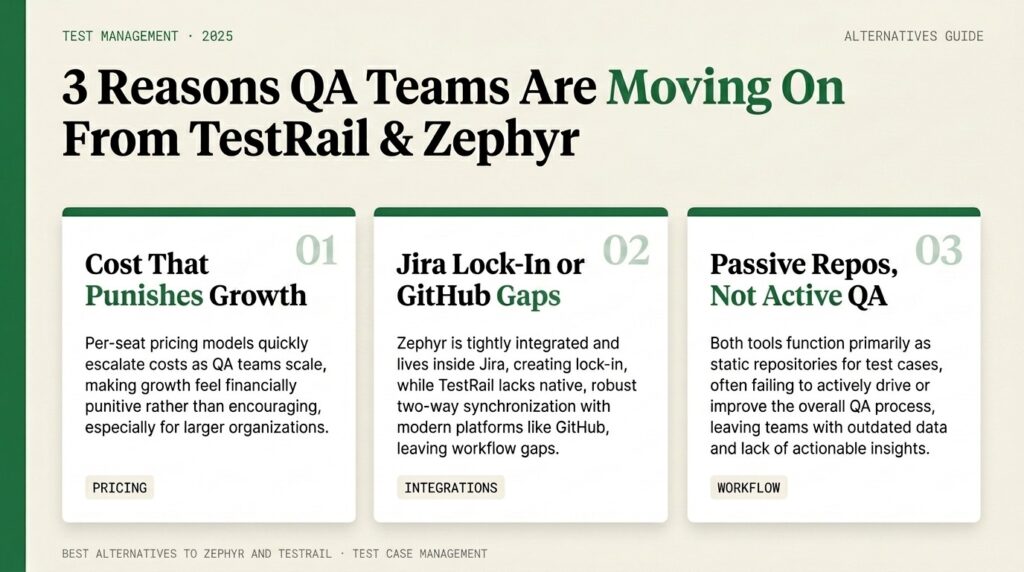
TestRail's pricing model is one of the most common friction points. What starts as a reasonable entry-level subscription escalates quickly as teams grow. The platform's folder-based organization works fine for smaller test repositories but becomes cumbersome at scale, and users consistently report the interface as dated. Customer support response times draw regular criticism in reviews, and the restriction of one connected bug tracker per project creates workflow constraints for teams managing multiple issue-tracking tools across different projects.
From a modern DevOps standpoint, TestRail functions as a system of record. It reports results; it doesn't drive the process. For teams that want QA test management software to be an active participant in their workflow rather than a passive log, that distinction matters considerably.
What Makes Teams Leave Zephyr?
Zephyr's biggest strength is also its main limitation: it lives inside Jira. If your entire development workflow runs through Atlassian, that's a genuine advantage. But if your team works heavily in GitHub, uses non-Atlassian CI/CD tooling, or needs a standalone test management environment with Jira as one of several integrations rather than the entire ecosystem, Zephyr becomes a constraint rather than a convenience. Zephyr Scale's pricing through the Atlassian Marketplace also adds up for larger teams, and the tool's complexity often requires significant onboarding investment before it delivers consistent value.
What Should You Evaluate in Test Case Management Tools?
Not all test case management tools are built around the same priorities. Before jumping into a feature comparison, it helps to define the criteria that actually matter for your team's specific workflow.
Here are the key dimensions worth evaluating:
- Integration architecture & Shift-Left support: Does the tool integrate natively with GitHub and Jira, or does it treat them as afterthoughts? Look for unified test management that supports automated GitHub Pull Request (PR) testing to catch issues before merging, rather than just periodic API polling.
- BDD and Gherkin support: Teams using behavior-driven development need a tool that handles Gherkin natively, not one that bolts on a BDD template field and calls it done.
- AI-assisted test generation: Modern platforms generate test cases from requirements and user stories, reducing manual authoring effort significantly.
- Pricing transparency and scalability: Does cost scale reasonably with team size, or does it punish growth with steep per-seat increases?
- Standalone vs. embedded: Do you want a purpose-built test management environment with deep integrations, or a plugin that lives inside another tool?
- Active test plan management: Does the tool treat the test plan as a living document that drives execution, or as static documentation updated after the fact?
How Do the Top Alternatives Compare?
The comparison below covers key evaluation criteria across five commonly evaluated test case management tools, with TestRail and Zephyr as the starting baseline.
| Tool | GitHub Integration | Jira Integration | Native Gherkin/BDD | AI Test Generation | Standalone | Starting Price |
| TestRail | Via API | Deep (2-way) | Template only | Limited | Yes | ~$38/user/mo |
| Zephyr Scale | Limited | Native (Jira-only) | Yes | Limited | No (Jira plugin) | Atlassian Marketplace |
| Xray | Limited | Native (Jira-only) | Strong | Emerging | No (Jira plugin) | Atlassian Marketplace |
| PractiTest | Via API | Yes | Yes | AI insights (SmartFox) | Yes | ~$39/user/mo |
| Testmo | Via API | Yes | Yes | Limited | Yes | Competitive tiers |
| TestQuality | Deep (2-way) | Native (2-way) | Strong | Advanced (QA Agent: TestStory.ai) | Yes | Free AI Builder + Competitive tiers |
Each of these tools covers the core test management workflow. Where they diverge is in how deeply they participate in your actual development process versus how much you have to work around them.
A Closer Look at the Top Alternatives to Zephyr and TestRail
When evaluating Zephyr alternatives and TestRail alternatives in depth, it helps to look at each option through the lens of a specific use case rather than just a feature checklist. The right tool depends heavily on your team's stack, size, and whether you're Jira-first, GitHub-first, or running both equally.
Xray
Xray is widely considered the strongest option for BDD-heavy teams working inside Jira. You can author Gherkin scenarios directly as Jira issue types, export them to Cucumber for execution, and import results back with full traceability. It's a natural fit for teams committed to the Atlassian ecosystem that want rich BDD support without leaving Jira. The tradeoff is the same as Zephyr: if GitHub is your primary version control environment or you work across non-Atlassian tooling, Xray's value proposition narrows significantly. Understanding how Gherkin integrates with test management workflows is worth doing before committing to any Jira-native tool for BDD.

PractiTest
PractiTest positions itself as an end-to-end ALM platform, covering requirements, test cases, execution, and defect tracking in a single environment. Its SmartFox AI engine generates test cases from requirements, flags duplicates, and suggests optimization strategies. For organizations that need deep traceability from business requirement to test outcome, PractiTest is a legitimate contender. It carries a premium price point and can feel heavy for smaller teams that don't need the full ALM scope.
Testmo
Testmo is one of the cleaner modern Zephyr alternatives for teams wanting a unified approach to manual, exploratory, and automated testing without enterprise-platform weight. Its interface is genuinely modern, onboarding is fast, and the core test management workflow is well-covered. Teams with complex CI/CD pipelines or multiple automation frameworks running simultaneously may find gaps in the deeper integration architecture that more mature platforms provide.
TestQuality & TestStory.ai
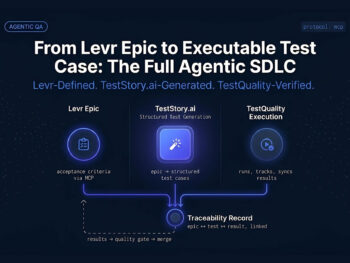
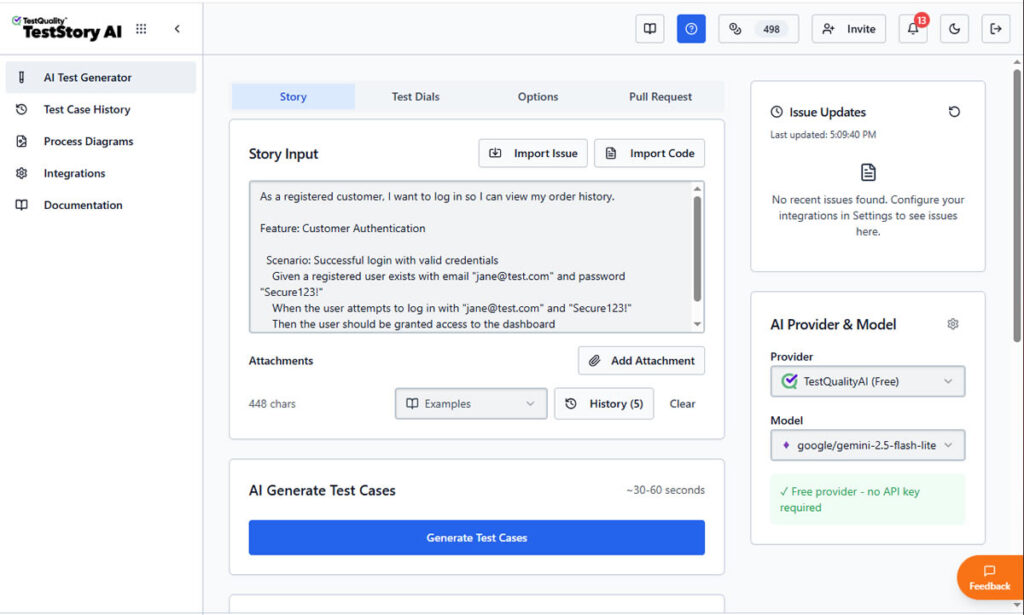
For teams looking to transition to an AI-driven, shift-left testing strategy, TestQuality provides a Unified Test Management environment built around native GitHub PR testing and deep Jira integration. Its standout differentiator is TestStory.ai, an intelligent QA agent that integrates with developer workflows via MCP, translating user stories and even business process diagrams into verifiable test cases using customizable 'Test Dials'. While highly potent for modern DevOps and BDD/Gherkin automation, organizations looking for fully air-gapped, on-premise legacy tools might find its cloud-first, AI-native approach more advanced than their immediate needs.
Qase
Qase has gained traction as a lightweight, developer-friendly platform with API-based GitHub and GitLab connectivity alongside Jira integration. It's a strong choice for teams that want something modern and approachable without heavy configuration overhead. The free tier makes evaluation easy, though teams with larger repositories or more advanced reporting requirements may hit plan limits. Reviewing how modern test management tools support shift-left practices can help you evaluate whether lighter platforms like Qase fully cover your pipeline needs.
Tricentis qTest
Tricentis qTest targets enterprise teams with complex, multi-project testing programs. It handles cross-project test case reuse, requirements traceability, and enterprise-grade reporting well. The tradeoff is significant cost and configuration complexity. For smaller or mid-sized teams, qTest is frequently more platform than needed, and its pricing reflects an enterprise positioning that's difficult to justify without a dedicated QA organization behind it.
What Should a Modern Test Management Platform Actually Do?
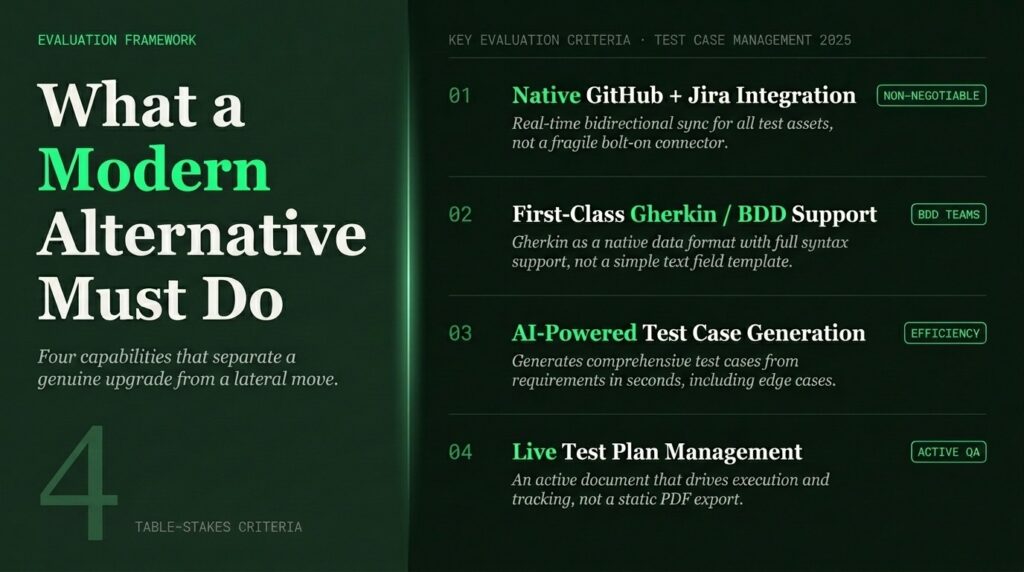
The tools above all represent legitimate options depending on your priorities. But certain capabilities stand out as table-stakes for any platform worth switching to. The 2024 Stack Overflow Developer Survey found that most professional developers already have CI/CD, DevOps, and automated testing available at their organizations, and that access to AI-assisted tooling at work doubled in a single year. The platform your team uses needs to keep pace with that reality.
Does It Integrate Where Your Work Already Happens?
The best modern platforms aren't separate systems you consult after the fact. They connect directly to GitHub pull requests, sync with Jira issues in real time, and surface test results inside the tools developers are already using. The Jira integrations available to QA teams vary significantly in depth across platforms, and real-time bidirectional sync is a fundamentally different experience from a lightweight webhook or an export-and-import cycle. Native GitHub integration is also worth scrutinizing carefully: many platforms advertise it as a feature while treating it as an afterthought in practice.
Does It Support AI-Powered Test Generation?
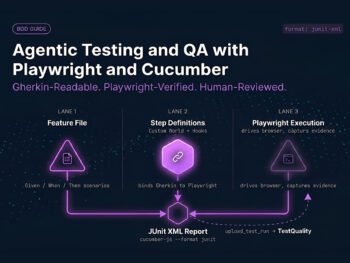
Manual test case authoring is still necessary, but it shouldn't be the default for every scenario. Modern QA test management software increasingly offers the ability to generate test cases from requirements, user stories, or feature descriptions in seconds. For teams practicing BDD, the ability to generate Gherkin test cases from requirements with AI directly addresses one of the most consistent bottlenecks in the workflow. Look for platforms where AI generation is integrated into the core test management experience either by using a chat interface or by integrating them directly into your agentic workflows.
Does It Treat the Test Plan as a Live Document?
One of the most overlooked differences between legacy tools and modern alternatives to Zephyr and TestRail is how they handle the test plan itself. Traditional platforms treat the test plan as documentation created at the start of a project and rarely revisited. Modern platforms make the test plan a live, executable artifact that actively drives test execution, tracks coverage, and surfaces quality metrics in real time. If your team's test plan currently lives in a Google Doc or a static PDF attached to a ticket, exploring what active test plan management looks like in a modern tool is worth doing before your next evaluation.
How to Make the Migration Less Painful
Switching test case management tools is a real commitment, and the fear of migrating existing test cases keeps plenty of teams on platforms they've outgrown. A few things that make the transition significantly smoother:
- Choose a platform with a well-documented importer for TestRail or Zephyr. Bulk migration of existing test cases, suites, and results eliminates the most painful part of the switch.
- Run a parallel pilot on a single new project before committing to full migration. This lets your team evaluate the platform on real work without risking existing test coverage.
- Prioritize integrations before migrating content. Get your new platform connected to GitHub and Jira first. A broken integration discovered mid-migration is far more disruptive than one caught during the pilot phase.
- Use AI test generation to refresh stale test cases during migration rather than simply relocating outdated content. Migration is a good opportunity to improve coverage at the same time.
Frequently Asked Questions
What are the main reasons teams switch from TestRail? The most common reasons include rising costs as teams scale, a dated user interface, slow customer support response times, limited real-time GitHub integration, and the restriction of one connected bug tracker per project. Teams practicing modern DevOps often find TestRail's passive reporting model doesn't fit their workflow.
Is Zephyr a good fit for teams that don't primarily use Jira? Generally, no. Both Zephyr Squad and Zephyr Scale are built to run inside Jira. Teams that work heavily in GitHub or use non-Atlassian CI/CD tooling will find Zephyr's architecture limiting. For teams with a mixed or GitHub-first workflow, a standalone QA test management software platform with native Jira integration is typically a better fit.
What should BDD teams look for in alternatives to Zephyr and TestRail? Look for native Gherkin support rather than a template field, the ability to import and export feature files, AI-powered test scenario generation in BDD format that takes context directly from your issue trackers (like Jira or GitHub defects), and real-time traceability from user stories to test execution. Platforms that treat Gherkin as a first-class format will serve BDD workflows significantly better over time.
How difficult is it to migrate from TestRail or Zephyr? Migration difficulty depends on the platform you're moving to and whether it provides a dedicated importer. Tools with native TestRail importers can dramatically compress the migration timeline. Running a pilot on a new project before committing to full migration is a reliable way to validate the platform without risking existing test coverage.
What are the best free alternatives to TestRail and Zephyr? Several platforms offer free tiers or trials, including Qase (free tier for small teams), TestLink (open-source), and TestQuality's free AI-powered test case builder (TestStory.ai). The right free option depends on whether you need pure test case tracking, BDD support, AI-driven context generation from Jira/GitHub, or CI/CD pipeline integration alongside basic test management.
Ready to Move Beyond TestRail and Zephyr?
Teams that successfully switch from TestRail or Zephyr share a consistent realization: they stopped looking for a tool that stores test cases and started looking for a platform that actively participates in how they build and ship software. That means a GitHub pull request that automatically surfaces related test results, a new user story that generates a structured Gherkin test suite in seconds, and a test plan that is a living document connected to real execution data.
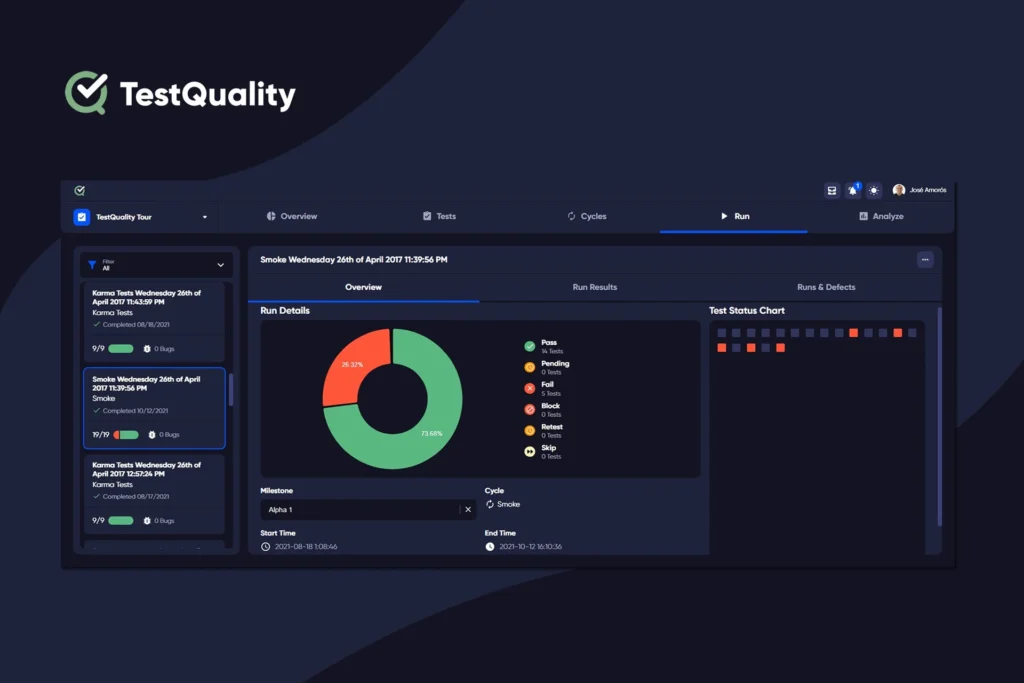
TestQuality is an AI-powered QA platform built specifically for that kind of workflow. With native GitHub and Jira integration, full Gherkin/BDD support, and QA Agents that assist throughout the test lifecycle from creation to execution, it addresses the core limitations that drive teams away from both TestRail and Zephyr.
TestStory.ai, TestQuality's AI-powered test generation engine, takes context directly from user stories, Jira issues, or GitHub defects to instantly build complete, Gherkin-ready test cases in seconds, making it a genuine upgrade for BDD teams at scale. Start your free trial and see what modern test management looks like when it's built for the way your team actually works.