Requirements traceability is the practice of linking high-level business goals and acceptance criteria directly to the code commits, test suites, and execution histories that verify them. In modern software engineering, achieving requirements traceability confirms that autonomous coding agents do not introduce silent bugs or build misaligned features; this forms the core of a disciplined agentic SDLC. By bridging Levr—an agentic project control plane—with TestQuality and TestStory.ai, teams can establish a continuous loop of verification. This process binds every agentic task to an executable test case, closing the visibility gap for human managers while maintaining delivery velocity across automated and manual testing environments.
At a Glance
The End-to-End Traceability Loop
Connecting requirements, execution, and verification in agentic teams.
The Problem: Agent-driven code generation moves too quickly for traditional issue trackers, leading to untracked features, silent failures, and a loss of historical test context.
The Levr Solution: Defines human intent via structured acceptance criteria, giving connected coding agents (such as Claude Code or Cursor) immediate project context over the Model Context Protocol (MCP).
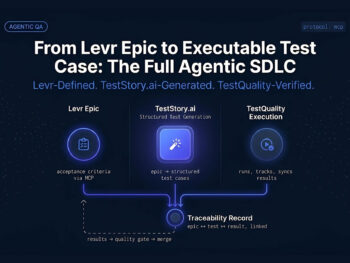
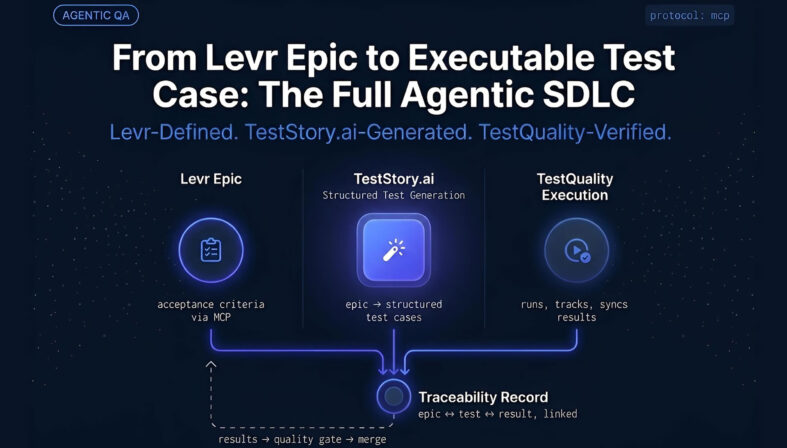
The TestStory.ai Bridge: Takes Levr's acceptance criteria, converts them into structured test cases, and syncs them instantly with TestQuality for manual or automated execution.
The Bottom Line: Merging these workflows establishes complete test case traceability, proving that agentic code output meets specifications before hitting production.
Traceability is not just about audit trails; it is the mechanism that keeps autonomous agents aligned with human intent. When requirements and testing operate in the same graph, teams can safely delegate coding to AI.
What Is Requirements Traceability in an Agentic Development Workflow?
Requirements traceability in an agentic workflow is the continuous thread linking business specifications to agent-written code and verification runs. It keeps autonomous systems from operating in a vacuum, providing a transparent record that proves every generated feature aligns with human intent.
In a traditional development lifecycle, humans write user stories, translate them into code, and manually link them to test suites inside a test management system. However, when software development teams integrate coding agents like Claude Code, Cursor, or Codex, this manual process breaks down. Agents construct and modify branches in minutes, while the corresponding documentation, tracking boards, and test plans often drift out of sync.
Without a structured connection between requirements and test artifacts, teams encounter what researchers call the "Planner-Coder Gap." According to empirical software engineering research published on arXiv:2510.10460, task decomposition failures and critical information loss during agent handoffs account for 75.3% of multi-agent execution errors. To mitigate this risk, teams need test case traceability—a bidirectional mapping that verifies every single requirement corresponds to a distinct test, and that every test execution is tied directly back to its originating epic or story.
How Does Levr's 4-Step Workflow Organize Agentic Execution?
Levr organizes agentic execution by wrapping AI coding agents in a structured four-step lifecycle. This control plane guides the process from human intent definition and agent tool consumption over MCP, through native verification graphs, to final human review and release gate approval.
As an agent-native project control plane, Levr acts as a centralized command center where human developers and coding agents share live objects.
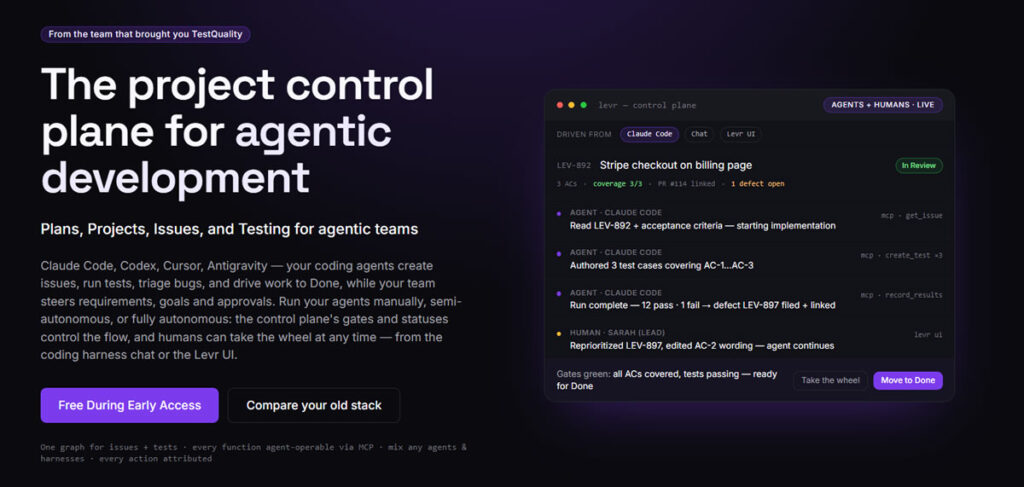
Levr's homepage messaging: the control plane positions itself as the coordination layer between coding agents (Claude Code, Codex, Cursor, Antigravity) and human-defined requirements, with configurable autonomy levels and gated status transitions.
Rather than retrofitting traditional boards with lightweight AI chat add-ons, Levr implements a core four-step workflow:
- Define intent in human language: Your team authors agent-assisted epics and issues with structured acceptance criteria. This criteria establishes the contract that your agents will implement and verify against.
- Agents pick up tasks: Connected coding agents (such as Claude Code, Cursor, or Codex) read the issue, its metadata, and the associated acceptance criteria directly over MCP. The agent can request clarification if ambiguities are detected before writing code.
- Verification in the same graph: Agents write functional code, author tests, and record run results using Levr's execution tools (start_run, record_results, and finish_run). If a test fails, a linked defect is filed on the same board automatically.
- Human review & approval: A human development lead inspects the changes, reviews the run histories, assesses the architectural impact, and approves the merge once all quality gates are satisfied.
Through this workflow, Levr's quality gates guarantee that code is never generated without clear requirements, and that no agent-written pull request is merged without execution proof.
How Does TestStory.ai Establish Test Case Traceability?
TestStory.ai establishes test case traceability by transforming requirements inputs into structured test cases and syncing them with TestQuality. This process groups tests into cycles and records execution results; once a tester confirms a failure as a genuine defect, TestQuality's GitHub and Jira integrations sync the record back to the team's tracker automatically.
While Levr manages the agentic orchestration and code-writing loop, TestStory.ai focuses squarely on generating high-fidelity test cases directly from your team's existing product context. It provides a structured, multi-step pipeline:
- Feed supported inputs: You provide TestStory.ai with a GitHub issue, Jira issue, user story, epic, process diagram, or raw source code.
- Structured test cases generated: Using advanced QA reasoning models, TestStory.ai parses the input to generate detailed, structured test cases (available as steps, Gherkin/BDD, or free-text).
- Cases sync into TestQuality: The generated test cases synchronize with TestQuality, where they're organized alongside your existing test plans and suites.
- Grouped into a run or cycle: QA leads organize these cases into execution runs or cycles linked to specific releases.
- Executed and recorded: Human testers or CI pipelines execute the runs, documenting results alongside manual and automated attempts.
- Coverage/defects link back automatically: Test results update your coverage metrics. Once a tester confirms a failing test represents a genuine defect, TestQuality's GitHub and Jira integrations sync the defect record to the team's tracker automatically, keeping the engineering records unified.
Where Do Levr and TestStory.ai Meet to Close the Quality Loop?
The two workflows converge when Levr's acceptance criteria serve as the input for TestStory.ai's test generation. Once verified within TestQuality, the execution results stream back to Levr's control plane to satisfy the quality gates required for human approval and merge.
This intersection establishes the ideal balance between autonomous code generation and governed, professional-grade quality assurance. Rather than letting coding agents self-verify using basic, unmonitored scripts, the team routes Levr's epic acceptance criteria into TestStory.ai.
This generates an independent, structured test suite inside TestQuality. As the coding agents implement the feature in Levr, their execution results are mirrored across both platforms, closing the quality loop.
The Integration Point
When something breaks, whose name is on it?
A trace only holds up if every link in it is attributed. Levr, an agent-first project control plane, keeps issues, tests, and run results in one graph — so when a test fails, you can see exactly which agent or person authored the change, ran the test, and is responsible for resolving it.
Built into the workflow itself:
Every action — human or agent — attributed and timestamped in one audit trail
Nothing reaches Done until it clears the verification gates you've defined
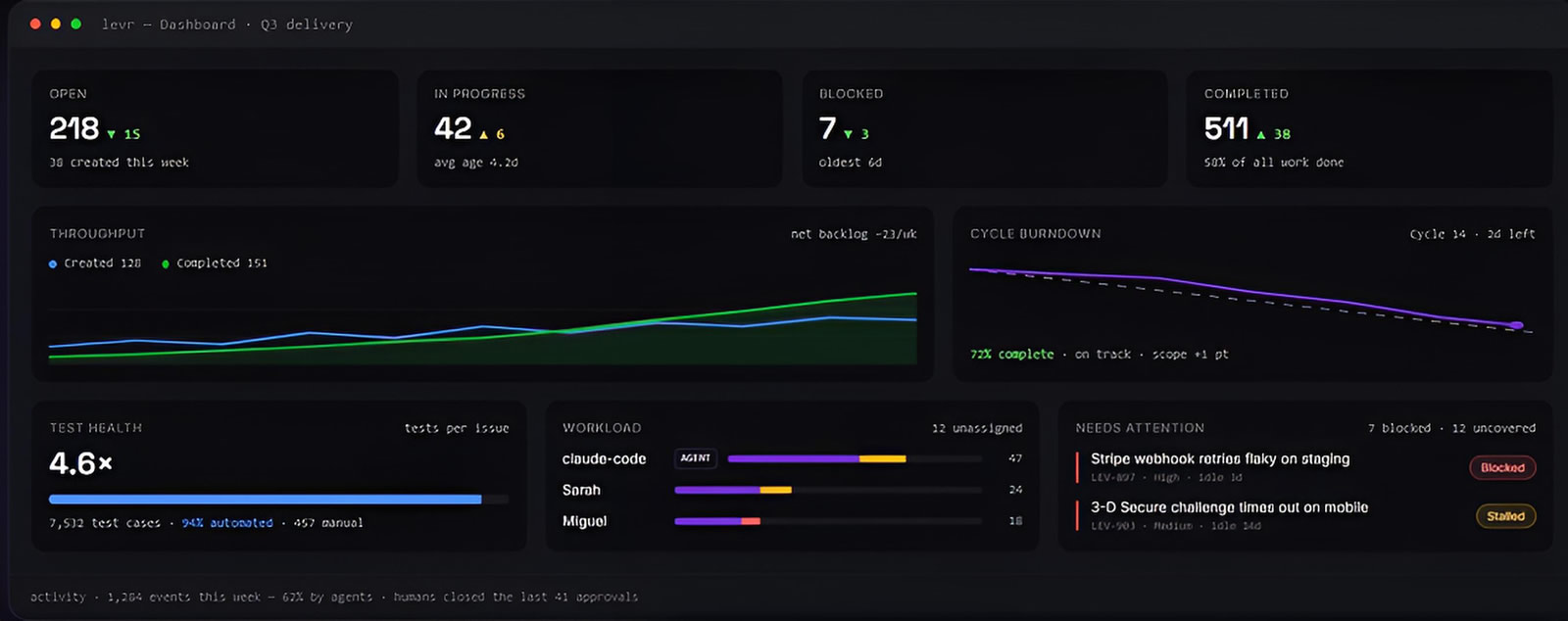
See Levr's agent-run execution →
What Are the Operational Benefits of an Integrated Traceability Thread?
An integrated traceability thread eliminates manual verification overhead and bridges the planner-coder gap. It provides teams with real-time audit trails, mitigates the risks of non-deterministic agent behaviors, and maintains human governance without slowing down autonomous agent execution speeds.
When requirements and testing operate in a shared, synchronized graph, software engineering organizations gain several operational improvements:
- Mitigating Non-Deterministic Risk: Autonomous agents are fundamentally non-deterministic. As detailed in VirtusLab's research on testing and evaluating agentic systems, non-deterministic agents suffer from a "verification gap" where traditional compilation passes miss semantic failures. Linking Levr to TestQuality captures trajectory-level evaluation data for human review.
- Eliminating Silent Semantic Errors: Many agentic failures are silent errors that bypass standard syntax checking. Integrating TestStory.ai's functional test scenarios catches these errors during run cycles, rather than after release.
- Continuous Compliance: For regulated industries, having an unbroken chain of custody from Levr Epics, through TestStory.ai test generations, to TestQuality execution logs provides an out-of-the-box audit trail.
- Optimized Resource Routing: Human developers can remain focused on architecture, goals, and approvals, while coding agents handle repetitive implementation and first-pass validation.
Technical Deep Dive FAQ
Key Takeaways
Requirements Traceability in Practice
Enforcing standards across human-agent collaborative teams.
Traceability stops drift: Bidirectional mapping keeps agentic code modifications aligned with human-specified epics.
Levr defines intent: Structured acceptance criteria are made available to coding agents directly via MCP.
TestStory.ai generates coverage: Epics convert to verified test cases in TestQuality with zero manual script-writing overhead.
Quality gates enforce safety: Code branches cannot merge until associated TestQuality runs record successful execution.
By coupling the generative power of coding agents with structured test repositories, engineering teams can maintain both high delivery speeds and strict software quality standards.
About the Author
Jose Amoros is part of the TestQuality marketing team, writing regularly about agentic QA, requirements traceability, and modern software testing strategies. He specializes in helping development teams integrate automated testing systems with collaborative human workflows.
Further Reading
- The Agentic SDLC Guide: Building, Testing, and Verifying AI-Generated Code — TestQuality's foundational handbook for agentic teams.
- TestQuality Features Overview — Exploring suites, runs, cycles, and native integrations.
- TestQuality Documentation — Reference for CLI usage, GitHub/Jira integration setup, and API details.
- Understanding and Bridging the Planner-Coder Gap — Zongyi Lyu, Songqiang Chen et al. on task-decomposition failures.
- How to Test and Evaluate Agentic Systems for Reliability — Tomasz Gołębiowski / VirtusLab on non-deterministic system verification.
- Levr Project Control Plane — The home of agent-first project and issue management.
Start Free Today
Bring Order to Your Agentic Quality Workflows
Don't let agent speed break your QA process. Use TestStory.ai to instantly generate test cases from user stories, criteria, or diagrams, then manage, execute, and track results within TestQuality.
Get 500 TestStory.ai credits every month included with your TestQuality subscription — no extra cost.
No credit card required. Free trials available for both platforms.