AI test case generation tools are transforming how QA teams create, maintain, and execute tests by automating repetitive work and improving coverage.
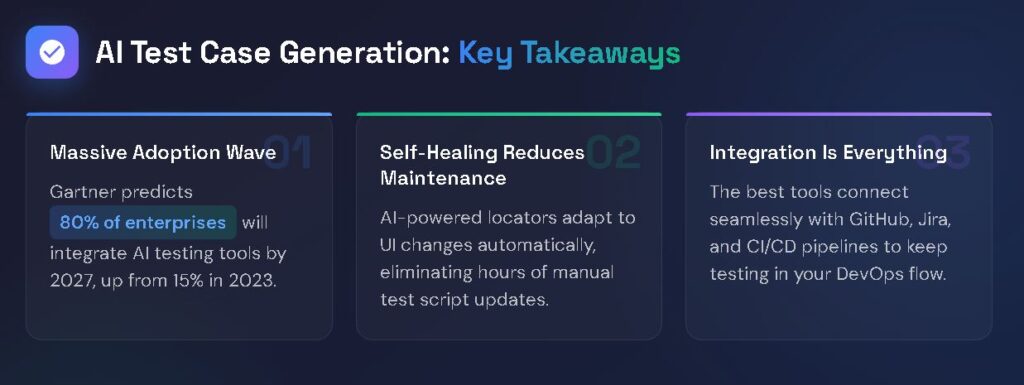
- Gartner predicts 80% of enterprises will integrate AI-augmented testing tools by 2027.
- The best AI test case builders combine natural language processing, self-healing capabilities, and deep integrations with DevOps workflows.
- Choosing the right tool depends on your existing tech stack, team size, and whether you prioritize Salesforce-specific testing or broader GitHub/Jira integration.
Teams that adopt AI for QA now will reduce manual test creation time while expanding their test coverage.
Software testing has always been a balancing act between thoroughness and speed. You want comprehensive coverage, but you also want to ship features before your competitors do. Traditional test creation methods force QA teams into an uncomfortable choice: spend days manually writing test cases or accept gaps in coverage that might let bugs slip through.
The AI-enabled testing market hit $1.01 billion in 2025 and is projected to reach $3.82 billion by 2032, signaling that teams everywhere are embracing smarter approaches to quality assurance. AI test case generation tools are automating the creation of test scenarios from requirements, user stories, and application behavior, giving QA professionals more time to focus on exploratory testing and edge cases that actually require human judgment.
Where teams once relied on spreadsheets and manual documentation, AI for QA now enables intelligent test creation that adapts as applications change.

What Are AI Test Case Generation Tools?
AI test case generation tools use machine learning, natural language processing, and pattern recognition to automatically create test scenarios from various inputs. Instead of QA engineers manually translating requirements into step-by-step test cases, these platforms interpret user stories, acceptance criteria, or application behavior to generate comprehensive test coverage.
The technology works through several interconnected processes. First, the AI parses your requirements or user stories to identify key actions, conditions, and expected outcomes. Then it generates multiple test scenarios, including edge cases and boundary conditions that human testers might overlook. Finally, each scenario gets converted into actionable test steps that can be executed manually or automated through frameworks like Selenium, Playwright, or Cypress.
What separates modern AI test case generation tools from earlier automation attempts is their ability to understand context. They recognize that a login feature requires testing for valid credentials, invalid passwords, account lockouts, session management, and dozens of other scenarios that would take hours to document manually. The best test automation approaches combine this intelligent generation with robust execution and reporting capabilities.
These tools also increasingly incorporate self-healing capabilities. When your application's UI changes, traditional automated tests break and require manual updates. AI-powered locators can identify elements even after modifications, reducing maintenance overhead and keeping your test suites running smoothly through rapid development cycles.

Why Does AI Test Case Generation Matter for QA Teams?
The pressure on QA teams is high. Agile methodologies demand faster release cycles, continuous integration requires constant validation, and application complexity keeps growing. According to Gartner's market analysis, 80% of enterprises will integrate AI-augmented testing tools into their software engineering toolchains by 2027.
Test generation with AI addresses several pain points that slow down development teams. Manual test case creation is time-consuming and error-prone. QA engineers spend countless hours translating requirements into test steps, often missing scenarios that seem obvious in hindsight. Automated test design powered by AI can generate comprehensive test suites in minutes rather than days.
Maintenance costs are another major driver. Traditional automated test suites become increasingly fragile as applications evolve. Every UI change, new feature, and refactored component risks breaking existing tests. Teams often spend more time maintaining tests than creating new ones. AI-powered tools with self-healing capabilities and intelligent locators reduce this burden.
The coverage gap matters too. Human testers naturally focus on obvious scenarios and happy paths. AI test case builders systematically identify edge cases, boundary conditions, and negative test scenarios that manual approaches typically miss. This comprehensive coverage catches bugs earlier in the development cycle when they are much cheaper to fix.

What Features Should You Look for in Test Generation AI Tools?
Selecting the right AI test case builder requires evaluating capabilities across several dimensions. The most effective tools share certain characteristics that separate them from basic automation platforms.
Natural Language Processing Capabilities: The best tools interpret requirements written in plain English, Gherkin syntax, or informal user stories. Look for platforms that understand context and intent rather than requiring rigid formatting.
Integration with Existing Workflows: Tools that connect with your issue trackers, version control systems, and CI/CD pipelines deliver the most value. Deep integration with GitHub and Jira workflows eliminates context switching and keeps testing data synchronized with development activities.
Self-Healing Test Maintenance: AI-powered locators that adapt to UI changes without manual intervention reduce maintenance overhead. This capability becomes increasingly important as applications evolve rapidly.
Support for Multiple Testing Types: Comprehensive platforms handle manual test case generation, automated test creation, API testing, and exploratory testing within a unified environment. This flexibility allows teams to choose the right approach for each scenario.
Customization and Control: While AI generates test cases, QA teams need the ability to fine-tune outputs, add custom logic, and adapt generated content to specific requirements. The best tools provide guardrails and customization options rather than black-box outputs.
Reporting and Analytics: Understanding test coverage, identifying gaps, and tracking quality trends requires robust analytics. Look for platforms that provide actionable insights rather than just raw data.
How Do the Top AI Test Case Generation Tools Compare?
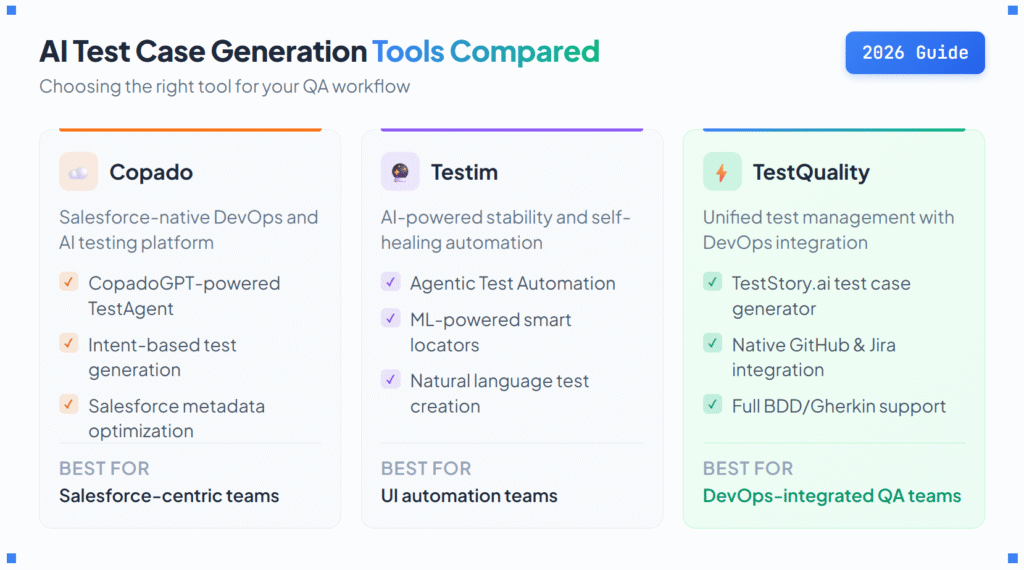
Evaluating AI test case generation tools requires understanding how each platform approaches the balance between automation and control. Three platforms represent different approaches to this challenge, each with distinct strengths depending on your specific needs and existing technology investments.
The following comparison examines key capabilities across these leading solutions:
| Feature | Copado | Testim | TestQuality |
| Primary Focus | Salesforce DevOps | Web/Mobile/Salesforce UI | Unified Test Management |
| AI Test Generation | TestAgent with CopadoGPT | Agentic Test Automation | TestStory.ai |
| Self-Healing | Yes (Salesforce-optimized) | ML-powered locators | Supported via framework integrations |
| Natural Language Input | Yes | Yes | Yes |
| CI/CD Integration | Native Salesforce DevOps | Multiple CI/CD tools | Jenkins, CircleCI, GitHub Actions |
| GitHub/Jira Integration | Limited | Basic | Native live two-way sync |
| BDD/Gherkin Support | Limited | Limited | Full native support |
| Pricing Model | Enterprise licensing | Per-user subscription | Team-based (starts at $90/month for 10 users) |
| Best For | Salesforce-centric teams | UI test automation | DevOps-integrated QA workflows |
Copado
Copado has built its reputation as the leading DevOps and testing platform for Salesforce environments. Their AI capabilities, powered by CopadoGPT, focus specifically on the unique challenges of testing custom Salesforce applications.
The TestAgent feature allows teams to create test scripts from natural language prompts, convert existing manual tests into automated scripts, and generate API test cases to supplement UI testing. The platform's intent-based testing approach interprets user objectives and generates relevant test scenarios aligned with business requirements.
Copado excels in environments where Salesforce is the primary application under test. The platform's integration with Salesforce metadata enables dynamic Lightning element handling and reduces the brittleness typically associated with Salesforce UI testing. Teams using Copado benefit from tight alignment between development and testing within a single DevOps pipeline.
The platform's limitations become apparent when testing extends beyond the Salesforce ecosystem. Organizations with diverse application portfolios may find themselves needing additional tools for non-Salesforce testing, potentially fragmenting their quality assurance workflows.
Testim
Testim, now part of Tricentis, approaches AI test case generation with a focus on stability and reduced maintenance. The platform's ML-powered locators offer sophisticated approaches to handling dynamic web applications.
The platform's Agentic Test Automation enables teams to describe tests in natural language and let the AI automatically build complete test scripts. For Salesforce environments specifically, this means building comprehensive tests without code using conversational descriptions. The self-healing capabilities identify elements across web, mobile, and Salesforce applications using customized AI and ML smart locators.
Testim's strength lies in reducing the ongoing maintenance burden that plagues traditional automated test suites. The platform's locator technology learns from application behavior and adapts to UI changes, keeping tests running even as applications evolve.
The platform integrates with CI/CD pipelines and provides comprehensive reporting, though teams seeking deep integration with specific issue trackers or version control systems may find the connections less seamless than purpose-built integrations.
TestQuality
TestQuality takes a different approach by positioning AI test case generation within a broader unified test management platform. Rather than focusing exclusively on test automation, the platform integrates AI-powered test creation with comprehensive test planning, execution, and analytics.
TestStory.ai, the platform's AI test case generator, creates functional test cases from user stories, epics, and issues imported directly from Jira, Linear, or GitHub. The system offers fine-grained control through "Test Dials" and reusable "Preset Packs" that let teams customize generation for specific scopes, audiences, and test types.
The platform's architecture prioritizes live two-way integration with development tools. Changes in GitHub or Jira automatically reflect in test management, and test status flows back to development workflows in real time. This bidirectional synchronization eliminates the manual export/import cycles that create data inconsistencies in other platforms.
For teams practicing behavior-driven development, the platform provides native Gherkin support with drag-and-drop feature file import and Cucumber integration. The combination of AI-generated test cases and structured BDD workflows offers flexibility that pure automation tools typically lack.
The platform's approach prioritizes test management and workflow integration over built-in test execution, meaning teams still rely on external automation frameworks like Selenium or Playwright for actual test runs. However, this framework-agnostic approach provides flexibility that locked-in solutions cannot match.
How Can You Choose the Right Tool for Your Team?
Selecting an AI test case builder depends heavily on your existing technology investments and testing priorities. However, most modern development teams share common needs: seamless integration with their existing workflows, flexibility across testing types, and pricing that scales reasonably as teams grow.
Teams heavily invested in Salesforce environments will find Copado's specialized capabilities compelling, particularly for organizations seeking unified DevOps and testing workflows within the Salesforce ecosystem. The platform excels in its niche but requires supplementary tools for applications outside that environment.
Organizations prioritizing UI test automation with minimal maintenance overhead should evaluate Testim's self-healing capabilities and agentic automation. The platform's focus on stability makes it particularly suitable for teams struggling with flaky tests, though the per-user pricing model can become costly as organizations scale.
Development teams using GitHub and Jira as their primary collaboration tools—which represents the majority of modern software organizations—will benefit most from platforms offering native, live integration with these workflows. The ability to maintain synchronized data across development and testing activities eliminates friction and keeps quality visible throughout the delivery process. This integration-first approach also tends to drive higher adoption rates since testing feels like a natural extension of existing workflows rather than a separate activity.
Consider these questions when evaluating options:
Does your primary testing focus center on a specific platform like Salesforce, or do you need broad coverage across diverse applications? Platform-specific tools offer deeper capabilities within their domain but may require additional solutions for comprehensive coverage.
How important is integration with your existing issue trackers and version control systems? Teams that prioritize seamless workflows should evaluate integration depth carefully, as superficial connections often create more friction than they eliminate.
What level of control do you need over generated test cases? Some platforms prioritize automation over customization, while others provide extensive fine-tuning capabilities that let teams adapt outputs to specific requirements.
How does pricing scale with your team growth? Per-user licensing can become expensive for growing organizations, while team-based pricing models offer more predictable costs as you scale.
For most development teams, the combination of AI-powered test generation, native DevOps integration, and flexible pricing creates the strongest foundation for sustainable quality engineering practices.

Frequently Asked Questions
What is the difference between AI test case generation and traditional test automation? Traditional test automation executes pre-written test scripts, while AI test case generation creates the test scenarios themselves. AI tools interpret requirements and user stories to generate comprehensive test cases, including edge cases that humans might miss. Traditional automation requires someone to write each test manually before execution.
Can AI test case generation tools replace human QA engineers? AI test case generation tools augment rather than replace QA professionals. They handle repetitive test creation tasks, freeing engineers to focus on exploratory testing, strategy, and complex scenarios requiring human judgment. The most effective teams combine AI-generated coverage with human expertise in identifying subtle quality issues.
How do self-healing capabilities work in AI testing tools? Self-healing tools use machine learning to identify application elements through multiple attributes rather than single locators. When UI changes occur, the AI recognizes elements based on context, behavior, and learned patterns, automatically updating test scripts without manual intervention.
What ROI can teams expect from AI test case generation tools? Organizations typically see reductions in test creation time, often completing in minutes what previously took days. Maintenance costs decrease with self-healing capabilities, and expanded test coverage catches bugs earlier when they are cheaper to fix. The specific ROI depends on team size, testing volume, and current manual processes.
Transform Your Testing Workflow with AI
Rather than spending days manually creating test cases, teams can now generate comprehensive test coverage in minutes while focusing their expertise on exploratory testing, edge cases, and quality strategy.
The key to success lies in choosing tools that integrate naturally with your existing workflows rather than forcing teams to adapt to new processes. The most effective platforms enhance rather than disrupt, providing AI capabilities within familiar environments and maintaining seamless connections with the development tools teams already use daily.
For teams seeking an AI-powered test management platform that combines intelligent test case generation with deep GitHub and Jira integration, TestQuality offers a unified solution that brings AI capabilities directly into your DevOps workflow. Start your free trial and discover how AI-driven test creation can accelerate your quality engineering efforts.