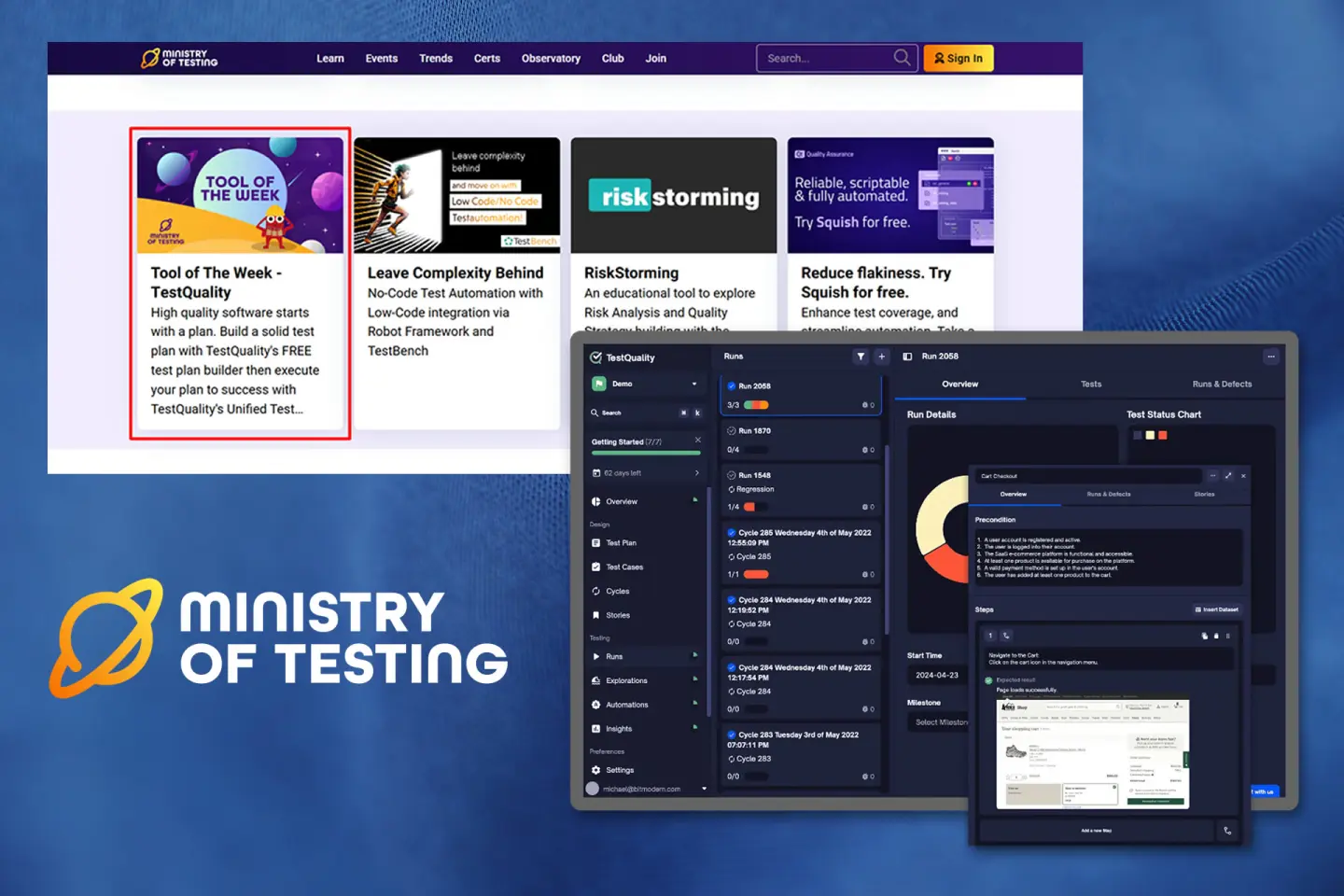
TestQuality Named “Tool of the Week” by Ministry of Testing!
Why TestQuality Test Management was named “Tool of the Week” by Ministry of Testing? Explore our free Test Plan Builder, Test Case Management, GitHub & Jira integrations, and more.
We’re excited to share some big news with our community of QA professionals, software testers, and developers: TestQuality has been named “Tool of the Week” by the Ministry of Testing (MoT), one of the most respected communities in the software testing world!
So, what makes this special, and why should it matter to you?
A Unified Test Management Platform Built for Today’s QA Needs
At TestQuality, our goal has always been to empower teams with a unified QA test management platform that works for both manual and automated testing workflows. From planning to reporting, we help QA professionals and developers deliver high-quality software with confidence.
We were founded with a simple belief: testing tools should work with your dev process, not against it.
With our recent updates, we’re more excited than ever to offer our core platform completely free to help teams get started:
💡 Visual Test Plan Builder
📄 Test Case Builder
✅ Complete Free Test Management Plan
All designed for rapid adoption with zero friction.
Explore our simple, fair pricing with a 14-day trial on any premium plan — no credit card required.
Spotlight: The Test Plan Builder (Free and Powerful)
One of the tools that helped TestQuality stand out is our Test Plan Builder — a free, guided tool that walks users through creating a detailed and professional test plan from scratch or template.
With the Test Plan Builder, you can:
Add structured test plan components like:
Objectives, Scope, Approach, Roles and Responsibilities
Ministry of Testing has built a vibrant and trusted QA community. Being featured as Tool of the Week is not just a badge — it’s a reflection of how useful, reliable, and community-aligned TestQuality has become.
And it’s only the beginning.
Ready to Take TestQuality for a Spin?
If you haven’t yet tried TestQuality or your free trial ended, this is the perfect time to jump back in.
🔗 Try the Free Plan — no expiration, no credit card: Start Free 🔄 Or activate your 14-day free trial on any of our premium plans
TestQuality helps QA teams and developers write better test plans, manage test cases smarter, and execute tests with confidence — all in one platform.
Well-written Gherkin test cases are the foundation of successful BDD, but sloppy scenarios wreck team collaboration and break your automation suite. The gap between good and bad Gherkin…
The right test management software connects your test plans, dev tools, and results into one system that actually keeps up with how you ship. If your tests still live in spreadsheets or a…
Test automation software runs your tests automatically so teams catch bugs sooner and ship faster. Start by mapping which tests actually deserve automation, then choose the tool that fits…
Jul 8, 2026 · 9 min read
We use optional analytics cookies to understand how this site is used. They are off unless you accept. Essential cookies needed to run the site are always on.We use optional analytics cookies to understand how this site is used. You can opt out at any time. Essential cookies needed to run the site are always on.See our Privacy Policy.