
Key Takeaways
Test automation efficiency revolutionizes software quality assurance by transforming time-intensive manual processes into rapid, reliable, and repeatable testing cycles.
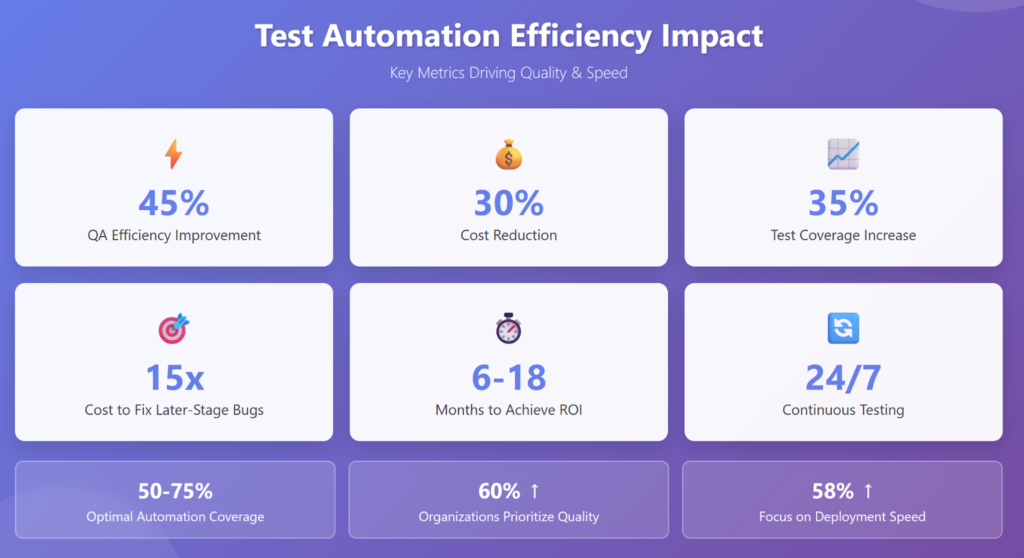
- Organizations implementing test automation achieve 45% improvements in QA efficiency while reducing overall testing costs by 30%
- Automated testing delivers 24/7 execution capabilities, dramatically expanding test coverage and accelerating feedback loops for development teams
- The productivity gains from automation free skilled QA professionals to focus on strategic initiatives like exploratory testing and complex scenario validation
- Test automation efficiency compounds over time as reusable test scripts and comprehensive test management scale across projects, platforms, and releases, ensuring consistent quality.
The smartest QA teams recognize that automation isn't about replacing testers; it's about amplifying their impact and maximizing the value they deliver to the business.
Software teams face relentless pressure to deliver faster without sacrificing quality. Manual testing can't keep pace with modern development cycles, creating bottlenecks that delay releases and frustrate stakeholders. According to research published in academic journals, organizations focusing on quality metrics through automation achieve average improvements of 45% in quality assurance efficiency while cutting testing costs by 30%.

Test automation efficiency represents more than just faster test execution. It encompasses the entire ecosystem of benefits that automation brings: reduced cycle times, improved accuracy, expanded coverage, resource optimization, and sustainable testing practices that scale with your applications. When teams successfully implement automation strategies, they fundamentally transform how they approach quality assurance.
The question isn't whether to automate anymore. Teams that resist automation fall behind competitors who can test more thoroughly, release more frequently, and respond to market demands with agility. The real question becomes: how do you maximize test automation efficiency to gain these competitive advantages?
What Makes Test Automation Efficiency Different from Just Automation?
Test automation efficiency transcends merely automating individual test cases. True efficiency measures the optimal value delivered by your automation investment relative to the resources consumed. Automating thousands of tests without strategic test management—if they're poorly designed, unstable, or target irrelevant aspects—will not yield genuine efficiency.
Efficient test automation exhibits several key characteristics. First, it targets the right test cases for automation based on factors like stability, execution frequency, and business impact. Not every test should be automated, and efficient teams recognize this distinction. Second, efficient automation maintains itself with minimal overhead, often facilitated by features within a robust test management platform that simplify test updates. Tests that require constant manual updates waste resources and negate the benefits of automation.
Third, test automation efficiency manifests through measurable improvements in development velocity. When automation provides rapid feedback on code changes, developers can iterate faster and catch issues before they compound. The testing productivity gains extend beyond the QA team to accelerate the entire delivery pipeline.
Finally, efficient automation integrates seamlessly into existing workflows rather than creating new silos. Teams achieve maximum efficiency when automated tests run automatically as part of continuous integration pipelines, providing instant validation without manual intervention.
How Does Test Automation Dramatically Improve Speed and Execution Time?
Speed represents one of the most immediate and visible benefits of test automation efficiency. Manual test execution follows a linear path where testers work through test cases sequentially, constrained by human limitations. Automated tests execute at machine speed, completing in minutes what would take hours or days manually.
The speed advantage compounds when running regression test suites. After each code change, teams must verify that existing functionality still works correctly. Manual regression testing for complex applications can require weeks of effort. Automated regression suites run the same comprehensive checks overnight, freeing teams to focus on new feature testing.
Parallel execution multiplies these speed benefits exponentially. While a manual tester can only execute one test at a time, automation frameworks can run dozens or hundreds of tests simultaneously across multiple environments, browsers, and devices. This parallel capability transforms testing from a bottleneck into an enabler of rapid release cycles.
According to a Gartner Peer Insights survey, 60% of organizations cited improving product quality as a primary reason for automation, with 58% seeking to increase deployment speed. Automated tests execute quickly and repeatedly, essential in agile settings where changes are frequent and need validation promptly. The continuous nature of automated testing means development teams receive feedback within minutes rather than waiting for the next manual testing cycle.
Beyond raw execution speed, automation eliminates the delays inherent in coordinating manual testing efforts. No scheduling conflicts, no waiting for testers to become available, no handoffs between shifts. Tests run on demand, on schedule, or triggered automatically by code commits, providing consistent velocity regardless of human resource constraints.

What Tangible Cost Savings Does Test Automation Deliver to Organizations?
The financial case for test automation efficiency becomes compelling when you calculate the full spectrum of cost impacts. While automation requires upfront investment in tools, infrastructure, and training, these costs are typically recovered within the first year through multiple savings mechanisms.
Labor cost reduction represents the most direct savings. Manual testing consumes significant personnel resources, with teams spending thousands of hours executing repetitive test cases. Automation handles these repetitive tasks at a fraction of the cost. Organizations implementing comprehensive automation strategies consistently achieve substantial cost reductions in their testing operations while maintaining or improving quality levels.
The earlier defects are detected, the less expensive they become to fix. Industry research from software security leaders shows that fixing bugs found during testing can cost 15 times more than fixing those found during design. Automated tests running continuously throughout development identify issues immediately, preventing expensive downstream fixes and production incidents.
Hidden costs of quality problems also decrease with automation. Production defects damage customer relationships, generate support tickets, and create emergency response situations that disrupt planned work. According to industry analysis, organizations with robust automation report significantly fewer customer-facing issues, translating to reduced support costs and improved customer retention.
Resource reallocation creates additional financial value. When automation handles routine testing, skilled QA professionals can focus on high-value activities like exploratory testing, usability analysis, and test strategy development. This optimal use of human capital drives innovation and quality improvements that pure cost reduction metrics don't capture.
The scalability economics of automation improve over time. Initial test development requires investment, but those tests run repeatedly across multiple releases with minimal incremental cost. As your test suite grows, the average cost per test execution decreases while coverage and confidence increase.
How Does Automation Exponentially Increase Test Coverage?
Test coverage represents the breadth and depth of testing across your application. Manual testing faces inherent coverage limitations due to time and resource constraints. Teams must prioritize which scenarios to test, inevitably leaving gaps where defects can hide.
Automation removes these coverage constraints by enabling exhaustive testing that would be impractical manually. Comprehensive regression suites verify thousands of scenarios after every code change. Data-driven testing validates functionality across hundreds of input combinations. Cross-platform testing ensures compatibility across multiple browsers, devices, and operating systems simultaneously.
The ability to test edge cases and unusual scenarios improves dramatically with automation. Manual testers naturally gravitate toward happy path scenarios and common use cases. Automated tests can systematically explore boundary conditions, error handling, and rare user journeys that might reveal critical defects.
Organizations leveraging AI-powered test case generation, like TestStory.ai, report coverage improvements of 25-35% according to recent industry studies. These intelligent systems analyze application behavior to identify untested code paths and automatically generate test cases that expand coverage into previously unexplored areas, dramatically increasing testing depth and speed.
Organizations implementing AI-based test generation report coverage improvements of 25-35% according to recent industry studies. These intelligent systems analyze application behavior to identify untested code paths and automatically generate test cases that expand coverage into previously unexplored areas.
Continuous testing, facilitated by robust test management platforms, ensures coverage persists across all stages of the development lifecycle. Automated unit tests validate code at the component level, integration tests verify system interactions, and end-to-end tests confirm complete user workflows. This layered approach, managed effectively, creates comprehensive protection against defects at every level.
5 Proven Ways Test Automation Boosts Testing Productivity
Organizations seeking to maximize QA automation benefits need practical strategies that deliver measurable productivity gains. Here are five proven approaches that consistently improve team performance:
1. Eliminate Repetitive Manual Work
The most immediate productivity gain comes from automating tedious, repetitive tasks that consume vast amounts of manual testing time. Regression testing, smoke testing, and sanity checks represent perfect automation candidates. These tests must run frequently but rarely reveal new defects, making them ideal for automation. When automation handles these routine checks, testers reclaim hundreds of hours for more valuable work.
2. Enable Continuous Feedback Loops
Automation integrates testing directly into development workflows through continuous integration pipelines. Every code commit triggers automated test suites that provide instant feedback to developers. This rapid feedback cycle catches issues within minutes of introduction, preventing defects from propagating through the codebase. Teams working with continuous testing report resolving bugs in hours rather than days, dramatically accelerating development velocity.
3. Facilitate Parallel Testing at Scale
Modern automation frameworks support parallel test execution across distributed infrastructure. A single tester might execute 20-30 test cases per day manually. The same test suite automated can run across 50 virtual machines simultaneously, completing in under an hour. This parallel execution capability transforms testing from a sequential bottleneck into a scalable operation that keeps pace with rapid development cycles.
4. Create Reusable Testing Assets
Well-designed automation creates reusable test components that compound productivity over time. Page object models, utility functions, and test data generators become shared resources that accelerate new test development. Teams report that reusability reduces test creation time by 30-50% for subsequent projects as their automation library matures. This compound productivity effect makes automation investments increasingly valuable over time.
5. Support Shift-Left Testing Practices
Automation enables testing to move earlier in the development lifecycle, a practice known as shift-left testing. When developers can run automated tests locally before committing code, they catch issues immediately without involving QA teams. Early-stage testing improves overall productivity by preventing defects from ever reaching formal testing phases. Research shows teams leveraging shift-left approaches identify considerably more critical defects before production release, cutting rework and maintaining development momentum.
Manual vs Automated Testing: A Clear Efficiency Comparison
Understanding when to use manual versus automated testing requires examining their efficiency characteristics across multiple dimensions:
| Efficiency Factor | Manual Testing | Automated Testing |
| Execution Speed | Limited by human pace, typically 20-30 tests per day | Executes hundreds or thousands of tests per hour |
| Repeatability | Prone to human variation and errors in repetitive tasks | Perfectly consistent execution every time |
| Coverage Capacity | Constrained by available time and resources | Scales to comprehensive coverage across platforms |
| Cost Over Time | Ongoing labor costs for each test cycle | Initial investment with declining per-execution cost |
| Feedback Speed | Hours to days depending on test complexity | Minutes to hours with continuous integration |
| Best Use Cases | Exploratory testing, usability evaluation, ad-hoc scenarios | Regression testing, load testing, repetitive validation |
| Maintenance | No script maintenance but requires process documentation | Requires script updates when application changes |
| Skill Requirements | Domain knowledge and testing intuition | Technical skills plus testing knowledge |
This comprehensive comparison reveals that test automation efficiency, when integrated with effective test management, excels in scenarios demanding speed, scale, and repetition. Manual testing, conversely, remains superior for tasks requiring human judgment, creativity, and subjective evaluation. The most efficient testing strategies, often facilitated by a unified test management platform, leverage both approaches strategically, treating them as complementary rather than competitive.
Modern QA teams recognize that automation and manual testing form complementary parts of a comprehensive quality strategy. Automation handles the heavy lifting of repetitive validation, while skilled manual testers focus on exploratory work, usability assessment, and complex scenarios that benefit from human insight. Organizations that strike this balance achieve optimal efficiency and quality outcomes.

What Challenges Can Impact Test Automation Efficiency?
Despite the compelling benefits, organizations encounter common obstacles that can undermine test automation efficiency if not addressed proactively. Understanding these challenges helps teams navigate implementation successfully and maximize their automation ROI.
Test maintenance represents one of the most persistent efficiency drains. Applications evolve constantly with UI changes, feature updates, and architectural modifications. Automated tests that worked perfectly last month may fail after routine updates, requiring time-consuming maintenance. Teams that neglect maintenance find their test suites becoming increasingly unreliable, creating false failures that waste time investigating non-issues. The solution involves designing tests for maintainability from the start, implementing page object patterns, and allocating dedicated time for test upkeep.
Choosing inappropriate tests for automation damages efficiency more than it helps. Not every test should be automated. Tests that change frequently, require subjective evaluation, or validate rare scenarios may cost more to automate and maintain than they deliver in value. Efficient automation focuses on stable, high-frequency, high-impact test cases that provide clear ROI. Teams must resist the temptation to automate everything and instead be strategic about automation candidates.
Tool selection and technical skills create another common challenge. The automation landscape offers countless tools, frameworks, and approaches. Selecting tools that don't align with your technology stack or team capabilities leads to inefficient implementations. Similarly, automation requires technical skills that many manual testers haven't developed. Organizations achieve better efficiency outcomes by investing in training, choosing accessible tools, and building automation capabilities gradually rather than attempting wholesale transformations overnight.
Integration complexity can undermine automation efficiency when tests operate in isolation from development workflows. Automated tests that require manual triggering, produce reports in separate systems, or don't integrate with existing toolchains create friction that reduces adoption and value. Efficient automation integrates seamlessly into continuous integration pipelines, communicates results through existing channels, and fits naturally into team workflows.
How Can Teams Optimize Their Approach to Speed Up Testing Through Automation?
Maximizing test automation efficiency requires strategic implementation rather than simply automating everything in sight. Teams that approach automation thoughtfully achieve superior results compared to those that automate haphazardly.
Start by establishing clear automation goals aligned with business objectives. Are you trying to reduce release cycle time? Improve test coverage? Cut testing costs? Your automation strategy should directly support specific, measurable goals that matter to stakeholders. This focus ensures your automation efforts deliver tangible business value rather than just technical achievements.
Prioritize test cases for automation using objective criteria. High-frequency tests that run repeatedly across releases deliver maximum efficiency gains from automation. Stable tests that don't change frequently minimize maintenance overhead. Business-critical tests that validate revenue-generating or high-risk functionality provide the most valuable coverage. Use these factors to create a prioritized automation backlog rather than automating tests randomly.
Invest in proper automation architecture and design patterns. Tests built on solid foundations maintain themselves more easily and scale more effectively than hastily cobbled scripts. Implement page object models to separate test logic from UI structure, making tests resilient to interface changes. Create reusable utility functions that eliminate duplication across your test suite. Build modular tests that can be maintained independently rather than creating monolithic test scripts.
Integrate automation into continuous integration pipelines from day one. Automated tests sitting in a repository waiting for manual execution waste their potential. Configure your CI system to run appropriate test suites automatically on code commits, pull requests, and scheduled intervals. Make test results visible to development teams through dashboards and notifications that drive immediate action on failures.
Establish metrics that track automation efficiency over time. Monitor test execution time, pass/fail rates, maintenance effort, and defect detection effectiveness. These metrics reveal whether your automation investment delivers expected returns and highlight areas needing improvement. Regular analysis of automation metrics enables continuous refinement of your testing strategy.
Frequently Asked Questions About Test Automation Efficiency
How long does it take to see ROI from test automation?
Most organizations begin realizing positive ROI from test automation within 6-18 months of implementation. The timeline depends on factors like the size of your test suite, stability of your application, and how strategically you select tests for automation. Teams that focus on high-value, frequently-executed tests typically achieve ROI faster than those that automate indiscriminately. Industry analysis shows that approximately one-quarter of companies report immediate ROI from their automation investments, while the majority see substantial returns within the first year as automation scales across their testing efforts.
What percentage of testing should be automated?
Industry data shows that most successful organizations automate 50-75% of their testing, with the optimal balance varying based on application characteristics and team capabilities. Attempting 100% automation proves counterproductive, as certain tests benefit more from human evaluation. Focus automation on regression testing, integration testing, API validation, and performance testing while reserving manual testing for exploratory work, usability assessment, and complex scenarios requiring human judgment. The goal isn't maximum automation percentage but rather optimal efficiency through strategic automation of the right test cases.
Does test automation eliminate the need for manual testers?
Absolutely not. Test automation transforms the role of QA professionals rather than replacing them. While automation handles repetitive validation tasks, skilled testers remain essential for exploratory testing, usability evaluation, test strategy development, and automation maintenance. Organizations implementing automation typically redeploy manual testers to higher-value activities that leverage their domain knowledge and creative problem-solving abilities. The most efficient QA organizations combine automation for speed and coverage with human intelligence for areas requiring judgment and insight.
How do you measure test automation efficiency?
Measure automation efficiency through multiple metrics that capture different dimensions of value. Track execution speed improvements by comparing automated test suite runtime against equivalent manual testing time. Monitor cost savings by calculating labor hours saved through automation. Assess coverage expansion by measuring the increase in test scenarios executed regularly. Evaluate quality improvements through metrics like defect detection rates and defect escape rates. Calculate maintenance overhead by tracking time spent updating and fixing automated tests. These metrics together provide a comprehensive view of whether your automation investment delivers expected efficiency gains.
Ready to Transform Your Testing Efficiency with TestQuality's Unified Test Management Platform?
TestQuality understands that test automation efficiency is one of the highest-return investments available to modern software organizations. The compound benefits of faster execution, reduced costs, expanded coverage, and improved productivity create competitive advantages that extend far beyond the QA team. Organizations that master automation, often with the right test management solution, deliver higher-quality software faster and more reliably than competitors still dependent on manual testing alone.
The path to automation efficiency requires strategic thinking rather than tactical test scripting. Teams succeed by aligning automation with business goals, prioritizing the right tests for automation, investing in maintainable architecture, and continuously measuring and refining their approach.
TestQuality provides the framework for this strategic thinking. The most efficient testing organizations recognize that automation amplifies human expertise rather than replacing it, freeing skilled professionals to focus on work that truly requires their talents.
Modern development demands testing approaches that scale with increasing complexity and velocity. Manual testing alone cannot keep pace with continuous delivery pipelines, multi-platform requirements, and expanding application footprints. Test automation efficiency provides the answer, transforming quality assurance from a bottleneck into an accelerator of business value.
TestQuality empowers teams to maximize their test automation efficiency through unified test management platform that seamlessly integrates manual and automated testing workflows. Our platform connects with leading automation tools, CI/CD systems, and development platforms to create a comprehensive testing ecosystem that scales with your needs. Whether you're beginning your automation journey or optimizing existing practices, TestQuality provides the foundation for sustainable testing efficiency. Start your free trial today and discover how unified test management transforms quality assurance into a strategic competitive advantage.