Key Takeaways
Shift left testing moves quality assurance earlier in the software development lifecycle to catch defects when they're cheapest to fix.
- Poor software quality costs the U.S. economy at least $2.41 trillion annually, with much of that stemming from defects discovered too late in development
- Early testing accelerates feedback loops, reduces rework, and improves collaboration between developers and QA teams
- Successful implementation requires cultural change, automation investment, and integration with CI/CD pipelines
If you're still testing only at the end of development, you're paying a premium for bugs that could have been caught in minutes instead of weeks.
Software defects drain resources at a staggering scale. According to the Consortium for Information & Software Quality (CISQ), poor software quality costs the U.S. economy at least $2.41 trillion annually. Technical debt alone accounts for roughly $1.52 trillion of that figure. The solution isn't more testing at the end of your project. The solution is testing earlier and more strategically.
Shift left testing addresses this problem by integrating quality assurance activities from the earliest stages of development. Rather than treating testing as a final checkpoint before release, teams embed testing throughout the entire software development lifecycle. This approach transforms QA from a bottleneck into a continuous process that improves code quality while accelerating delivery timelines.
For teams adopting agile methodologies or building DevOps pipelines, understanding shift left testing is no longer optional. It's foundational to delivering reliable software at speed.
What Is Shift Left Testing?
Shift left testing refers to the practice of moving testing activities earlier in the software development lifecycle. The term comes from how development phases are typically visualized on a timeline: requirements and design sit on the left, while testing and deployment occupy the right. Traditional approaches concentrate testing efforts toward the right side of that timeline. Shift left testing pushes those activities leftward, closer to the beginning.
In sequential development models like waterfall, testing happened primarily after most coding was complete. Teams would spend weeks or months building features, then hand everything to QA for validation. Problems discovered at this stage meant expensive rework, delayed releases, and frustrated stakeholders.
Shift left testing flips this approach. Instead of waiting until software is nearly finished, teams begin testing during requirements gathering, continue through design and development, and maintain testing intensity throughout the project. This doesn't mean abandoning end-stage validation entirely. It means catching the majority of issues before they compound into larger problems.
The goal is simple: find defects when they're easiest to fix. A bug identified while a developer is actively writing code takes minutes to address. That same bug discovered in production might require days of investigation, hotfixes, rollbacks, and customer communication. Test management platforms that integrate directly with development workflows enable this kind of rapid feedback by connecting automated test results with issue tracking and requirements traceability.
Why Does Shift Left Testing Matter?
The economics of defect detection tell a compelling story. Industry research consistently shows that fixing bugs becomes significantly more expensive as software progresses through development phases. Studies from researchers like Barry Boehm have demonstrated that defects found during later stages of the SDLC require substantially more effort to remediate than those caught during design or early development.
These numbers reflect the compounding complexity of late-stage fixes. When a bug surfaces in production, teams must reproduce the issue, trace it through layers of code, implement a fix without breaking other functionality, deploy the change safely, and communicate with affected users. Compare that to catching the same issue during a code review, where the developer simply updates a few lines before moving on.
Beyond cost, shift left testing addresses the feedback gap that plagues traditional development. When weeks separate writing code from receiving test results, developers have moved on to other tasks. Returning to fix old code requires context-switching, rediscovery, and often introduces new issues. Rapid feedback keeps developers engaged with their work and enables faster iteration. Modern unified test management platforms bridge this gap by pulling automated test results directly from CI/CD pipelines into centralized dashboards where teams can monitor quality in real time.

The following table illustrates how testing focus differs between traditional and shift left approaches:
| Aspect | Traditional Testing | Shift Left Testing |
| When testing begins | After development is mostly complete | During requirements and design |
| Primary testers | Dedicated QA team | Developers, QA, and stakeholders |
| Feedback speed | Days to weeks | Minutes to hours |
| Defect cost | High (late detection) | Low (early detection) |
| Release risk | Higher uncertainty | Lower uncertainty |
| Collaboration model | Sequential handoffs | Continuous collaboration |
How Does Shift Left Testing Fit Into DevOps?
Modern devops testing strategy depends heavily on shift left principles. DevOps emphasizes continuous integration, continuous delivery, and rapid iteration. None of these practices work well when testing remains a late-stage bottleneck.
In a DevOps environment, code changes trigger automated pipelines that build, test, and potentially deploy software within minutes. This automation demands that testing be integrated throughout the pipeline, running unit tests as developers commit code, executing integration tests as features merge, and validating deployments continuously. The results speak for themselves: according to Capgemini's World Quality Report, 64% of organizations reported that agile and DevOps adoption improved on-time delivery, while 61% noted improvements in customer experience.
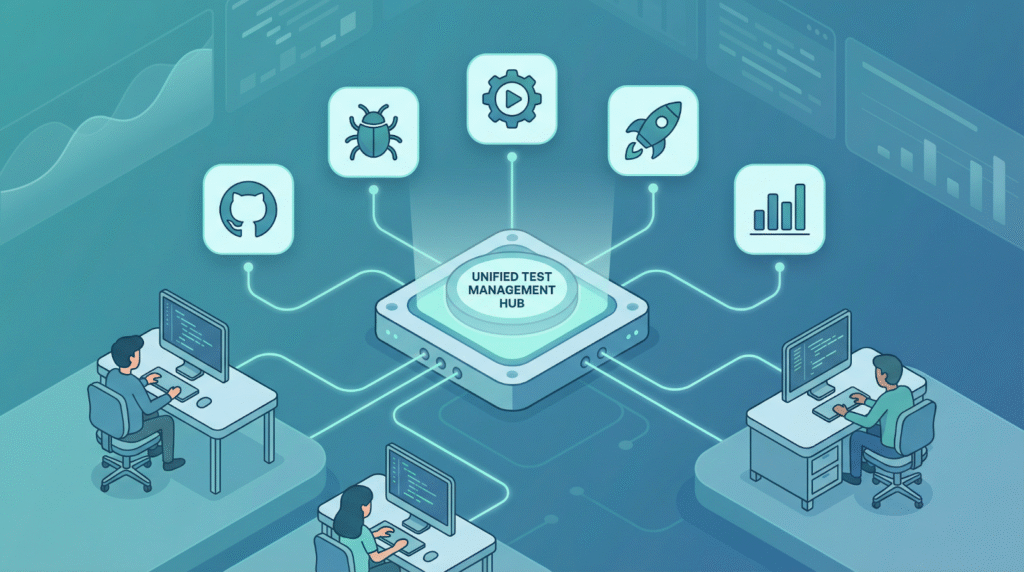
Shift left testing provides the foundation for this automation by establishing testing practices that can run quickly and frequently. Instead of comprehensive manual test passes that take days, teams develop suites of automated tests designed to catch regressions immediately. This enables the rapid release cadences that DevOps promises. Platforms that offer native integrations with tools like GitHub and Jira help teams maintain their existing workflows while gaining comprehensive test management capabilities.
The cultural aspects of DevOps also align with shift left thinking. DevOps breaks down silos between development, operations, and QA teams. Everyone shares responsibility for quality, and testing knowledge spreads across the organization rather than concentrating in a separate department. Developers write testable code, testers contribute during design discussions, and operations provides feedback on deployment reliability.
Techniques like Test-Driven Development (TDD) and Behavior-Driven Development (BDD) naturally support both shift left and DevOps goals. TDD requires writing tests before code, guaranteeing that testing happens at the earliest possible moment. BDD leverages Gherkin syntax to create shared specifications that stakeholders and developers understand, aligning requirements with automated validation from project inception. Today, AI-powered test case generation has revolutionized this process, allowing teams to instantly convert user stories into valid Gherkin scenarios without the manual overhead.
What Are the Core Benefits of Shift Left Testing?
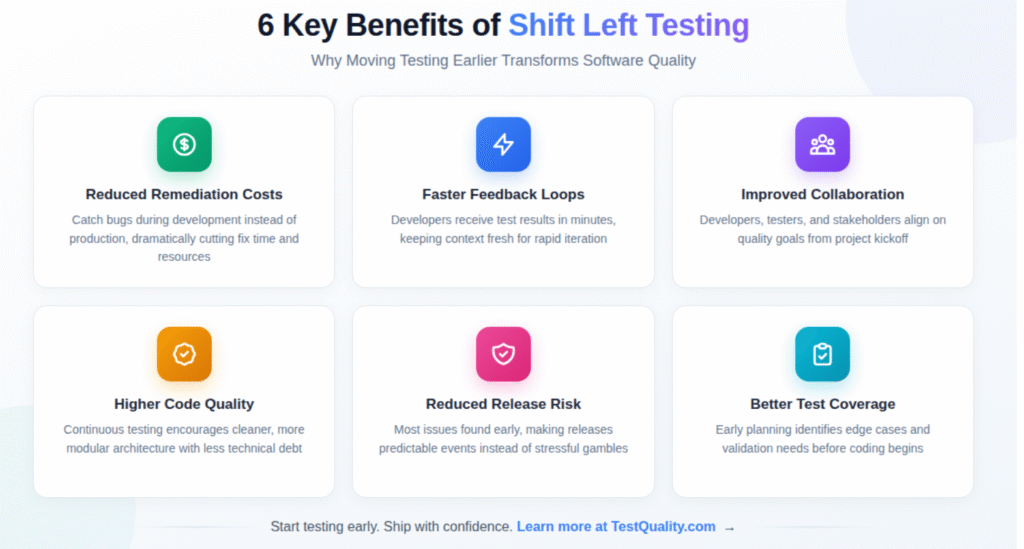
Organizations adopting shift left testing typically experience improvements across multiple dimensions. While cost reduction often drives initial interest, the benefits extend further:
- Reduced defect remediation costs: Catching bugs during development rather than production slashes the time and resources required for fixes. Teams spend less energy on emergency patches and more on building new features.
- Faster feedback loops: Developers receive test results within minutes of committing code. This immediacy keeps context fresh and enables rapid iteration. Problems get addressed before they propagate into other areas of the codebase.
- Improved collaboration: When testing happens early, it involves more stakeholders. Developers, testers, product managers, and designers discuss quality from project kickoff. This shared ownership reduces finger-pointing and builds stronger teams.
- Higher code quality: Continuous testing pressure encourages cleaner code architecture. Developers write more modular, testable code because they know tests will run immediately. Technical debt accumulates more slowly when quality gates operate throughout development.
- Reduced release risk: By the time software reaches final validation stages, most issues have already been found and fixed. Releases become predictable events rather than high-stress gambles. Teams ship with confidence because extensive testing has already occurred.
- Better test coverage: Early test planning ensures comprehensive coverage. When teams consider testing during requirements, they identify edge cases and validation needs before coding begins. This proactive approach catches scenarios that late-stage testing often misses.
Integrating AI-driven automation into your workflow amplifies these benefits. While traditional automation requires heavy scripting, modern QA agents can now create, run, and analyze tests automatically. This executes consistently and quickly at scale, freeing human testers to focus on high-value exploratory work and strategy that machines can't replicate.
How Do You Implement Shift Left Testing Successfully?
Moving to shift left testing requires more than declaring a new policy. It demands changes to processes, tools, culture, and skills. Organizations that succeed typically approach implementation systematically.
Start With Early Test Planning
Quality considerations should enter projects during requirements gathering, not after development begins. Include testers in sprint planning, design reviews, and specification discussions. Their perspective helps identify testability concerns, missing requirements, and potential defects before anyone writes code.
Create test plans alongside feature specifications. Define acceptance criteria, identify test scenarios, and establish coverage targets while requirements are still being refined. This parallel development ensures testing receives adequate attention and resources from project inception. AI-powered test management tools can now accelerate this phase by scanning requirement documents to automatically generate test cases and edge scenarios, making the early planning process instant rather than labor-intensive.
Build Automation Infrastructure
Shift left testing depends heavily on automated tests that run quickly and reliably. Invest in building robust test automation frameworks that integrate with your CI/CD pipelines. Start with unit tests that developers can run locally, then expand to integration and end-to-end tests that execute automatically on each build.
Choose tools that support your technology stack and team skills. The automation infrastructure should make testing easier, not create additional complexity. Look for test management solutions that can automatically import results from popular frameworks like Selenium, Playwright, Cucumber, JUnit, and others through standardized formats like JUnit XML. Monitor test suite health to prevent flaky tests from undermining confidence in results.
Foster Cultural Change
Technical implementation alone won't achieve shift left success. Teams must embrace shared responsibility for quality. Developers need to view writing tests as integral to their work, not an afterthought. QA professionals should engage during design phases, not wait for code to arrive.
Leadership plays a critical role in cultural transformation. Prioritize quality metrics alongside velocity. Celebrate catching bugs early rather than just counting features shipped. Create psychological safety for reporting issues without blame.
Iterate and Improve
No organization implements shift left testing perfectly on the first attempt. Start with pilot projects to learn what works in your context. Measure results, gather feedback, and adjust approaches based on evidence. Build on successes while addressing pain points.
Establish metrics that reflect shift left goals. Track where in the lifecycle defects are discovered. Measure time from code commit to test feedback. Monitor test strategy effectiveness and adjust coverage based on findings.
What Challenges Come With Shift Left Testing?
Despite clear benefits, shift left testing presents real challenges that organizations must address:
Cultural resistance often emerges when existing workflows change. Developers may feel that testing responsibilities distract from coding. QA teams might worry about job security if developers handle more testing. Address these concerns through clear communication about how roles evolve rather than disappear.
Initial investment in automation and tooling requires upfront resources. Building comprehensive test suites takes time before delivering returns. Organizations focused on short-term velocity may struggle to justify this investment. Frame automation as infrastructure that compounds returns over time.
Skills gaps appear when teams lack testing expertise. Developers may not know how to write effective tests, or how to format scenarios in Gherkin. QA professionals may need training on complex automation frameworks. Leveraging AI-assisted testing tools can bridge this gap, acting as a force multiplier that helps team members generate code-compliant tests and analyze failures via simple chat interfaces, reducing the steep learning curve of traditional automation.
Coordination complexity increases when more people participate in testing. Communication overhead grows. Teams need clear processes for managing test ownership, resolving conflicts, and maintaining consistency. Strong tooling that provides real-time synchronization between test management, issue tracking, and development workflows helps manage this complexity effectively.
Frequently Asked Questions
What is the difference between shift left and shift right testing?
Shift left testing moves quality assurance earlier in development to catch defects before deployment. Shift right testing extends testing into production environments, using techniques like canary releases, A/B testing, and monitoring to validate software with real users. Many organizations use both approaches together for comprehensive quality coverage.
Does shift left testing replace traditional QA?
No. Shift left testing changes when and how testing occurs but doesn't eliminate the need for QA professionals. Testers take on new roles including automation development, early planning involvement, and exploratory testing that complements automated validation. QA expertise remains essential; it simply applies earlier and more continuously.
How long does it take to implement shift left testing?
Implementation timelines vary based on organizational size, existing practices, and automation maturity. Pilot projects can show results within a few sprints. Full organizational adoption typically takes six months to two years, including cultural change and infrastructure development. Start small, demonstrate value, and expand gradually.
What tools support shift left testing?
Shift left testing uses various tools including unit testing frameworks (JUnit, pytest, Jest), CI/CD platforms (Jenkins, GitHub Actions, GitLab CI), static analysis tools (SonarQube, ESLint), and test management platforms that integrate with development workflows. The specific tools depend on your technology stack and team preferences.
Accelerate Your Testing With the Right Platform
Shift left testing transforms quality assurance from a late-stage checkpoint into a continuous practice woven throughout development. Organizations that embrace early testing catch defects faster, reduce costs, ship more confidently, and build stronger teams. The approach requires investment in automation, culture, and skills, but the returns justify the effort.
For teams ready to implement shift left practices, having the right AI-Powered QA foundation matters. TestQuality has evolved beyond traditional management to offer TestStory.ai, a tool that leverages powerful QA agents to create and run test cases, and analyze test results automatically from a chat interface. Get started with TestQuality and TestStory.ai today.