
Key Takeaways: The Rise of Agentic AI
- From Scripted to Autonomous: Testing is shifting from rigid, pre-defined scripts to Agentic AI systems that perceive, reason, and act independently.
- Market Swift: Gartner predicts that by 2028, 33% of enterprise software will include agentic AI, up from near zero in 2024. With 69% of teams shipping code 2x faster year-over-year, human-only testing can no longer keep pace. Also, Early adopters of AI in Quality Engineering report 72% faster automation processes (Capgemini`s 16th edition of the World Quality Report)
- Action-Oriented: Unlike Generative AI (which creates content), Agentic AI executes complex workflows, runs tests, and interacts with APIs without constant human prompting.
- The Agentic Loop: Successful agents operate on a cycle of Perception, Reasoning, Action, and Reflection, allowing for self-healing tests and smarter defect analysis.
- Strategic Tooling: Modern QA requires evolving your tech stack. This includes Test Case Builders (like TestStory.ai) for creation and AI-Powered Test Management Tools (like TestQuality) for orchestration.
- Human-AI Collaboration: The future is not replacement, but augmentation. Agents handle the repetitive regression execution, allowing humans to focus on high-value exploratory testing.
Introduction
The landscape of software development is undergoing a profound transformation. We are witnessing a collision between unprecedented development speed and spiraling architectural complexity. According to the 2024 Global DevSecOps Report by GitLab, 69% of Global CxOs report that their organizations are shipping software at least twice as fast as they did a year ago.
Today, the industry is moving beyond this brittle, scripted approach and embracing Agentic AI, a revolutionary paradigm where software systems do not just follow instructions but possess the critical abilities to perceive, reason, and act independently to achieve broad quality goals.

This shift from passive automation to active autonomy is not merely an incremental update; it represents the next major evolution after Generative AI (GenAI). It is poised to reshape how Quality Assurance (QA) professionals operate, transforming the CI/CD pipeline from a bottleneck into an accelerator.
What is Agentic AI?
To understand the future of testing, we must first define the technology driving it.
Agentic AI is defined as an autonomous or semi-autonomous AI system designed to achieve specific objectives with minimal human intervention. The term “Agentic” derives from “agency”—the capacity of an entity to act independently.
Unlike traditional test automation frameworks, which adhere strictly to predefined code paths (if X, then Y), or basic Generative AI, which waits for a user prompt to output text, Agentic AI is proactive. It acts as an intelligent, context-driven tester capable of executing sophisticated, multi-step workflows.
The 4 Core Characteristics of Agentic AI
This autonomy is built upon four core characteristics that distinguish an “Agent” from a simple “Bot”:
- Goal-Oriented Behavior: Agentic systems are not task-bound; they are goal-bound. They are trained to pursue overarching objectives, such as “Ensure the checkout flow is functional” or “Maximize regression coverage,” rather than simply executing Line 40 of a script.
- Autonomy: These systems make independent decisions based on their environment. They can determine which tests to prioritize based on recent code commits, when to retry a flaky test, or when to halt execution due to critical environment failures.
- Perception: Agents continuously monitor their environment. They gather information from diverse sources—APIs, DOM elements, system logs, user stories, and Jira tickets. This constant perception informs their decision-making process.
- Action and Execution: This is the critical differentiator. Based on their planning, agents take physical or digital actions. In QA, this involves interacting with the application (clicking, typing), compiling code, querying databases, or triggering third-party tools via API.
The Agentic Workflow: A Continuous Cycle
For an AI-powered QA tool to be truly effective, it must follow a recursive pathway designed for continuous improvement. We call this the Agentic Loop:
- Perceive: The agent collects real-time data from the software environment (e.g., detecting a new commit or a change in the UI DOM).
- Reason: Utilizing Large Language Models (LLMs) as the system’s “brain,” the agent interprets the context. It asks: Does this code change impact the login module? If so, which tests are relevant?
- Act: The agent executes the plan. This could involve generating a new test case using a test case builder, running a specific regression suite, or logging a defect.
- Reflect (Learn): The system evaluates the outcome. If a test failed, was it a bug or a flaky script? The agent uses reinforcement learning to refine its strategy, prioritizing high-risk areas in future cycles.
Agentic AI vs. Generative AI: The Functional Difference
It is common for organizations to conflate Generative AI with Agentic AI, but for QA strategy, the distinction is vital.
| Feature | Generative AI (GenAI) | Agentic AI |
| Primary Role | The Creator | The Doer |
| Core Function | Generates content (Text, Code, Images) based on prompts. | Orchestrates and executes workflows to achieve goals. |
| Autonomy | Passive (Requires user input). | Active (Can trigger its own tasks). |
| QA Application | Writing a test script snippet. | Running the script, analyzing the failure, and retrying. |
In essence: Generative AI writes the strategy; Agentic AI goes to war. While GenAI might generate a specific test case description, Agentic AI would proceed to execute that test case, analyze the results, log a corresponding bug, and adapt the regression suite based on the failure.
How AI Agents are Transforming the Software Testing Landscape
The rise of Agentic AI is timely. Traditional scripted automation struggles to keep pace with modern agile development cycles and the sheer volume of code generated by AI assistants like GitHub Copilot.
By integrating AI-Powered QA agents into the lifecycle, organizations unlock several transformative benefits:
1. Faster Test Creation and Coverage
AI agents can automatically generate test cases directly from requirements, user stories, or code analysis. This drastically cuts the time QA teams spend on manual test design.
- In Practice: Advanced tools dedicated to Story-Driven Test Case Creation, such as TestStory.ai, bridge the gap between business requirements and run-ready tests. By analyzing the narrative of a user story, the agent ensures comprehensive test coverage is achieved before a single line of code is committed.
2. Adaptive Execution (Self-Healing)
A major pain point in Selenium or Cypress automation is maintenance. If a developer changes a CSS ID, the test fails. Agentic AI utilizes “self-healing” techniques. If an agent cannot find an element by ID, it “perceives” the page, finds the element by text or position, updates the test script automatically, and continues execution.
3. Smarter Defect Detection and Analysis
Agents do not just report “Fail.” They analyze logs, network traffic, and historical patterns to identify the root cause.
- Scenario: Instead of a generic error message, the agent reports: “Test failed due to a timeout in the Payment API (500 Error), likely caused by the recent database migration.” This reduces the Triage phase from hours to minutes.
Distinguishing Key QA Tools in the Agentic Era
For QA professionals evaluating modern solutions, it is crucial to understand the specialized roles of key tool categories, especially as they integrate agentic capabilities.
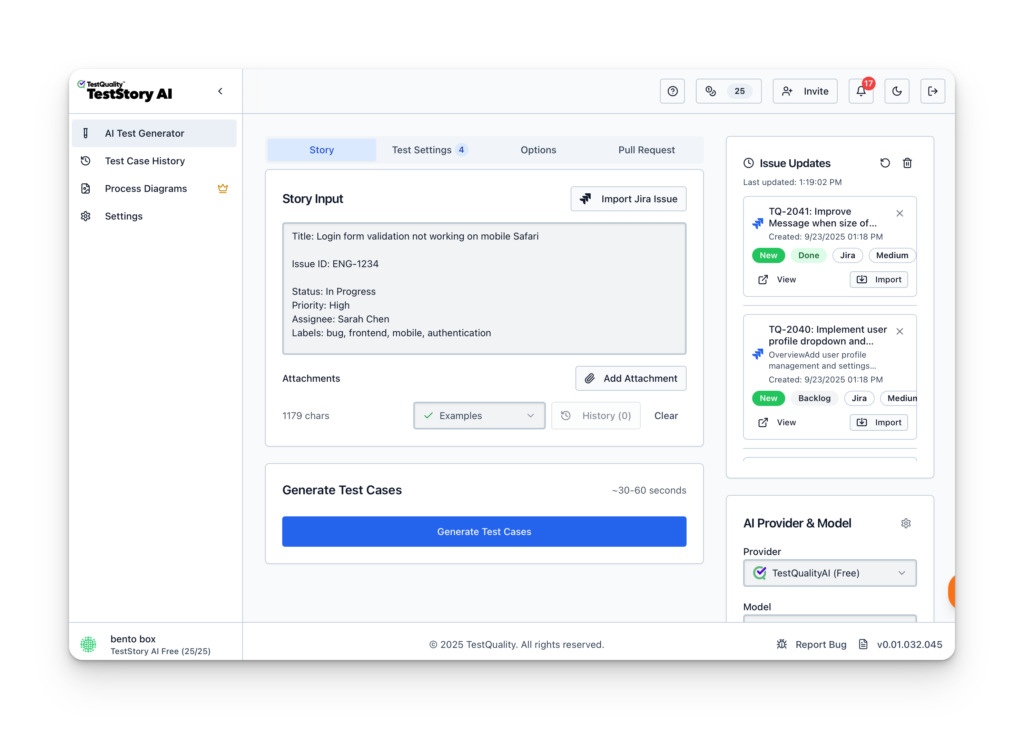
The Test Case Builder
This tool focuses specifically on automating the design and documentation of individual test cases. It takes inputs—user stories, Gherkin syntax, or rough notes and outputs structured, executable test cases.
- Modern Example: TestStory.ai represents the next generation of this category, moving beyond static templates to intelligent, context-aware creation.
- This Story powered AI test Case builder empowers developers and QA to build effective test cases from User Stories, Issues, Epics, Process Diagrams, and even free form test.
Test Plan Tools
These tools focus on strategy. A test plan defines the scope, resources, schedule, and environment. In the agentic era, “Test Plans” are becoming dynamic. Instead of a static PDF, a test plan is a set of directives that agents execute continuously based on risk assessment.
Test Management Tools (TMT)
The Test Management Tool is the centralized brain of the QA operation. TMTs serve as the system of record, housing all test cases, execution history, and defects.
However, a legacy TMT is just a database. A modern AI-Powered QA platform, like TestQuality, acts as the command center. It is the hub where agents are deployed to manage, execute, and analyze all these components autonomously.
Leveraging TestQuality for Autonomous QA Workflows
The introduction of agentic capabilities shifts the focus of the test management tool from a passive record-keeping system to a dynamic, intelligent partner. This is the foundation of the strategy embodied by TestQuality.
TestQuality provides the infrastructure necessary to leverage powerful QA agents. It allows teams to create and run test cases, and analyze test results automatically from a chat interface or agentic workflows—accelerating software quality for both human and AI-generated code, 24/7.
From Dashboard to Chat Interface
This capability moves testing from rigid, static processes to conversation-driven problem-solving.
- The Old Way: A QA Lead manually selects 50 tests, runs them, waits 2 hours, and combs through a dashboard of red and green lights.
- The Agentic Way: A QA Lead asks the TestQuality interface: “Run the critical payment suite and analyze why the API returned a 500 error.”
The internal agents then autonomously manage the multi-step execution (Action), collect data (Perception), identify causes (Reasoning), and generate a final report. This is the definition of AI-Powered QA.
Strategic Adoption: Risks and Responsibilities
The rise of Agentic AI signifies a fundamental change in the role of the QA professional. Agentic AI is not meant to replace the human tester but to augment them.
The hybrid approach allows AI agents to handle the execution, maintenance, and initial analysis of extensive regression suites. Meanwhile, the human QA team focuses on strategic areas like exploratory testing, user experience (UX) verification, and ethical oversight.
However, we must remain vigilant. Autonomous systems rely on LLMs, which carry risks such as hallucinations (inventing bugs that don’t exist) or drift (changing behavior over time). Just as we test software, we must now learn to test the agents themselves.
This critical domain of evaluation is vital for ensuring the integrity of autonomous systems. To deepen your understanding of the foundational models that drive these agents, we recommend reviewing our dedicated resource: LLM Testing and Evaluation: A Comprehensive QA Guide.
Conclusion
By embedding intelligence across the SDLC, (from converting requirements into tests with TestStory.ai to orchestrating complex runs via TestQuality ), Agentic AI ensures QA is proactive, adaptive, and continuous.
The era of brittle, scripted automation is ending. The era of resilient, intelligent agents has arrived.
Frequently Asked Questions (FAQ)
What is the difference between Automation and Agentic AI?
Automation follows a strict, pre-defined script (e.g., “Click button A”). Agentic AI perceives the environment and makes decisions to achieve a goal (e.g., “Find the best way to complete the checkout process”).
Can Agentic AI replace manual testers?
No. Agentic AI replaces repetitive checking and script maintenance. It frees up manual testers to perform high-value exploratory testing, creative edge-case analysis, and strategic planning.
How does Agentic AI help with Regression Testing?
Agentic AI can intelligently select which tests to run based on code changes (Test Impact Analysis), rather than running the entire suite. It can also self-heal broken tests if UI elements change, significantly reducing maintenance downtime.
Is TestQuality an Agentic AI tool?
Yes. TestQuality is an AI-Powered QA management platform that integrates agentic workflows, allowing users to manage, execute, and analyze tests through natural language and autonomous agents.