Key Takeaways
Gherkin BDD tools are revolutionizing how teams approach modern test management by creating a unified bridge between business requirements and technical implementation.
- Enhanced Collaboration: BDD tools eliminate communication gaps between technical and non-technical stakeholders through human-readable test specifications
- Automated Integration: Modern platforms seamlessly connect Gherkin scenarios with popular automation frameworks like Selenium, Playwright, and Cypress
- Unified Testing Strategy: Leading comprehensive platforms combine manual testing, automated execution, and living documentation in a single ecosystem
- Market Momentum: The test management software market reached $1.5 billion in 2023 and is projected to grow to $5.93 billion by 2032, driven largely by digital transformation and BDD adoption
The most effective teams are moving beyond isolated BDD frameworks toward comprehensive test management platforms that integrate Gherkin testing with their entire DevOps workflow.
Software testing has evolved far beyond simple pass-fail validation. Modern development teams need test management solutions that bridge the gap between business requirements and technical implementation, ensuring that what gets built actually matches what was requested. This is where gherkin BDD tools become game-changers, transforming abstract requirements into executable specifications that drive both collaboration and automation.
The challenge is creating a unified testing strategy that connects human-readable business scenarios with automated validation processes. Teams using Gherkin BDD tools report significantly improved stakeholder alignment, faster defect detection, and more maintainable test suites compared to traditional testing approaches.
According to recent industry analysis, the test management software market is experiencing unprecedented growth, expanding from USD 1.5 billion in 2023 to an expected USD 5.93 billion by 2032 at a CAGR of 16.5%. This rapid expansion reflects how specialized methodologies like Behavior-Driven Development are becoming essential components of modern software development practices.
What Are Gherkin BDD Tools?
Gherkin BDD tools represent a category of software that interprets human-readable specifications written in the Gherkin language and translates them into executable test scenarios. Unlike traditional testing frameworks that require technical expertise, these tools create a shared language that business analysts, product managers, developers, and testers can all understand and contribute to.
The Gherkin language follows a structured "Given-When-Then" syntax that clearly articulates preconditions, actions, and expected outcomes in plain English. This approach transforms abstract requirements into concrete, testable scenarios that serve dual purposes: they function as living documentation and provide the foundation for automated test execution.

What sets modern Gherkin BDD tools apart from basic BDD frameworks is their ability to integrate these human-readable specifications directly into comprehensive test management ecosystems. Rather than existing as isolated testing artifacts, Gherkin scenarios become central components of a unified quality assurance strategy that connects requirements, test planning, execution, and reporting.
The most effective gherkin BDD tools create seamless workflows where business stakeholders can define expected behavior in natural language, developers can implement corresponding functionality, and testers can validate results—all while maintaining perfect traceability from requirement to verification.
Why Does Modern Test Management Demand BDD Integration?
Traditional test management approaches often create silos between different phases of software development. Requirements get documented in one system, test cases live in another, automation scripts exist separately, and results scatter across multiple reports. This fragmentation leads to miscommunication, duplicated effort, and gaps in test coverage.
Modern development practices demand a more integrated approach. Teams practicing Agile methodologies need testing strategies that adapt quickly to changing requirements. DevOps workflows require continuous feedback loops where test results directly inform development decisions. Shift-left testing initiatives push validation activities earlier in the development cycle, requiring closer collaboration between traditionally separate roles.
BDD integration addresses these challenges by creating a unified language for describing software behavior. When properly implemented, Gherkin testing scenarios serve as the single source of truth that connects business requirements, development implementation, and test validation. This alignment reduces the costly miscommunications that often plague software projects.
The collaborative nature of BDD also supports modern development team structures. Cross-functional teams working on complex features need shared understanding that goes beyond technical specifications. Gherkin scenarios provide this common ground, enabling product owners, developers, and testers to discuss functionality using the same vocabulary and mental models.
Furthermore, modern test automation strategies benefit enormously from the structure that BDD provides. Automated tests written against Gherkin scenarios tend to be more maintainable because they focus on behavior rather than implementation details. When requirements change, teams can update Gherkin scenarios and the underlying automation adapts accordingly, reducing the maintenance overhead that often makes test automation unsustainable.
What Essential Features Should Every Gherkin BDD Tool Have?
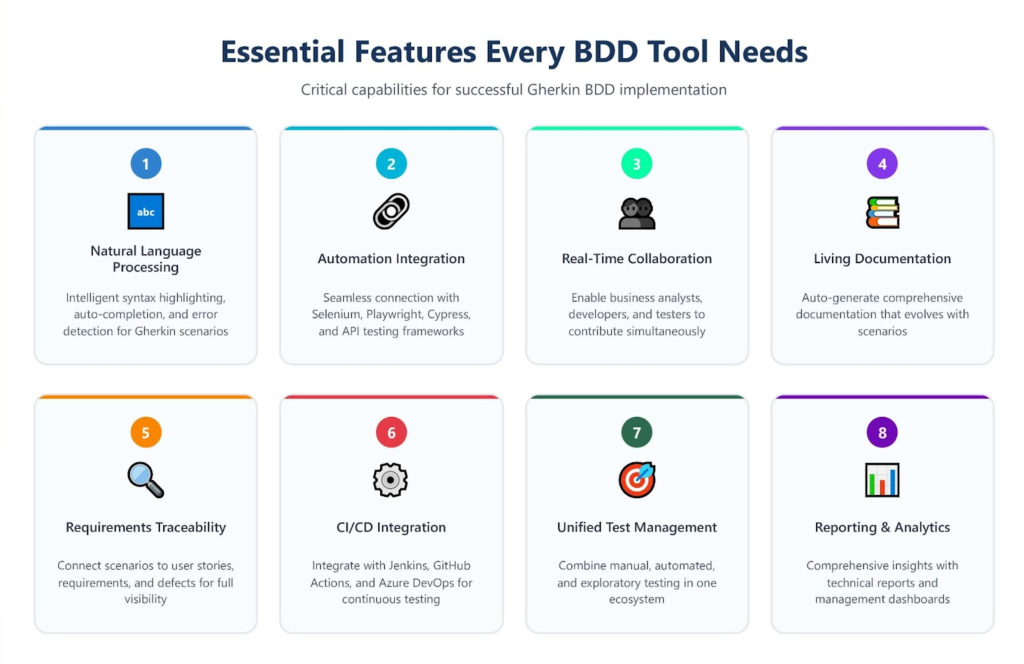
Selecting the right gherkin BDD tools requires understanding which capabilities truly impact testing effectiveness. Based on analysis of successful BDD implementations across diverse organizations, several features consistently distinguish high-performing solutions:
1. Natural Language Processing and Syntax Support
The foundation of any effective BDD tool is robust Gherkin language support with intelligent syntax highlighting, auto-completion, and error detection. Advanced tools provide step definition suggestions based on existing scenario libraries, reducing duplication and improving consistency across test suites.
2. Seamless Automation Framework Integration
Modern BDD tools must connect effortlessly with popular automation frameworks including Selenium WebDriver, Playwright, Cypress, and API testing tools like REST Assured. This integration should be bidirectional, allowing teams to execute Gherkin scenarios through automated runners while automatically importing results back into the test management system.
3. Real-Time Collaboration Features
Effective BDD requires input from multiple stakeholders, making collaboration features essential. Look for tools that support real-time editing, commenting, and review workflows that enable business analysts, developers, and testers to contribute simultaneously without conflicts or version control issues.
4. Living Documentation Generation
The best gherkin BDD tools automatically generate comprehensive documentation from Gherkin scenarios, creating reports that serve both technical teams and business stakeholders. This documentation should update dynamically as scenarios evolve, ensuring that project knowledge remains current and accessible.
5. Traceability and Requirements Mapping
Enterprise-grade BDD tools provide robust traceability features that connect Gherkin scenarios to original requirements, user stories, and defects. This traceability enables teams to assess test coverage, identify gaps, and demonstrate compliance with business objectives.
6. CI/CD Pipeline Integration
Modern development workflows depend on continuous integration and deployment pipelines. BDD tools should integrate seamlessly with popular CI/CD platforms like Jenkins, GitHub Actions, and Azure DevOps, automatically executing relevant scenarios when code changes occur and reporting results back to development teams.
7. Unified Test Management Integration
Teams need tools that can manage Gherkin scenarios alongside other testing activities without creating silos. Advanced BDD tools provide unified platforms that combine manual testing, automated execution, and exploratory testing within a single ecosystem, enabling teams to maintain comprehensive test coverage while reducing tool proliferation.
8. Reporting and Analytics
Comprehensive reporting capabilities help teams understand test execution trends, identify flaky scenarios, and optimize their BDD implementation. Look for tools that provide both detailed technical reports for development teams and high-level dashboards for management stakeholders.
Which Gherkin BDD Tools and Frameworks Are Most Popular?
The BDD ecosystem includes numerous frameworks and tools, each with distinct strengths and target audiences. Understanding the landscape helps teams make informed decisions about which solutions best fit their specific requirements and technical constraints.
- Cucumber remains the most widely recognized BDD framework, with implementations across multiple programming languages including Java, JavaScript, Ruby, and Python. Cucumber's strength lies in its maturity and extensive community support, making it an excellent choice for teams with strong development capabilities who want maximum flexibility in their BDD implementation.
- SpecFlow serves as the leading BDD framework for Microsoft .NET environments, providing tight integration with Visual Studio and Azure DevOps. Teams working primarily in Microsoft ecosystems often find SpecFlow's native tooling support and enterprise features particularly valuable for larger-scale implementations.
- Behave offers Python developers a lightweight BDD framework that integrates well with existing Python testing ecosystems. Its simplicity makes it popular among data science teams and organizations with significant Python expertise who want to add BDD practices without extensive tooling overhead.
- Playwright Test has emerged as a modern alternative that combines BDD capabilities with powerful browser automation features. Its built-in support for multiple browsers and advanced debugging capabilities make it particularly attractive for web application testing scenarios.
However, BDD frameworks alone don't provide complete test management solutions. Modern teams increasingly seek unified platforms that combine BDD capabilities with comprehensive test planning, execution tracking, and results analysis. These integrated approaches reduce tool proliferation while providing better visibility into overall testing activities.
How Do BDD Tools Integrate with Test Automation Platforms?
The true power of gherkin BDD tools emerges when they integrate seamlessly with broader test automation ecosystems. Modern development teams use diverse automation frameworks for different testing needs—Selenium for web application testing, Appium for mobile applications, REST Assured for API validation, and specialized tools for performance testing.
Effective BDD integration means that Gherkin scenarios can drive execution across all these automation types without requiring separate test implementation for each framework. The most sophisticated tools provide abstraction layers that allow teams to write scenarios once and execute them across multiple automation platforms based on the specific testing context.
This unified approach particularly benefits teams implementing shift-left testing strategies. By connecting BDD scenarios to multiple automation frameworks, teams can validate the same business requirements at different testing levels—unit tests validate individual components, integration tests verify API interactions, and end-to-end tests confirm complete user workflows.
Cloud-based test execution platforms enhance this integration by providing scalable infrastructure for running BDD scenarios across diverse browser and device configurations. Teams can execute the same Gherkin scenarios on Chrome, Firefox, Safari, and mobile browsers without maintaining separate test environments or writing platform-specific test code.
The integration also enables sophisticated test orchestration strategies. Teams can configure their CI/CD pipelines to execute different subsets of BDD scenarios based on the type of code changes being deployed. Feature additions might trigger comprehensive end-to-end scenario execution, while bug fixes might focus on specific regression test suites defined in Gherkin.
How to Choose the Right BDD Tools for Your Team
Selecting appropriate gherkin BDD tools requires careful evaluation of both technical capabilities and organizational factors. Teams often focus heavily on framework features while overlooking critical considerations like team skill levels, existing tool integrations, and long-term maintenance requirements.
Assess Team Technical Capabilities Evaluate your team's programming expertise and comfort with different development languages. Teams with strong Java skills might prefer Cucumber-JVM implementations, while .NET-focused organizations often find SpecFlow more intuitive. However, don't let current technical constraints limit your evaluation—consider the learning investment required for different options.
Evaluate Existing Tool Ecosystem Integration Modern development teams use numerous tools for version control, project management, continuous integration, and deployment. Your BDD tool selection should enhance rather than complicate these existing workflows. Prioritize solutions that integrate natively with your current GitHub, Jira, Jenkins, or Azure DevOps implementations.
Consider Collaboration Requirements Different organizations have varying needs for cross-functional collaboration on BDD scenarios. Some teams benefit from extensive review and approval workflows, while others need rapid iteration capabilities. Evaluate how different tools support your specific collaboration patterns and stakeholder involvement levels.
Analyze Long-Term Maintenance Implications BDD implementations require ongoing maintenance as applications evolve and requirements change. Consider which tools provide the best support for refactoring scenarios, managing step definition libraries, and maintaining traceability as your test suite grows. Tools with strong IDE integration and debugging capabilities often reduce long-term maintenance overhead.
Evaluate Reporting and Analytics Needs Different stakeholders need different types of information from BDD test execution. Development teams want detailed failure analysis and debugging information, while management stakeholders need high-level trend analysis and coverage metrics. Ensure your chosen tools can generate appropriate reports for all relevant audiences.
One approach that many successful teams adopt is implementing BDD capabilities within comprehensive test management platforms rather than using standalone frameworks. This approach provides better integration with existing quality assurance processes while reducing the overhead of managing multiple separate tools.
What Are the Best Practices for Successful BDD Implementation?
Successful BDD implementation extends far beyond tool selection. The most effective teams develop sustainable practices that maximize the collaborative benefits of behavior-driven development while avoiding common pitfalls that can make BDD implementations counterproductive.
- Start with Clear Stakeholder Alignment Before writing any Gherkin scenarios, ensure that all stakeholders understand their roles in the BDD process. Product owners need to provide clear acceptance criteria, developers must commit to implementing features that match BDD scenarios, and testers should understand how automated BDD tests complement other testing activities.
- Invest in Scenario Writing Skills Effective Gherkin scenarios require specific writing skills that differ from both traditional requirements documentation and technical test scripts. Invest time in training team members to write scenarios that are specific enough to drive implementation while remaining readable by non-technical stakeholders.
- Establish Consistent Step Definition Libraries Reusable step definitions are crucial for maintaining sustainable BDD implementations. Develop consistent patterns for common interactions like user authentication, data setup, and result validation. Well-organized step libraries reduce duplication and make scenarios easier to maintain as applications evolve.
- Integrate BDD with Existing Quality Processes BDD should enhance rather than replace existing quality assurance practices. Establish clear relationships between BDD scenarios and other testing activities like exploratory testing, performance validation, and security assessment. This integration ensures comprehensive coverage without unnecessary duplication.
- Plan for Scenario Maintenance BDD scenarios require ongoing maintenance as application functionality evolves. Establish processes for updating scenarios when requirements change, refactoring step definitions when implementation patterns shift, and archiving obsolete scenarios. Teams that neglect maintenance often find their BDD implementations becoming barriers rather than enablers.
- Measure and Optimize BDD Effectiveness Track metrics that indicate whether your BDD implementation is achieving its intended benefits. Monitor scenario execution time, maintenance overhead, defect detection rates, and stakeholder satisfaction with BDD processes. Use this data to continuously optimize your approach and address emerging challenges.
The most successful BDD implementations evolve gradually, starting with pilot projects that demonstrate value before expanding to broader organizational adoption. This measured approach allows teams to develop expertise and refine processes before committing to larger-scale changes.
What Does the Future Hold for BDD in Test Management?
The evolution of gherkin BDD tools continues accelerating as development teams demand more sophisticated testing capabilities. Artificial intelligence and machine learning are beginning to influence BDD implementations, with emerging tools that can suggest scenario improvements, identify redundant test coverage, and automatically generate step definitions from application interactions.
The broader software testing market reached USD 51.8 billion in 2023 and is projected to grow at 7% CAGR through 2032, indicating strong industry momentum toward advanced testing methodologies. Integration with modern development practices like microservices architecture and cloud-native deployment models is driving innovation in BDD tooling.
Teams need solutions that can handle distributed system testing scenarios, manage test data across multiple services, and provide appropriate abstractions for complex technical architectures. Modern platforms increasingly focus on unified test management approaches that can adapt to these evolving architectural patterns.
The trend toward unified test management platforms that combine BDD capabilities with comprehensive quality assurance features reflects the market's recognition that isolated tools often create more problems than they solve. Forward-thinking teams are moving toward solutions that provide seamless integration between behavior-driven development, traditional test case management, and automated test execution.
While some industry observers question whether BDD frameworks maintain their relevance in rapidly evolving development environments, the underlying collaborative principles continue proving valuable as teams seek better stakeholder alignment and clearer requirements definition. The underlying principles of behavior-driven development—collaborative requirement definition, executable specifications, and living documentation—remain more valuable than ever. The challenge is implementing these principles through tools and practices that enhance rather than complicate modern development workflows.
Teams that successfully leverage modern gherkin BDD tools find they can achieve better stakeholder alignment, faster feedback cycles, and more maintainable test suites compared to traditional testing approaches. The key is selecting solutions that integrate well with existing development practices while providing room for growth as team capabilities and project requirements evolve.
For many organizations, the question isn't whether to adopt BDD practices, but how to implement them most effectively within their specific technical and organizational constraints. The most successful implementations balance the collaborative benefits of behavior-driven development with practical considerations around tool complexity, maintenance overhead, and integration requirements.
TestQuality's approach to modern test management recognizes these implementation challenges by providing comprehensive BDD support that integrates seamlessly with existing development workflows. By combining Gherkin scenario management with automated test execution, requirements traceability, collaborative planning features, and advanced reporting, teams can realize the full potential of behavior-driven development without the complexity of managing multiple separate tools.
Frequently Asked Questions
What's the difference between BDD frameworks and BDD test management tools? BDD frameworks like Cucumber and SpecFlow focus primarily on executing Gherkin scenarios as automated tests. BDD test management tools provide broader capabilities including scenario authoring, collaboration features, test planning, results analysis, and integration with development workflows. Many teams benefit from using comprehensive test management platforms that include BDD capabilities rather than standalone frameworks.
How do I convince stakeholders to invest in BDD implementation? Focus on the business benefits: improved requirement clarity, faster defect detection, better stakeholder communication, and reduced rework. Start with pilot projects that demonstrate tangible value before seeking broader organizational commitment. Measure and report on specific improvements in areas like defect escape rates, requirement change management, and cross-functional collaboration effectiveness.
Can BDD tools integrate with existing test automation frameworks? Yes, modern BDD tools typically provide extensive integration capabilities with popular automation frameworks including Selenium, Playwright, Cypress, Appium, and API testing tools. The best solutions offer bidirectional integration that allows Gherkin scenarios to drive automated test execution while automatically importing results back into the test management system.
What are the main challenges in BDD implementation? Common challenges include initial learning curve for Gherkin writing, maintaining scenario libraries as applications evolve, ensuring appropriate stakeholder involvement in scenario creation, and balancing the detail level in scenarios to serve both business and technical audiences. Success typically depends on adequate training, clear process definition, and ongoing commitment to maintaining BDD artifacts.
How do I measure the success of BDD implementation? Track both quantitative and qualitative metrics including scenario execution trends, defect detection rates, requirement change impact analysis, stakeholder satisfaction with collaborative processes, and maintenance overhead for BDD artifacts. The most successful teams establish baseline measurements before BDD adoption and monitor improvements over time in areas like cross-functional communication effectiveness and testing efficiency.
How Can You Transform Your Testing Strategy with Modern BDD Tools?
The evolution of software development demands testing approaches that enhance collaboration, accelerate feedback, and maintain quality standards across increasingly complex application landscapes. Gherkin BDD tools provide the foundation for achieving these goals by creating shared understanding between business stakeholders and technical teams while enabling sophisticated automation capabilities.
The most effective implementations go beyond isolated BDD frameworks toward comprehensive test management solutions that integrate behavior-driven development with broader quality assurance strategies. Teams that embrace this unified approach report significant improvements in stakeholder alignment, defect detection speed, and overall testing efficiency.
Ready to transform your testing strategy with integrated BDD capabilities? TestQuality's modern test management platform combines powerful Gherkin support with comprehensive test planning, execution tracking, and results analysis—all designed to enhance rather than complicate your existing development workflows.