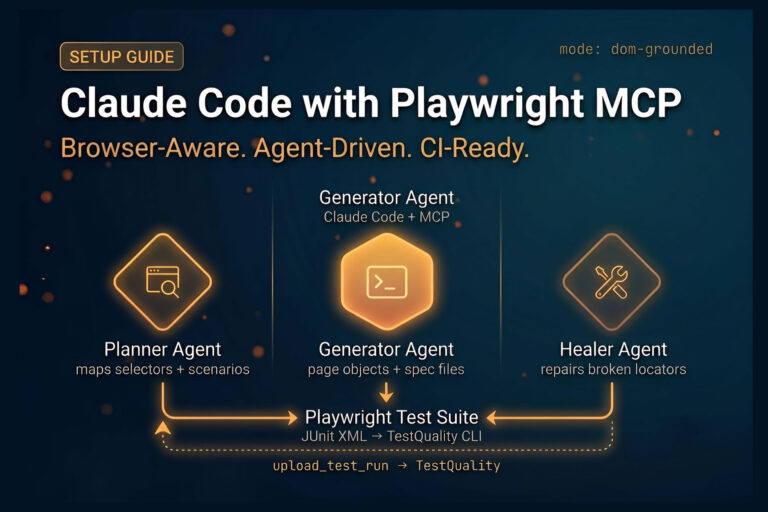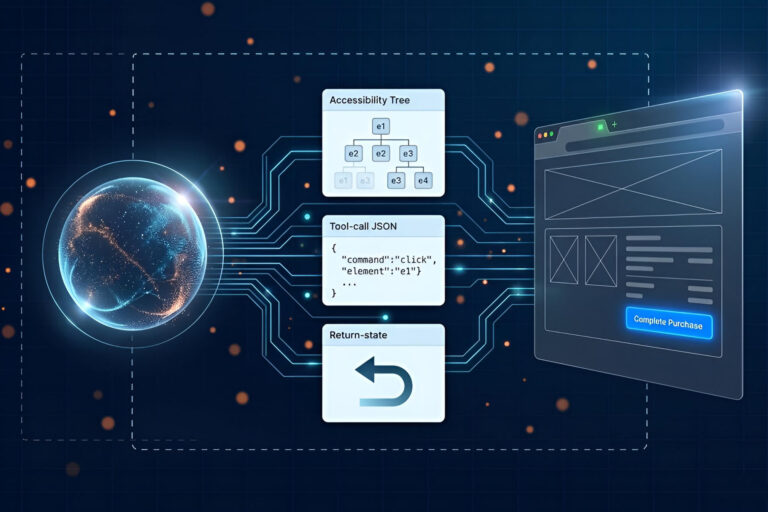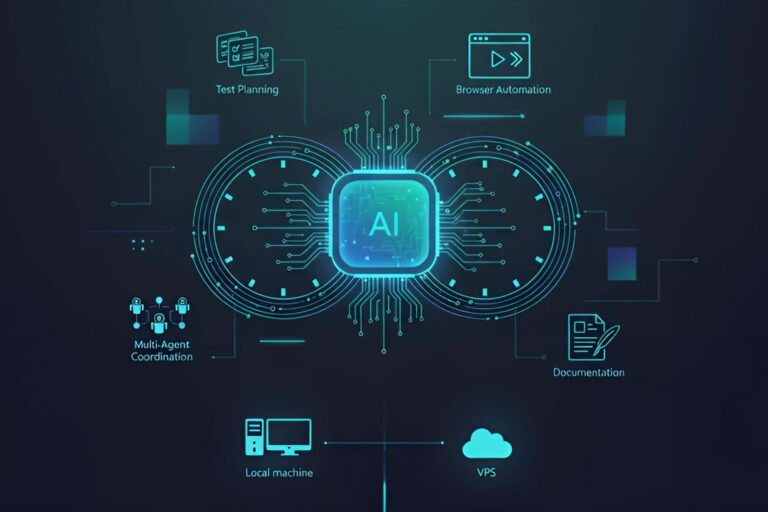
At a Glance Playwright Test Agents and MCP — A 2026 Architecture Decision Strategic guidance for engineering leaders evaluating agentic Playwright workflows Definition: Playwright test agents are LLM-driven execution loops that interpret high-level intent via the Model Context Protocol (MCP), rather than executing hardcoded selectors. Token economics: Microsoft’s MCP server consumes ~200–400 tokens per accessibility-tree… Continue reading Playwright Test Agents & MCP: A 2026 Architecture Guide
Category: Agentic QA
Agentic QA is the next evolution of software testing — where autonomous AI agents read user stories and requirements, generate test cases across manual, exploratory, BDD, and automated testing workflows, self-heal broken selectors, and maintain full coverage without human intervention at every step. This category covers the architecture, tooling, and real-world implementation of Agentic QA — from Plan-Act-Verify reasoning loops and LLM-based visual regression to intelligent test prioritization, HITL validation, and native CI/CD pipeline integration. Whether your team runs Gherkin scenarios, Playwright suites, unit tests, or structured manual cycles, this is where autonomous AI changes how testing gets done.
Explore how TestStory.ai Agent and TestQuality power the shift from reactive test authoring to outcome-driven quality engineering.
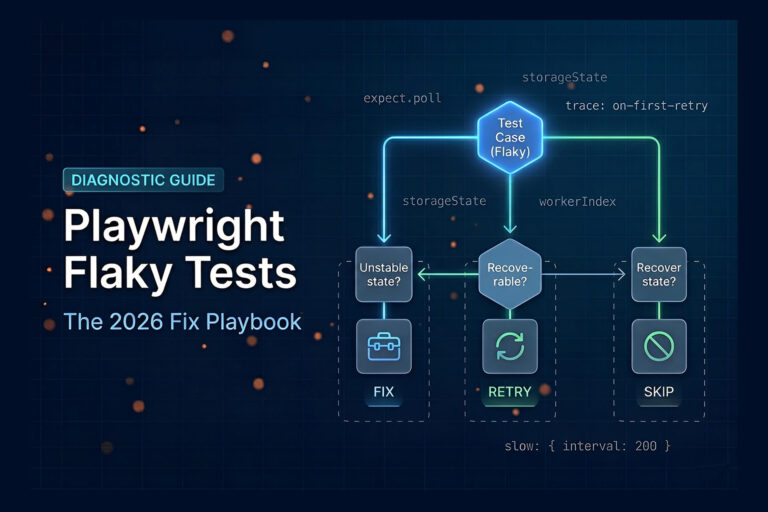
Playwright Flaky Tests: The 2026 Fix Playbook
At a Glance Five diagnostic patterns. One decision tree. A senior practitioner’s triage playbook for Playwright flakiness in 2026. Flakiness is architectural, not framework-borne: Almost every flake traces back to async state, locator drift, session pollution, environment variance, or AI-agent non-determinism — not to Playwright itself. The fix is bigger than the diagnosis: Replace static… Continue reading Playwright Flaky Tests: The 2026 Fix Playbook
Beyond RAG: How Agentic Memory Solves Context Rot in AI Agents
Key Takeaways Agentic Memory: The Persistence Layer Beyond RAG Stop rebuilding context every session. Start writing it once and remembering it forever. Silent Semantic Errors Dominate Multi-Agent Failures: Eliminate the silent semantic drift behind 75.17% of multi-agent failures by anchoring agents to persistent state. A-MEM Doubles Multi-Hop Reasoning Performance:Research from Xu et al. at NeurIPS… Continue reading Beyond RAG: How Agentic Memory Solves Context Rot in AI Agents
How to Build a 24/7 AI Tester with OpenClaw: A Practical Guide for QA Teams
A 24/7 AI tester is a persistent, agent-based assistant that accepts plain-language QA instructions through a chat channel, uses connected tools and a large language model, and operates continuously across testing tasks without per-prompt supervision. OpenClaw — an open source personal AI agent built by Peter Steinberger and a growing community — enables this pattern.… Continue reading How to Build a 24/7 AI Tester with OpenClaw: A Practical Guide for QA Teams
Agentic Testing and QA: Why Chrome DevTools Still Matters for Modern Testers
Chrome DevTools is the built-in browser inspector and debugger that ships with Google Chrome, giving testers ground-truth visibility into DOM state, network traffic, device rendering, and runtime behavior. In the context of Agentic Testing and QA — the emerging pattern where AI agents draft, execute, and summarize tests with reduced human supervision — DevTools remains… Continue reading Agentic Testing and QA: Why Chrome DevTools Still Matters for Modern Testers
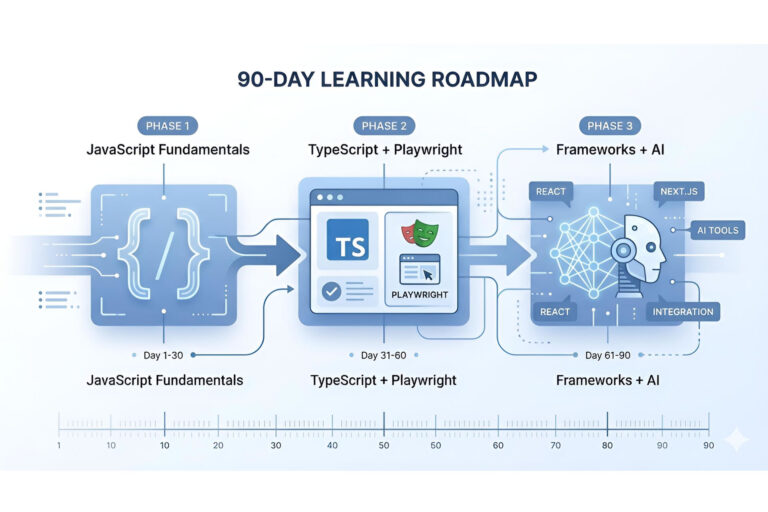
Agentic Testing and QA: A 90-Day Playwright Learning Roadmap
Opening Definition A 90-day Agentic Testing and QA roadmap is a structured learning plan that combines daily JavaScript and TypeScript practice with hands-on Playwright automation and AI-assisted testing skills. It is built around three 30-day phases — language fundamentals, Playwright fundamentals, and advanced framework plus AI-oriented work — and assumes about one hour of practice… Continue reading Agentic Testing and QA: A 90-Day Playwright Learning Roadmap
Context Engineering: Build Reliable AI Agents Without Vibe Coding
Key Takeaways The Discipline That Separates Reliable AI Agents From Technical Debt Factories Programmatic boundaries. Builder-validator chains. Verified outputs. Context engineering replaces vibe coding by enforcing programmatic boundaries, modular task decomposition, and strict builder-validator chains that eliminate AI technical debt at the source. Silent semantic errors drive 75.17% of multi-agent failures, requiring continuous verification loops… Continue reading Context Engineering: Build Reliable AI Agents Without Vibe Coding
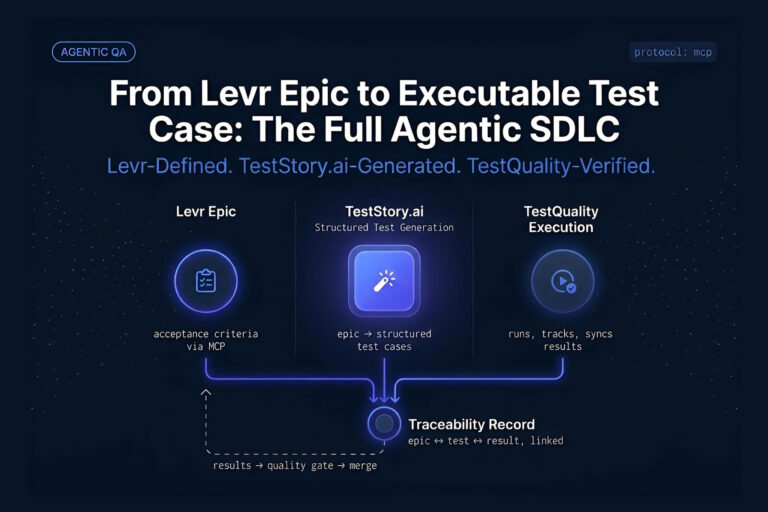
The Agentic SDLC: How to Build, Test and Verify AI-Generated Code Without Losing Control
At a Glance The State of AI-Generated Code in 2026 The verification gap is the defining engineering problem of the agentic era. 75.3% of multi-agent failures stem from the planner-coder gap — semantic breakdown during handoff from planning to coding agents. (arXiv 2510.10460, 2025) 75.17% of those failures are silent gray errors — code that… Continue reading The Agentic SDLC: How to Build, Test and Verify AI-Generated Code Without Losing Control
Gherkin vs Traditional Testing: Which One Wins with AI?
Gherkin’s structured, human-readable format gives it a decisive edge when working with AI-powered testing tools. Start evaluating your test suite structure now, as AI-powered QA is becoming the industry standard, and your test format determines how well these tools can assist you. The debate over Gherkin vs traditional testing has taken an unexpected turn. What… Continue reading Gherkin vs Traditional Testing: Which One Wins with AI?
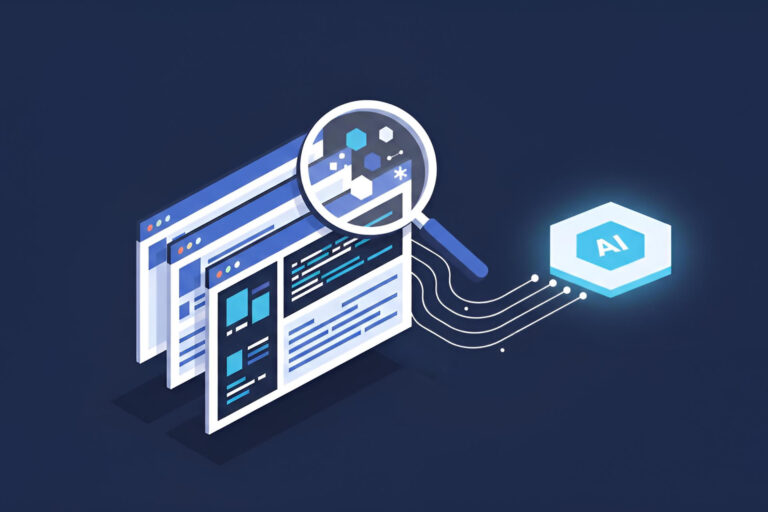
Agentic Exploratory Testing: Validating the Unexpected
Autonomous exploratory testing is an unscripted software validation approach in which AI agents dynamically interact with an application using reasoning rather than predefined scripts. Instead of following documented paths, these systems leverage heuristic-based exploration and context-awareness to navigate complex interfaces, map undocumented application states, and surface the “unknown unknowns” that structured testing consistently misses. Unlike… Continue reading Agentic Exploratory Testing: Validating the Unexpected